You've got a product idea, or maybe a dozen suppliers ready to sell through you. Now you're stuck on one question that sounds simple but isn't: build a store, or build a marketplace?
It's not just a technical choice. It changes how you make money, how much you'll spend upfront, and how fast you can grow. Get it wrong, and you'll either overbuild something you don't need or underbuild something that can't scale.
Let's break down both models honestly, no hype, so you can pick the one that fits your actual business, not the one that sounds more impressive.
What's the Real Difference?
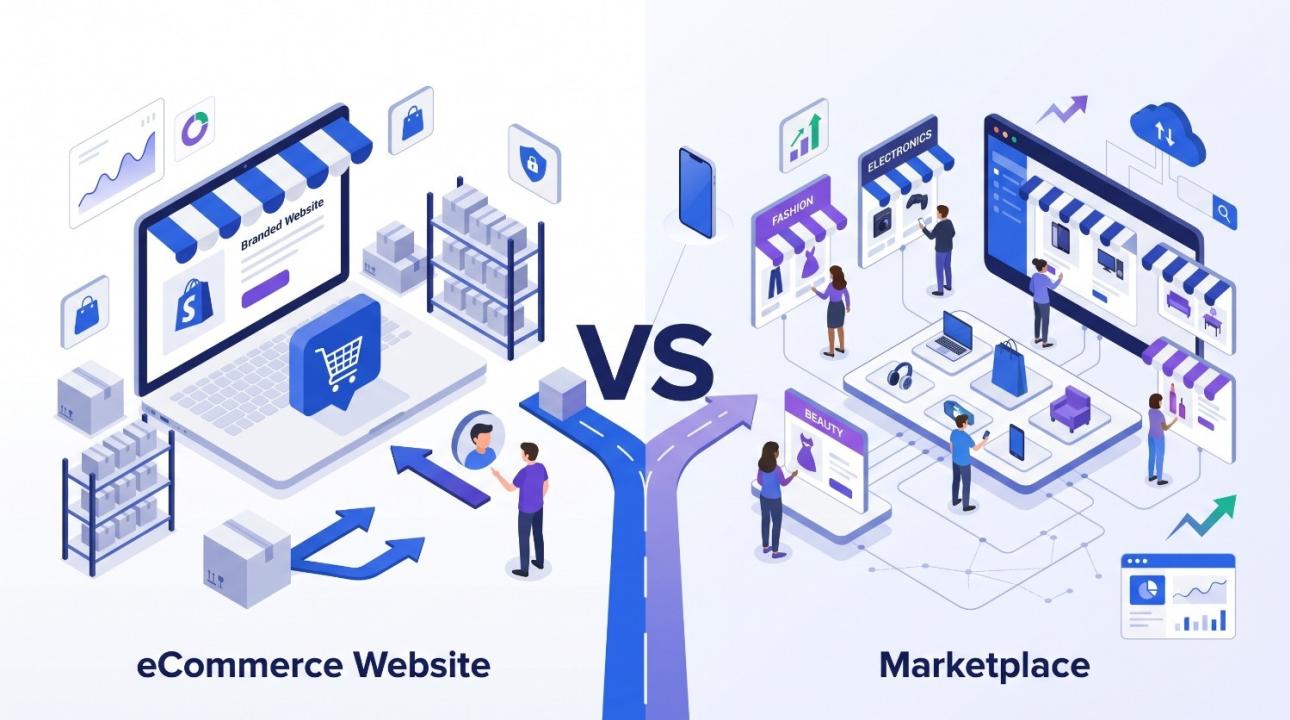
An ecommerce website is a single-seller store. You own the inventory, set the prices, and handle fulfillment. Think of a boutique clothing brand selling directly to customers through its own site.
A marketplace is a platform where multiple vendors list and sell products, and you take a cut of each transaction. You're not selling anything yourself; you're building shelf space and letting others stock it.
That one distinction changes everything downstream: your tech stack, your revenue model, your legal setup, even your customer service load.
Ecommerce Website: What You're Signing Up For
Pros:
- Full control over branding, pricing, and product quality
- Simpler to launch, fewer moving parts, fewer third parties to manage
- Direct customer relationships, which make retention easier
- Lower platform complexity (Shopify, WooCommerce, or a custom build can get you there)
Cons:
- You carry all the inventory risk
- Revenue is capped by what you can produce or source
- Marketing costs land entirely on your shoulders
This model works well if you have a defined product line and want tight control over the customer experience. It's the more predictable path, but also the one with a lower ceiling.
Marketplace: A Different Kind of Beast
Pros:
- You don't hold inventory; vendors do
- Revenue scales with the number of sellers and transactions, not your own production capacity
- Network effects kick in: more sellers attract more buyers, and more buyers attract more sellers
Cons:
- Building trust and quality control across third-party vendors is genuinely hard
- Onboarding, payments, and dispute resolution get complicated fast
- The technical build is more involved you're managing multiple user roles, commission logic, and vendor dashboards, not just a shopping cart
This is why plenty of founders underestimate marketplaces going in. It's not "an ecommerce site with extra logins." The architecture, payment splitting, and vendor management add real complexity. If you're weighing this path, it helps to look at how to create an ecommerce marketplace in more detail before committing to a build, since the planning phase is where most of these projects go sideways.
Why This Choice Matters More Than It Used To
Marketplaces aren't a niche experiment anymore. As of 2025, online marketplaces account for the largest share of online purchases worldwide, according to Statista's e-commerce research. That's a meaningful shift: buyers increasingly expect choice and comparison in one place, rather than hunting across individual brand sites.
That doesn't mean every business should chase the marketplace model. It means the decision deserves more thought than "marketplaces are trending, so let's build one."
A Quick Way to Decide
Ask yourself these questions honestly:
- Do I own the product, or am I connecting buyers and sellers? If you own it, lean ecommerce.
- Can I handle vendor onboarding, quality control, and dispute resolution? If not, a marketplace will strain your team fast.
- Is my growth capped by inventory or by demand? If demand outpaces what you can stock, a marketplace model removes that ceiling.
- What's my runway for a more complex build? Marketplaces typically take longer and cost more to launch properly.
There's also a hybrid path worth knowing about: some brands start as a single-vendor store, prove the demand, then open up a curated marketplace layer once they've got traction and trusted partners lined up. It's a slower route, but it reduces the risk of building marketplace infrastructure before you actually need it.
Don't Forget the Traffic Question
Whichever model you pick, the platform is only half the equation. A beautifully built store or marketplace with no visitors won't generate revenue. Traffic and conversion strategy, SEO, paid acquisition, and retention flows matter just as much as the build itself. If you're mapping out that side of things, this breakdown on ways to increase ecommerce sales covers practical tactics worth factoring into your plan early, rather than as an afterthought post-launch.
Common Mistakes to Avoid
- Choosing a marketplace because it "sounds more scalable." Scalability only helps if you can actually manage the vendor side.
- Underestimating payment complexity. Splitting commissions, handling refunds across multiple sellers, and managing payouts are not a simple checkout flow.
- Skipping vendor vetting. A marketplace's reputation lives or dies by the quality of its sellers.
- Building for scale before validating demand. Plenty of ecommerce businesses would have done better starting simple and expanding later.
FAQ
1. Can a single-vendor store eventually become a marketplace?
Yes, and it's a fairly common path. Many businesses launch as a store, build an audience, then introduce a marketplace layer once they have vendor relationships and enough traffic to support it.
2. Which model costs less to launch?
Generally, a single-vendor ecommerce website is cheaper and faster to build. Marketplaces require more development work upfront due to multi-vendor logic, payment splitting, and dispute handling.
3. Do marketplaces make more money than ecommerce stores?
Not automatically. Marketplaces have higher revenue potential because they scale with vendor count, but they also carry more operational overhead. A well-run ecommerce store can easily outperform a poorly managed marketplace.
4. Is one model "better" for SEO?
Marketplaces often generate more organic pages (more listings, more categories), which can help with long-tail search traffic but only if the content and product data are genuinely useful, not thin or duplicated. Whichever direction you go, the honest answer is that neither model is inherently better. One matches how you actually plan to operate; the other doesn't. That's the only distinction that matters.