The way people move around cities has changed dramatically. Customers now expect transportation to be available on demand, bookings to happen instantly, fares to be transparent, and drivers to be trackable in real time. For mobility startups, fleet operators, and entrepreneurs, this creates a strong opportunity to build a branded ride-hailing platform with modern technology.
Professional Bolt clone development can help transform that opportunity into a complete digital transportation business.
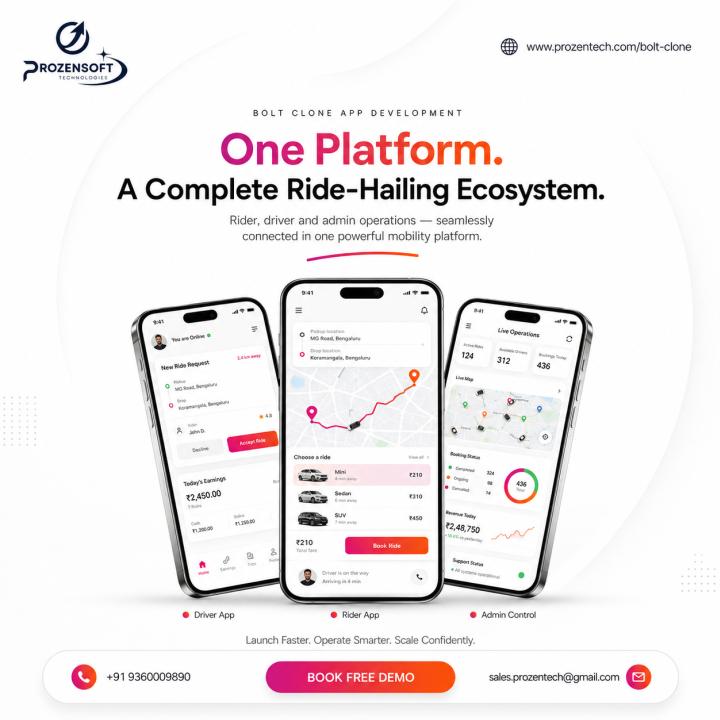
Rather than building only a booking app, businesses can create an ecosystem that connects passengers, drivers, administrators, payments, locations, pricing, notifications, and analytics through one unified platform.
A well-built Bolt clone can support a small local launch today while providing the technical flexibility needed to expand into larger cities and new mobility services in the future.
1. Create a Faster Ride Booking Journey
Speed is one of the most important parts of the ride-hailing experience.
Passengers should not need to go through several complicated screens before requesting a ride. The journey from entering a pickup point to confirming a vehicle should feel smooth and effortless.
A modern Bolt clone can allow customers to:
- Detect pickup locations automatically
- Search destinations quickly
- Select preferred vehicle types
- View estimated fares
- Book rides instantly
- Schedule rides for later
- Track nearby drivers
- View driver and vehicle information
- Make secure payments
- Access previous trips
- Rate completed rides
The simpler the experience becomes, the easier it is for customers to trust and repeatedly use the platform.
2. Use Intelligent Driver Dispatching
A strong ride-hailing platform depends heavily on how efficiently rides are matched with available drivers.
When a passenger confirms a booking, the system can identify suitable nearby drivers based on location, availability, vehicle category, and service area.
This reduces unnecessary travel for drivers and can shorten pickup times for passengers.
A smarter dispatch process can also help improve driver utilization throughout the day.
Instead of drivers waiting without clear direction or travelling long distances to collect passengers, the platform can create a more balanced distribution of ride requests.
This is one of the areas where professional Bolt clone development can have a major impact on everyday operational efficiency.
3. Give Drivers Better Control Over Their Work
Drivers need an application that is reliable, easy to understand, and fast to operate while working.
A dedicated driver app can allow them to manage availability, incoming rides, navigation, trip status, earnings, and withdrawals from one place.
Driver-side functionality may include:
- Driver onboarding
- Document submission
- Vehicle registration
- Online and offline status
- Nearby ride requests
- Accept or reject options
- Pickup navigation
- Passenger details
- OTP-based trip start
- Trip completion
- Daily earnings
- Wallet balance
- Withdrawal requests
- Ratings
- Trip history
Giving drivers a clear operational experience can improve engagement and reduce dependency on manual support teams.
4. Make Every Ride More Transparent with Live Tracking
Passengers want to know what is happening after they confirm a booking.
With GPS and mapping integrations, customers can track the driver's movement toward their pickup location and monitor progress throughout the journey.
The application can display:
- Driver location
- Estimated arrival time
- Vehicle information
- Pickup progress
- Trip route
- Ride status
Administrators can also monitor active rides through the backend.
This additional visibility helps businesses handle support issues more efficiently and provides both passengers and drivers with greater transparency.
5. Build Flexible Fare Rules Around Your Market
Every mobility market is different.
Pricing that works in one city may not work in another. Vehicle categories, customer expectations, fuel costs, and competition can all affect the ideal fare structure.
A scalable Bolt clone can allow administrators to configure pricing based on different conditions.
Fare calculations can include:
- Base fare
- Distance pricing
- Time-based pricing
- Minimum fare
- Waiting charges
- Vehicle category
- Booking charges
- Location-based pricing
- Additional service fees
Businesses can also configure different pricing for economy rides, premium cars, motorcycles, auto-rickshaws, or other mobility categories.
This gives operators greater flexibility to design a pricing model that supports both growth and profitability.
6. Simplify Digital Payments and Driver Earnings
Ride-hailing platforms manage a continuous flow of transactions between passengers, drivers, and the business.
Automating these financial operations can significantly reduce administrative work.
A Bolt clone can support multiple payment methods depending on the market, including:
- Debit and credit cards
- Digital wallets
- Cash
- Local payment gateways
- Promotional credits
Once a ride is completed, the system can calculate the driver's earning and platform commission automatically.
Drivers can view their wallet balance and withdrawal history, while administrators can monitor transactions, commissions, refunds, and payouts from the backend.
This creates a clearer and more structured payment process for everyone involved.
7. Build Stronger Passenger Trust
Trust plays a major role in whether passengers continue using a transportation platform.
A premium Bolt clone can include several features designed to improve accountability and safety.
These may include:
- Driver verification
- Vehicle verification
- Document approval
- OTP ride confirmation
- Passenger and driver ratings
- Trip history
- Driver profile visibility
- Ride status alerts
- Secure authentication
These tools help create a more structured experience and provide both users and administrators with better information throughout the ride lifecycle.
8. Control the Entire Business from One Admin Panel
The admin dashboard is the operational center of the platform.
Business owners should be able to manage all major activities without switching between multiple tools.
An advanced admin panel can include management for:
- Passengers
- Drivers
- Driver documents
- Vehicles
- Vehicle categories
- Active rides
- Scheduled bookings
- Pricing
- Service areas
- Promo codes
- Payments
- Commissions
- Driver payouts
- Reviews
- Cancellations
- Reports
- Revenue analytics
This centralized visibility makes it easier to monitor performance, identify issues, and make informed decisions.
9. Create Multiple Ways to Generate Revenue
A ride-hailing business can be monetized in several ways.
Instead of relying only on one source of income, businesses can build a flexible revenue structure.
Potential revenue models include:
- Commission per completed ride
- Passenger service charges
- Booking fees
- Driver subscription plans
- Cancellation charges
- Premium vehicle categories
- Corporate ride packages
- Airport transfer services
- Fleet partnership fees
The best model depends on the market, driver network, target customers, and competitive strategy.
A customizable Bolt clone gives businesses the freedom to test and refine these models over time.
10. Support Multiple Cities from a Single Platform
A mobility startup may begin in one location, but the platform should not become a limitation when the business grows.
Scalable architecture can support expansion into multiple cities and regions.
Each service area can have its own:
- Drivers
- Vehicles
- Pricing rules
- Operating zones
- Payment methods
- Promotions
- Language settings
This allows businesses to localize operations while maintaining centralized administrative control.
It also reduces the need to rebuild the platform when launching in new markets.
11. Build a Unique Brand Instead of a Basic Copy
A clone platform should provide the operational foundation of a proven ride-hailing model, but the final product should reflect the identity of your own business.
Custom Bolt clone development allows businesses to personalize:
- Logo and branding
- App interface
- Ride categories
- Booking workflow
- Pricing
- Driver commissions
- Payment methods
- Promotions
- Service locations
- Languages
This is important because customers need a reason to remember and choose your service instead of viewing it as another generic transportation app.
The technology should support your brand strategy rather than replace it.
12. Prepare the Platform for Future Mobility Services
A ride-hailing business does not need to remain limited to standard taxi bookings.
Once the core platform and user base are established, additional transportation services can be introduced.
Future options may include:
- Bike taxi services
- Auto-rickshaw bookings
- Airport transfers
- Hourly rentals
- Multi-stop rides
- Corporate transportation
- Driver subscriptions
- Fleet management
- Premium rides
- Scheduled transportation
Starting with a modular and scalable platform makes these future additions easier to introduce.
Why a Premium Bolt Clone Can Become a Long-Term Business Asset
The real value of a Bolt clone is not simply how fast it can be launched.
Its long-term value comes from how effectively it helps businesses manage transportation operations, customer relationships, driver networks, pricing, transactions, and expansion.
A professionally developed platform can create better operational visibility while giving passengers a smoother experience and drivers more structured tools.
When the system is customized correctly, the business gains greater control over how services are priced, promoted, managed, and expanded.
That control can become an important competitive advantage.
Build the Next Generation of Your Ride-Hailing Business
The ride-hailing industry continues to evolve, and businesses entering the market need technology that can evolve with it.
A premium Bolt clone development solution can provide the foundation for launching a modern mobility platform with intelligent booking, real-time tracking, powerful driver tools, automated payments, flexible pricing, and centralized administration.
For startups, transport operators, and mobility entrepreneurs, the goal should be bigger than simply releasing another taxi booking app.
The stronger opportunity is to build a recognizable mobility brand supported by technology that is scalable, customizable, and ready for future growth.
With the right platform, a local ride-hailing concept can gradually become a sophisticated transportation ecosystem capable of serving more customers, more drivers, and more cities.
Frequently Asked Questions
What is a Bolt clone?
A Bolt clone is a customizable ride-hailing platform built around the core workflow of modern on-demand transportation services. It typically includes passenger and driver apps along with an admin dashboard.
What features can be included in a Bolt clone?
Features can include instant booking, scheduled rides, live GPS tracking, fare estimation, driver management, online payments, ratings, wallets, promo codes, commissions, and admin analytics.
Can I use my own brand name and design?
Yes. The app can be customized with your own branding, interface, vehicle categories, pricing model, payment methods, and operational workflow.
Can drivers manage earnings through the app?
Yes. Drivers can view trip earnings, wallet balances, completed rides, commissions, and withdrawal information depending on the business model.
Can the platform operate in multiple cities?
Yes. A scalable Bolt clone can support multiple cities, service zones, pricing structures, languages, and driver networks.
Can I add scheduled ride booking?
Yes. Customers can be provided with both instant and advance ride booking options.
Can multiple vehicle categories be added?
Yes. Economy cars, premium vehicles, bikes, auto-rickshaws, vans, and other transportation categories can be configured.
Can online payments and cash be supported together?
Yes. The platform can support both digital payments and cash where required.
How does a Bolt clone business make money?
Businesses can earn through ride commissions, service fees, driver subscriptions, cancellation charges, booking fees, premium ride categories, and corporate transportation services.
Is a Bolt clone suitable for a startup?
Yes. Startups can launch in a focused area first and gradually expand their driver network, customer base, cities, vehicle categories, and additional transportation services.