For years, international students in the UK could build their plans around a fairly clear route: study, move into skilled employment, complete the required residence period, and eventually apply for Indefinite Leave to Remain (ILR). The proposed UK ILR overhaul could change that calculation dramatically. Under the government's proposed “earned settlement” model, the standard qualifying period could rise from five years to ten for many routes.
That does not mean the change is already law. The current five-year qualifying period remains in force, and several parts of the proposal are still being discussed. But for international students already in Britain, or those considering a UK university, the proposal deserves serious attention because it could affect career choices, finances and long-term plans.
How the Proposed ILR Rules Could Change the Timeline
The biggest proposed change is simple: settlement could take much longer.
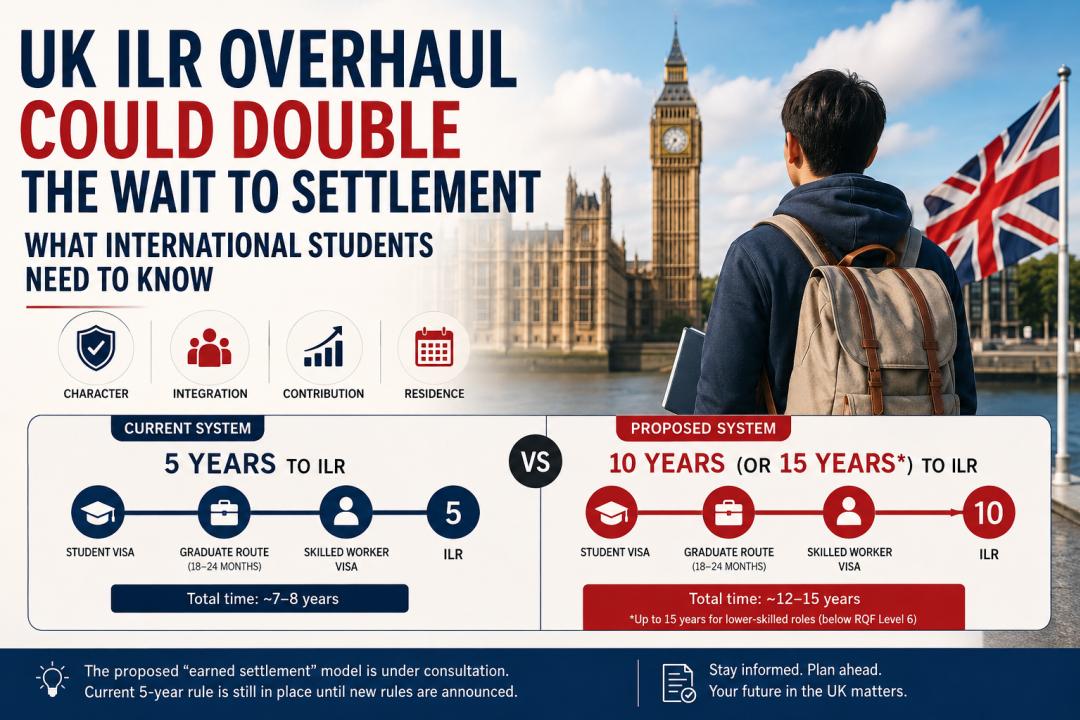
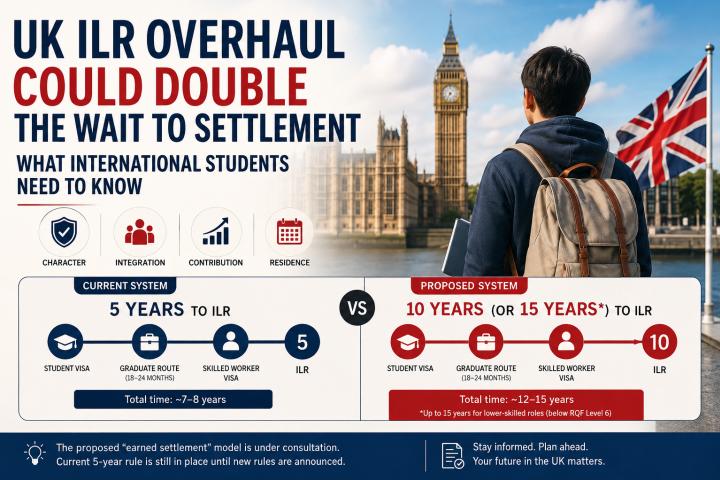
Under the current system, five years of continuous lawful residence on a qualifying route, such as Skilled Worker, can lead to ILR. The proposed earned-settlement framework would make ten years the baseline for many applicants. For some lower-skilled roles below RQF Level 6, the wait could reach 15 years.
The change also introduces four broad factors for settlement: character, integration, contribution and residence. In other words, simply completing a period of residence would no longer be the central measure. Applicants could also face greater expectations around income, conduct, integration and language.
For international graduates, the effect becomes clearer when the entire study-to-work pathway is considered. A student might complete a one-year master's degree, spend time on the Graduate Route, secure Skilled Worker sponsorship and then work toward settlement. Under the existing system, the complete journey from arrival to permanent residence can take around seven to eight years.
Under the proposed framework, that journey could extend to roughly 12 to 15 years, depending on salary, occupation and the final rules.
One detail matters here: time spent on a Student visa or Graduate Route does not count toward the five-year Skilled Worker settlement period. The proposal does not change that basic structure.
Why Current International Students Face More Uncertainty
The most difficult issue is not simply the longer waiting period. It is the possibility that the new rules could affect people who are already living in the UK.
The consultation indicates that people already in the country who have not yet secured settlement could potentially fall under the revised framework. However, transitional protection has not been finalized. That leaves current students and workers facing an unusual question: will the rules that applied when they started their journey still determine when they can settle?
Consider a student who arrived in 2023 expecting to study, secure a sponsored job and eventually qualify for ILR under the existing framework. That person may have chosen a university, accepted a job, signed a lease or made family decisions based on the expected timeline. If the qualifying period changes during that journey, the financial and personal consequences could be significant.
Language requirements may add another layer. The proposal includes raising the English-language requirement for several settlement routes from CEFR B1 to B2. Students therefore need to think beyond simply accumulating years of residence.
For those managing demanding university coursework at the same time, academic support can also become useful. Resources such as Expertsmind's subject expert network can help students deal with coursework and assignment demands while they keep track of changing career and immigration plans.
What Students Should Do While the Rules Remain Unsettled
The most sensible response is to separate confirmed law from proposed policy.
According to the source, the five-year ILR qualifying period has not officially changed. New requirements cannot take effect until revised Immigration Rules are formally introduced. The consultation process is also still considering transitional arrangements for people already in the UK.
That means students should not make major decisions solely because of headlines about a 10-year settlement period.
Instead, they should keep accurate records of their immigration history. Visa start and end dates, changes between routes, employment history and salary progression may all become relevant if transitional arrangements depend on when someone entered a particular route.
Students should also examine whether their career could eventually qualify for a faster settlement pathway. The proposal includes potentially shorter routes for certain high earners and categories such as Global Talent and Innovator Founder. A five-year fast track has also been discussed for some frontline public-service roles.
These possibilities make career planning more important. A graduate choosing between two jobs may need to consider not only salary and professional development but also how the role fits into future immigration eligibility.
The Bigger Question for UK Universities
The proposed ILR overhaul could affect more than individual students. It may also change how attractive the UK looks to international applicants.
For years, the UK's appeal has included a relatively understandable progression from education to employment and, eventually, settlement. If that path becomes substantially longer and less predictable, prospective students may compare the UK more closely with countries such as Canada and Australia.
Universities could then face tougher questions from applicants and their families. Education agents and careers teams may also need to explain that the traditional “five-year plan” should no longer be treated as a guaranteed planning assumption.
Employers could feel the effects too. A company considering sponsorship for an international graduate may reassess the long-term retention picture if the employee expects to remain dependent on immigration sponsorship for a decade rather than five years.
The proposal therefore reaches beyond immigration paperwork. It could influence where students choose to study, where graduates seek employment and how employers think about international talent.
For now, the clearest takeaway is that the UK has not yet replaced the existing five-year ILR rule. The proposed overhaul could create a much longer path, but its final form, including transitional protection, remains unsettled. Students should keep detailed records, follow official rule changes and avoid irreversible decisions based only on the most pessimistic scenario.
The finish line may move, but it has not moved yet. For international students, the smartest response is preparation rather than panic.