The reported $100,000 OPT fee has turned a technical immigration discussion into a major question for international students: does a U.S. degree still offer the same career value if post-study work becomes dramatically more expensive?
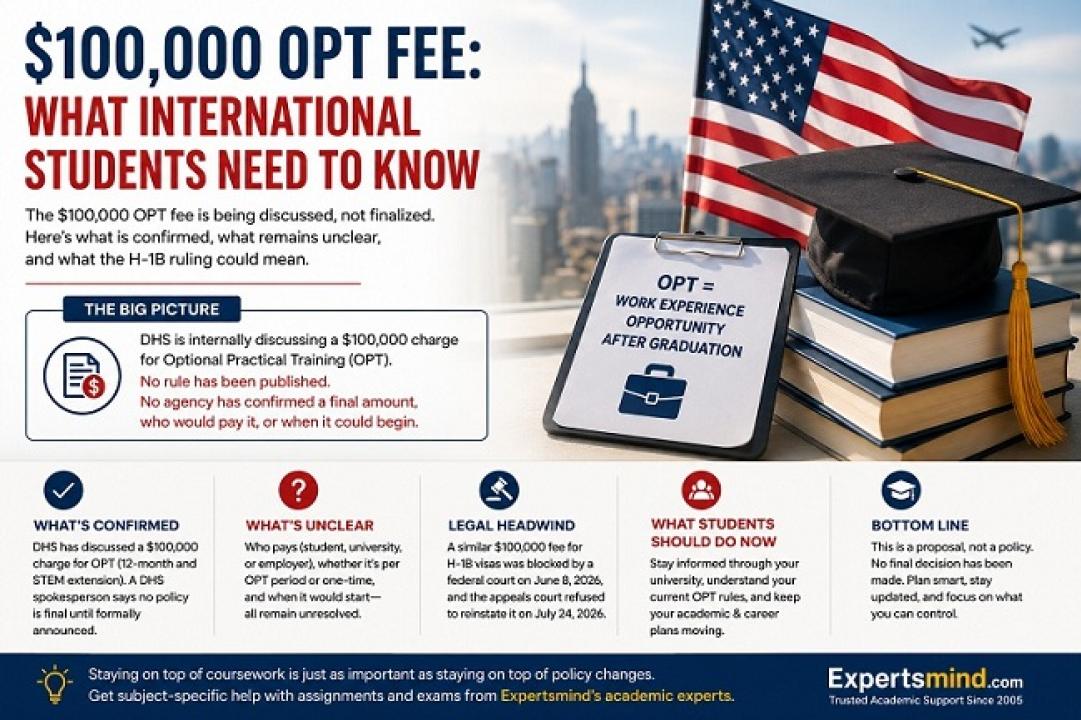
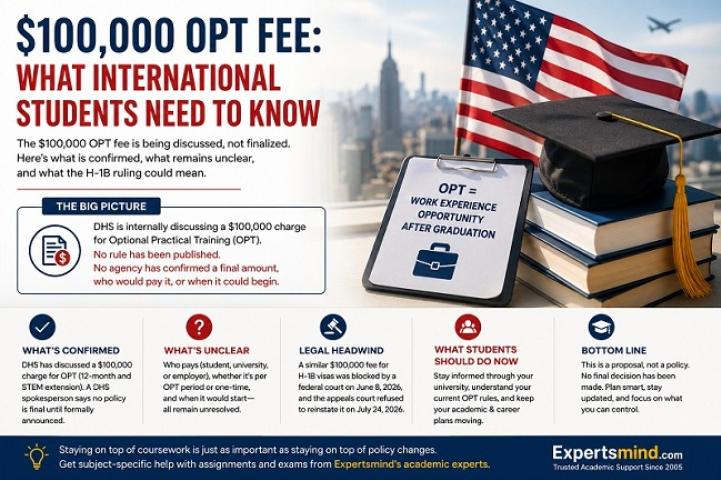
The answer is not settled. The research paper makes clear that DHS has reportedly discussed a six-figure OPT charge, but no formal rule has been published. There is no confirmed start date, payment structure or final fee. For students planning to study in the United States, that distinction matters more than the headline itself.
OPT has long been part of the financial logic behind a U.S. education. F-1 students can generally use regular OPT for up to 12 months after graduation, while eligible STEM graduates may receive a further 24 months. That period can provide income, professional experience and time to pursue longer-term employment options.
A large new fee would change that equation. It could make students and families reconsider whether the expected career return justifies the cost of studying in America.
The Real Cost Is Bigger Than the Fee
A $100,000 charge would not exist in isolation. Students already consider tuition, housing, insurance, travel and everyday expenses when calculating the cost of an overseas degree.
Adding another six-figure charge could force families to rethink the entire investment. For example, an international student choosing between two universities might previously have compared tuition and rankings. Under a high-cost OPT system, the student would also need to ask whether post-graduation employment remains financially realistic.
That could affect university decisions long before any rule takes effect. Students may choose shorter programs, lower-cost institutions or destinations with clearer post-study work expectations.
The uncertainty itself can also influence decisions. A student does not need to be charged $100,000 today for the possibility of such a fee to affect an application made today.
For students trying to balance demanding coursework with changing study-abroad plans, academic support can help keep immediate priorities under control. Expertsminds academic subject resources provide access to subject-focused support across different areas of study.
Why Students Should Watch the Legal Battle
The reported OPT proposal also has a legal dimension. The research paper points to the government's earlier attempt to impose a similar $100,000 fee on certain new H-1B petitions.
That fee faced a federal court challenge. On June 8, 2026, a Massachusetts judge vacated the policy, concluding that Congress, rather than DHS or the White House, has the authority to impose a fee of that size. The government appealed, but the First Circuit declined on July 24 to pause the ruling while the appeal continued.
That does not mean a future OPT fee would automatically fail in court. OPT and H-1B rules involve different legal questions, and the research paper does not present the H-1B decision as a direct precedent.
It does, however, show that a six-figure immigration charge can face substantial legal resistance. If DHS eventually publishes an OPT proposal, the statutory authority behind the charge is likely to receive close attention.
What This Means for Future Applicants
Prospective students should avoid two opposite mistakes. The first is assuming the $100,000 fee is already mandatory. It is not. The second is ignoring the proposal completely because it has not become law.
A better approach is to separate current rules from possible future changes. Students applying for upcoming intakes should monitor their university's international student office and official DHS announcements. Those sources are more useful than repeatedly reacting to headlines.
Students should also consider the wider financial picture. If post-study employment is an important part of the plan, calculate the degree's cost without assuming that future OPT conditions will remain unchanged.
At the same time, students should not allow immigration speculation to damage their current academic progress. Assignments, exams and course requirements remain immediate responsibilities. Expertsmind's homework help resources can be useful for students who need additional academic support while managing a demanding semester.
The US May Face Stronger Competition
The OPT discussion could also affect the international education market. The United States competes with destinations such as Canada, the UK and Australia for international students.
For years, the ability to study and then gain U.S. work experience has been an important part of the American proposition. If students begin to view that pathway as unpredictable or prohibitively expensive, competing destinations gain an opening.
Universities therefore have more at stake than enrollment numbers. International students make decisions years in advance. They want to know what a degree may cost, what work options may exist after graduation and how much uncertainty they can reasonably accept.
The reported OPT fee does not answer those questions yet. It does, however, show why students should treat immigration policy as part of their study-abroad planning rather than as an issue to consider only after admission.
For now, the most sensible conclusion is straightforward: the $100,000 OPT fee remains a reported proposal, not an established charge. Students should keep studying, follow official updates and avoid making irreversible decisions based on an unfinished policy discussion.
The biggest lesson is not to abandon the U.S. automatically. It is to make sure the career plan still works if the rules change.