Introduction
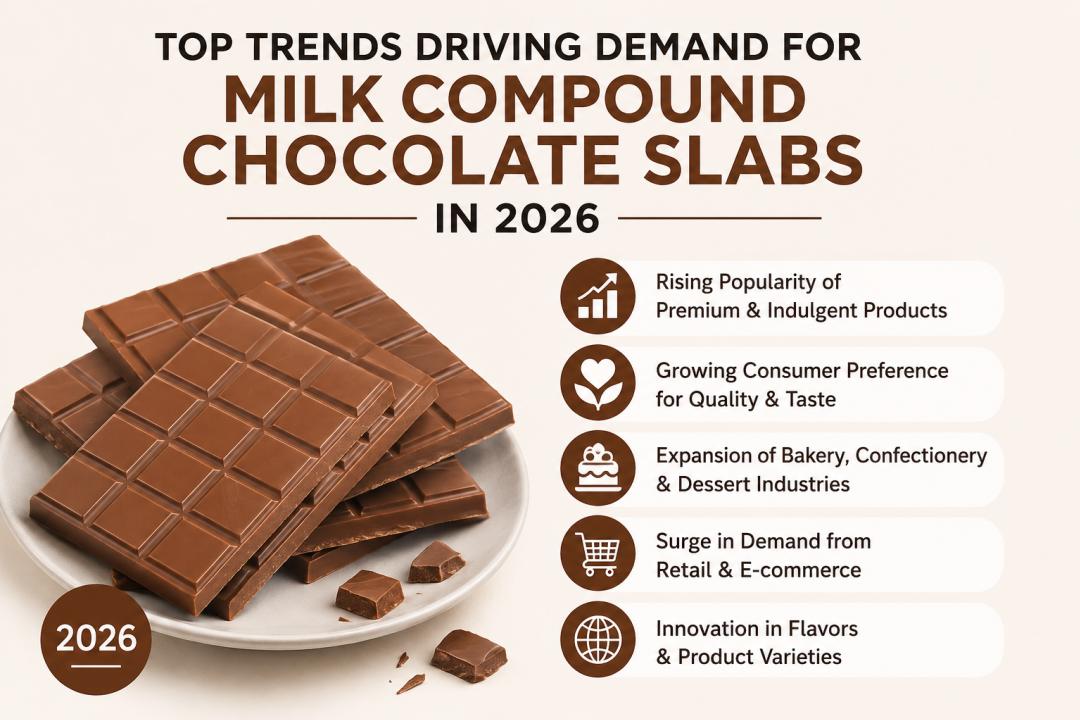
Historically driven by affordability, compound chocolate has seen rising demand through 2025 and is set to grow more in 2026 through a particular application: the Milk Compound Chocolate Slab. This slab represents value: it balances high dairy content for rich flavor with stability at high temperatures for Indian and South Asian climates, and it offers a cost advantage over cocoa butter-containing alternatives that allows bakers and confectioners to maintain stable retail pricing. Here are the trends fueling demand for this particular slab in 2026.
Premiumization Without Premium Prices
Consumers have developed an increased expectation for the quality of chocolate products, including fillings, bakery items, and confectionery center offerings, due to greater exposure to premium products through retail and quick commerce. However, the price of these items has not necessarily kept pace with these expectations. As a result, manufacturers are looking to balance quality with cost to meet consumer demands.
A slab made with a high-quality non-lauric fat system and milk solids offers a significant improvement in flavor over traditional compound chocolates while avoiding the cost and complexity of cocoa butter. This has driven demand for milk-based compound chocolate specifically rather than the category as a whole, with dark and unsweetened varieties seeing comparatively lower adoption rates among bakers and confectioners.
Heat Stability as a Requirement
Distribution across most of India and neighboring markets poses a risk to chocolate in packaged form, which often exceeds temperature thresholds at which standard cocoa-butter chocolate softens or blooms during transit. Melting points have become a specified requirement for businesses, which is where milk compound chocolate for confectionery has an advantage over traditional options, as its formulation allows for a higher melting point without risk to the stability of cocoa butter during temperature fluctuations.
The tendency has grown in recent years for businesses distributing products to less developed cold chain infrastructure networks, which still constitute the majority of retail networks outside of metro regions, to request compound chocolate, not due to financial considerations, but as a practical necessity.
Private Label and Quick Commerce Demand
Quick commerce and private label retailers represent a newly emerged category of buyers with unique requirements. These companies operate at lower profit margins than traditional FMCG distributors and require a high-quality, neutrally flavored chocolate option that can be incorporated into their private label product offerings. This has driven demand for milk-based compound chocolate specifically, as it provides a good balance of quality and cost over competing options.
This category of buyers has also contributed to a shift in ordering practices, with many preferring smaller, more frequent orders that allow them to test new products before committing to larger volumes. As a result, manufacturers are being pressed to offer more flexible minimum order size options than would have been necessary a few years ago.
Clean Label Focus
Both buyers and end consumers are showing greater interest in the specifics of the fat system used in compound chocolate, seeking to avoid partially hydrogenated fats, and a corresponding preference for interesterified or enzymatically modified systems from manufacturers. This has influenced formulation choices in the category, with interesterified fats being selected for their ability to avoid partially hydrogenated fats entirely and align with clean label demands both from buyers and regulators.
A best milk compound chocolate supplier for food businesses evaluation in 2026 would include an explicit question about the degree to which a manufacturer utilizes partially hydrogenated fats. Previously a non-issue for a category historically focused on cost, the question has gained importance in the past five years, with buyers desiring a direct answer rather than one implied by a certification on a spec sheet.
Application Focus
The specific applications for the slab, from enrobing to confectionery molding to ice cream coatings and QSR desserts, have influenced formulation choices more directly than in previous years. Buyers are specifying different viscosities and melting points for different applications, which has, in turn, led to greater emphasis on a manufacturer’s ability to offer a variety of products with different characteristics rather than a one-size-fits-all approach.
Viscosity and set time are particularly important considerations for enrobing and mold release, where issues such as surface tension and even flow can contribute to imperfections in the finished product. Similarly, a slab that performs poorly in a specific mold can lead to production delays and wasted materials. As a result, manufacturers that can offer customized products rather than a generic option are better positioned to capitalize on this trend.
Packaging Considerations
Packaging considerations have become increasingly relevant for buyers, to the point where they are influencing formulation choices as much as ingredient selection and price. This trend is indirectly influenced by the same climate factors affecting formulation choices, as companies utilizing longer distribution chains are seeking to optimize their packaging to reduce the likelihood of bloom occurring during shipment. A slab with good heat stability can be defeated by inadequate packaging, which has contributed to the demand for higher-performance packaging than was historically used for similar products.
Sourcing Transparency
More specific sourcing requirements are being applied when purchasing palm derivative-containing products, as buyers seeking to enter international markets or supplying multinational corporations with their own specifications find themselves having to choose between RSPO-certified options and significantly lower prices with unknown sustainability credentials. More relevant to exports than domestic sales, this trend has nevertheless begun to influence manufacturers’ priorities for third-party audits and certification.
2026 Implications: Buyers Seeking More Than Just Price Will See Greater Success
A generic slab purchased on price alone is less desirable to buyers entering into negotiations in 2026 than it would have been three or four years ago. Across the industry, demand is being driven by buyers specifying richer dairy content for improved flavor, higher melting point and heat stability for better performance, and cleaner labels for brand image, with formulation selection for specific applications playing an important role in differentiating between suppliers at a similar price point. As these considerations carry increasing weight, manufacturers that can position their products as addressing these specific concerns will find themselves with a stronger value proposition than those that enter the conversation from the perspective of price competition.
Choco Nutri India Private Limited offers bakery and confectionery-grade Milk Compound Chocolate Slab options designed to meet the requirements of buyers seeking to utilize heat-stable, rich dairy flavor while meeting formulation requirements for application-specific performance and clean label requirements. As a premier supplier of the Top Milk Compound Chocolate Slabs, Choco Nutri India Private Limited serves manufacturers evaluating the key trends influencing the market in 2026.
Conclusion
The companies seeing the highest growth rates in this segment are not necessarily those competing on the lowest price per kg. They are addressing specific formulation concerns related to flavor richness, heat stability, and ingredient transparency in a manner that positions their products against the growing consumer demand for quality chocolate products without the premium price tag. That dynamic is what influences most of the trends discussed above and is likely to continue to do so in the years to come.