The delivery app market has matured significantly over the last five years. Early movers competed primarily on availability — simply having an app was enough of a differentiator. That era is over. Today, customers have multiple delivery options at their fingertips, and their loyalty goes to the platform that consistently delivers the smoothest, most reliable experience.
For businesses entering or expanding in this space, the question is no longer whether to build a delivery app. It is how to build one that people actually keep using. The answer lies in the features — and the technical decisions behind them. This is where the expertise of a specialized food delivery app development company becomes the defining factor between an app that retains users and one that gets uninstalled after a single bad experience.
Why Features Alone Do Not Guarantee Success
Before diving into what makes delivery apps successful, it is worth establishing an important distinction. Features do not create success on their own. The way features are implemented — how fast they respond, how intuitively they are designed, how reliably they function under load — is what separates an app customers trust from one they abandon.
A food delivery app development company with genuine domain expertise understands this. They do not just build a feature list. They architect each feature around real user behavior, stress-test it under peak conditions, and refine it based on how actual customers interact with it post-launch.
With that foundation in place, here are the features that consistently define high-performing delivery apps.
Real-Time Order Tracking
No feature has a greater impact on customer confidence than live order tracking. The moment a customer places an order, anxiety about timing begins. Real-time tracking — showing order confirmation, preparation status, driver assignment, live GPS location, and estimated arrival — addresses that anxiety directly and removes the need for customers to contact support about their order status.
Building this well is technically non-trivial. It requires a reliable GPS integration, a low-latency data pipeline between the driver's device and the customer's app, and a map interface that updates smoothly without draining the user's battery. When implemented correctly, real-time tracking dramatically reduces support ticket volume and measurably improves post-delivery satisfaction scores.
Intelligent Search and Discovery
Customers who cannot find what they want quickly leave. Delivery apps with poor search functionality lose orders to competitors before the checkout process even begins.
Effective search in a delivery app goes beyond matching exact product names. It needs to handle spelling errors, recognize synonyms, support filtering by dietary preference, cuisine type, price range, and delivery time, and surface relevant results based on the customer's location and order history.
Beyond search, smart discovery features — curated collections, trending items, personalized recommendations based on previous orders — keep customers engaged and increase average order values. A capable food delivery app development company builds these discovery systems with machine learning capabilities that improve over time as user data accumulates.
Streamlined Multi-Step Checkout
Cart abandonment at checkout is one of the most costly problems in ecommerce and delivery apps alike. Every additional step, every form field that is not auto-filled, every payment method that is missing increases the likelihood that a customer leaves without completing their order.
A well-designed checkout for a delivery app includes saved delivery addresses with smart defaults, multiple payment options including digital wallets and cash on delivery where relevant, a clear order summary with itemized costs before the final confirmation, and a single-screen design that does not require unnecessary navigation.
Order instructions — special requests for customizations, allergies, or delivery notes — should be accessible without disrupting the checkout flow. These details matter to customers and significantly affect satisfaction when they are handled correctly.
Robust Driver and Fleet Management
The customer-facing side of a delivery app is only half the product. The driver experience and the fleet management tools behind it are equally important — and often receive far less attention than they deserve.
Drivers need a dedicated app interface that shows new order requests clearly, provides optimized navigation, tracks earnings transparently, and allows status updates without complicated interactions while on the road. A poor driver experience leads to high driver turnover, slower acceptance rates, and ultimately longer delivery times for customers.
On the operations side, fleet management tools allow businesses to monitor active deliveries in real time, identify bottlenecks, manage driver availability across zones, and analyze performance data to optimize dispatch logic over time.
An experienced food delivery app development company builds both the customer app and the driver interface with equal rigor, understanding that the quality of the delivery experience is directly dependent on how well the driver side of the system works.
Milk Delivery App Development: A Specialized Use Case
While restaurant food delivery attracts the most attention in industry conversations, milk delivery app development represents a distinct and growing segment with very different technical requirements that deserve specific consideration.
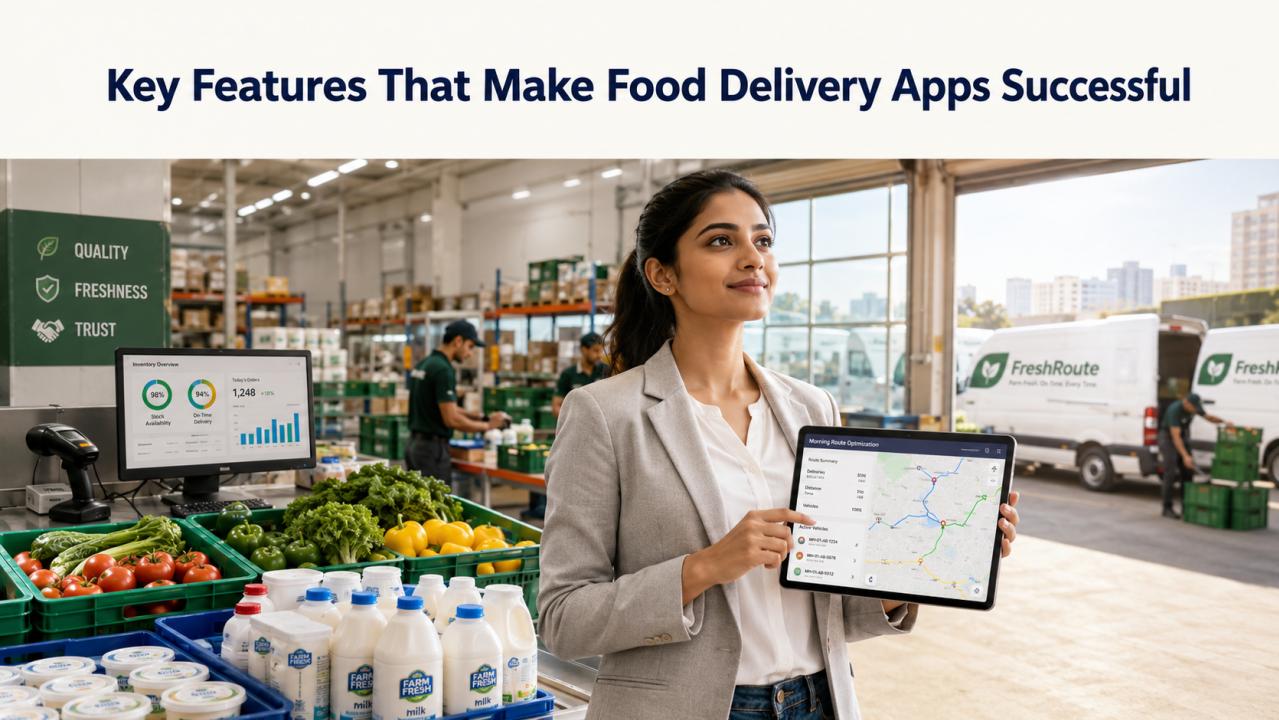
Milk and dairy delivery operates on subscription models, early morning delivery windows, and precise route optimization in a way that on-demand restaurant delivery does not. Customers typically set up recurring orders — daily, alternate-day, or weekly — and expect their deliveries to arrive within a narrow time window before they leave for work.
This model requires features that standard food delivery apps are not built for: flexible subscription management that allows customers to pause, modify, or cancel recurring orders easily; advance delivery scheduling across multiple days simultaneously; route optimization that organizes driver rounds for maximum efficiency across dense residential areas; and real-time delivery confirmation with proof of delivery, particularly important for unattended doorstep drops.
Payment for subscription delivery also works differently — recurring billing cycles, credit balance systems where customers pre-load accounts, and transparent billing histories are all standard expectations in this category.
For businesses in the dairy, fresh produce, or any subscription-based delivery vertical, working with a development company that understands these specific requirements produces a fundamentally better product than adapting a generic delivery template.
Why an Ecommerce Mobile App Builder Has Its Limits Here
There is a tempting shortcut for businesses entering the delivery space: using a generic ecommerce mobile app builder to launch quickly at lower upfront cost. For a basic product catalog or simple retail store, this approach can work. For delivery apps — particularly those with real-time tracking, driver management, subscription logic, or multi-vendor order routing — it falls short in ways that become expensive to fix.
Generic app builders are designed around browse-and-buy flows. Delivery apps require a fundamentally different architecture: real-time location services, push notification systems that respond to order state changes, split-second dispatch logic, and driver-side interfaces that the builder was simply never designed to support.
Businesses that launch delivery apps on generic builders frequently hit these limits within months — just as their user base is beginning to grow. The cost of migrating to a properly built platform at that stage, while managing live operations and customer expectations, is significantly higher than building correctly from the start.
Platforms like Shopaccino that are purpose-built with delivery and mobile commerce in mind bridge this gap thoughtfully — offering structured commerce infrastructure without forcing businesses into the constraints of a tool designed for an entirely different use case.
Ratings, Reviews, and Trust Signals
Delivery apps live and die by trust. Customers making repeat purchase decisions rely heavily on ratings and reviews — for restaurants, individual menu items, and drivers — to decide where to order from and whether to return.
A well-implemented review system captures feedback immediately after delivery while the experience is fresh, allows specific ratings for food quality and delivery experience separately, surfaces verified reviews prominently on restaurant and product pages, and gives operators actionable data on what is working and what needs improvement.
Beyond formal reviews, smaller trust signals matter too: order counts that show a restaurant's popularity, badges for highly rated vendors, response rates for customer queries, and transparent refund and complaint resolution processes all contribute to the overall confidence customers feel when choosing your platform over a competitor.
Push Notifications Done Right
Push notifications are one of the most powerful engagement tools available to delivery apps — and one of the most commonly misused. Notifications that are too frequent, irrelevant, or poorly timed train users to disable them, eliminating a critical communication channel.
Effective notification strategy in delivery apps follows clear principles: transactional notifications — order confirmed, driver assigned, arriving soon — are always welcome because they deliver information the customer is actively waiting for. Promotional notifications require more careful targeting, using order history and preference data to ensure relevance.
Timing, frequency caps, and personalization controls should be managed at the platform level, not left to manual campaign decisions. Development companies that build notification systems with behavioral logic built in produce platforms where push engagement rates stay high over time.
Analytics That Drive Continuous Improvement
The best delivery apps are never finished. They improve continuously based on data — and that requires analytics infrastructure that gives operators genuine visibility into how the platform is performing.
Useful analytics for delivery platforms go beyond basic order counts. Peak demand heat maps show when and where to concentrate driver availability. Funnel analysis identifies exactly where users drop out of the ordering process. Menu performance data shows which items drive repeat orders and which are abandoned in carts. Driver efficiency metrics highlight route optimization opportunities.
A food delivery app development company that builds robust analytics into the platform from day one gives operators the tools to make decisions based on evidence rather than intuition — which consistently produces better outcomes as the business scales.
Conclusion
Delivery app success is not accidental. It is the result of deliberate feature decisions, sound technical architecture, and continuous refinement based on real user behavior. Every feature discussed in this article — from real-time tracking to subscription-based milk delivery app development, from intelligent search to driver management tools — contributes to an experience that customers trust and return to.
A specialized food delivery app development company brings the domain expertise to build these features correctly the first time, avoiding the costly rebuilds that result from launching on infrastructure that was never designed for delivery. Whether you are building a restaurant marketplace, a grocery platform, or a subscription delivery service, the features you invest in and how well they are executed will determine how far your platform grows.
The market rewards apps that work reliably, feel effortless to use, and improve with every iteration. That is the standard worth building to.