Virtual WhatsApp for Business Messaging: A Smarter Way to Connect With Customers
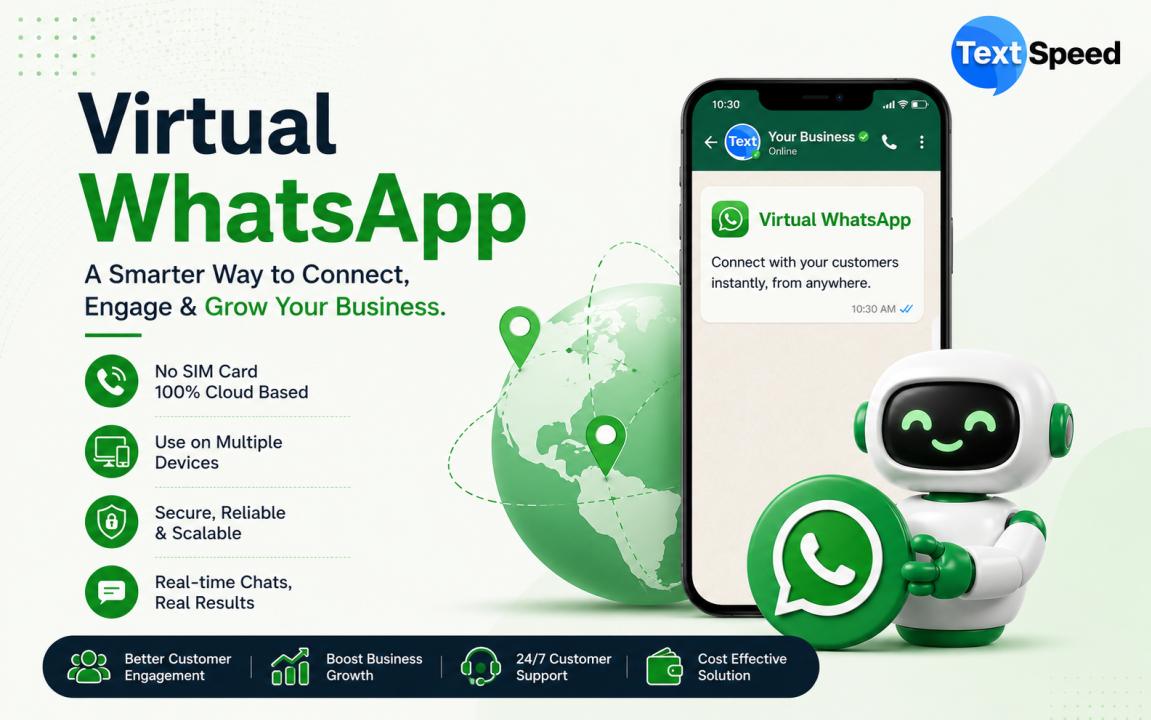
Virtual WhatsApp for Business Messaging helps businesses communicate with customers through WhatsApp without depending on a traditional personal phone number. It enables businesses to manage customer conversations, send notifications, automate communication, and scale WhatsApp messaging through business-focused solutions.
For companies looking to improve customer engagement, lead follow-ups, notifications, and support, a virtual WhatsApp solution can provide a more flexible and scalable approach to business messaging.
What Is Virtual WhatsApp for Business Messaging?
Virtual WhatsApp for Business Messaging refers to using a dedicated virtual business number or WhatsApp-enabled communication solution to communicate with customers professionally.
Instead of managing customer conversations from a personal WhatsApp account, businesses can use a business messaging platform to manage conversations, automate responses, send approved business messages, and organize customer communication.
A virtual WhatsApp setup can be useful for:
Customer support
Lead generation
Sales follow-ups
Appointment reminders
Order notifications
Payment notifications
Marketing communication
Customer engagement
Automated responses
How Does Virtual WhatsApp Business Messaging Work?
A typical virtual WhatsApp business messaging workflow looks like this:
Business setup → WhatsApp-enabled number → Customer opt-in → Message creation → Message delivery → Customer response → Follow-up or automation
Businesses can connect their WhatsApp communication with CRM systems, websites, applications, chatbots, and other business tools to create a centralized customer communication process.
Why Should Businesses Use Virtual WhatsApp Messaging?
Customers increasingly expect businesses to communicate through convenient messaging channels. WhatsApp provides businesses with a direct way to communicate with customers throughout the customer journey.
A virtual WhatsApp solution can help businesses:
Centralize customer conversations
Respond faster to enquiries
Follow up with leads
Automate repetitive messages
Send transactional notifications
Improve customer support
Manage high-volume communication
Build structured messaging workflows
Connect WhatsApp with business applications
Track communication performance
For growing businesses, the biggest advantage is the ability to turn WhatsApp from a simple messaging application into a structured business communication channel.
Virtual WhatsApp vs Personal WhatsApp
A personal WhatsApp account is designed primarily for individual communication, while business messaging solutions are designed around customer communication and business workflows.
| Feature | Personal WhatsApp | Virtual WhatsApp Business Solution |
|---|---|---|
| Business communication | Limited | Designed for business use |
| Automation | Limited | Available through integrations |
| Lead management | Manual | Can connect with CRM |
| Bulk communication | Restricted | Business messaging capabilities |
| API integration | Limited | Available through APIs |
| Customer support | Manual | Can support automation |
| Analytics | Limited | Messaging and delivery insights |
| Scalability | Low | Higher |
Businesses handling large numbers of customer interactions should consider a dedicated business messaging solution rather than relying entirely on personal messaging.
Key Use Cases of Virtual WhatsApp for Business
1. Lead Generation
Businesses can use WhatsApp to capture enquiries from websites, advertisements, landing pages, social media, and other marketing channels.
Once a prospect starts a conversation, sales teams can respond, qualify the lead, and continue the follow-up directly through WhatsApp.
2. Sales Follow-Up
Sales teams can use WhatsApp messaging to follow up with prospects after enquiries, demonstrations, quotations, or consultations.
Automated reminders can also help reduce missed follow-ups.
3. Customer Support
Businesses can provide customer assistance through WhatsApp instead of requiring customers to call or email.
Frequently asked questions can be automated through chatbots, while complex enquiries can be transferred to human agents.
4. Order and Delivery Updates
E-commerce and retail businesses can send customers updates about:
Order confirmation
Payment status
Shipping
Delivery
Returns
Refunds
This keeps customers informed throughout the purchase journey.
5. Appointment Reminders
Healthcare providers, educational institutions, consultants, salons, and service businesses can use WhatsApp notifications to remind customers about upcoming appointments.
6. Marketing Campaigns
Businesses can use WhatsApp business messaging to communicate promotional offers, product updates, launches, and other marketing information when they have the appropriate customer consent and follow applicable WhatsApp and regulatory requirements.
Virtual WhatsApp With WhatsApp Business API
For businesses requiring automation and system integration, the WhatsApp Business API can provide a more scalable foundation for business messaging.
An API-based WhatsApp solution can connect WhatsApp communication with:
CRM platforms
Websites
Mobile applications
E-commerce platforms
Helpdesk software
Chatbots
Marketing automation systems
Customer databases
This allows businesses to trigger WhatsApp messages based on customer actions or business events.
For example:
Customer submits enquiry → CRM creates lead → Automated WhatsApp confirmation → Sales team receives notification → Follow-up message is sent
This type of workflow can reduce manual work while improving response speed.
Can Virtual WhatsApp Be Used for Multiple Agents?
Yes. A business messaging platform can allow multiple customer service or sales agents to manage conversations from a centralized system, depending on the platform's features.
This is particularly useful for businesses with dedicated teams for:
Sales
Customer support
Marketing
Technical assistance
Order management
Instead of keeping customer conversations scattered across individual phones, businesses can create a more organized communication workflow.
Virtual WhatsApp for Lead Generation
One of the strongest business applications of WhatsApp messaging is lead conversion.
A typical lead-generation journey can be:
Advertisement → Landing Page → WhatsApp Enquiry → Automated Response → Lead Qualification → Sales Follow-Up → Conversion
Businesses can use click-to-WhatsApp campaigns, website WhatsApp buttons, QR codes, and other customer entry points to start conversations.
The key is not simply generating WhatsApp conversations but building a process that quickly converts conversations into qualified leads.
How Virtual WhatsApp Can Improve Customer Engagement
WhatsApp messaging can make communication more immediate and convenient for customers.
Businesses can use personalized messages to:
Welcome new customers
Confirm registrations
Answer enquiries
Share product information
Send reminders
Provide order updates
Request feedback
Re-engage customers
Relevant and timely communication can improve the overall customer experience.
Important WhatsApp Messaging Best Practices
Businesses should follow responsible messaging practices when using WhatsApp for customer communication.
Get Customer Consent
Send business messages to customers in accordance with applicable consent requirements and WhatsApp policies.
Provide Relevant Information
Avoid sending unnecessary or excessive messages. Communication should provide genuine value to the recipient.
Personalize Messages
Where appropriate, use customer information to make messages more relevant.
Respond Quickly
Fast responses are especially important for sales enquiries and customer support.
Use Automation Carefully
Automation should improve customer experience rather than make communication feel completely impersonal.
Monitor Messaging Performance
Track metrics such as delivery, engagement, responses, and conversions to identify what is working.
How to Choose a Virtual WhatsApp Provider
Choosing the right Virtual WhatsApp provider can have a direct impact on messaging reliability, automation, and lead generation.
Before selecting a provider, evaluate:
WhatsApp Business API capabilities
API documentation
Message delivery reliability
Automation features
Chatbot support
CRM integration
Multi-agent inbox
Message templates
Analytics and reporting
Scalability
Customer support
Security
Compliance requirements
Pricing and messaging costs
Businesses should choose a solution based on their actual messaging volume, automation requirements, integration needs, and customer communication goals.
Virtual WhatsApp for Different Industries
E-commerce
Use WhatsApp for order confirmations, shipping updates, abandoned-cart communication, customer support, and product enquiries.
Healthcare
Use WhatsApp for appointment reminders, confirmations, patient communication, and service information while following applicable privacy and regulatory requirements.
Education
Educational institutions can use WhatsApp for admission enquiries, application updates, reminders, and student communication.
Real Estate
Real-estate companies can use WhatsApp to respond to property enquiries, schedule site visits, share property information, and follow up with prospects.
Banking and Financial Services
Financial businesses can use secure messaging workflows for customer notifications and service communication, subject to applicable regulatory and security requirements.
Travel and Hospitality
Hotels, travel agencies, and booking businesses can send confirmations, reminders, itinerary information, and customer support messages.
Frequently Asked Questions About Virtual WhatsApp for Business Messaging
What is Virtual WhatsApp for Business Messaging?
Virtual WhatsApp for Business Messaging is a business communication approach that uses a dedicated WhatsApp-enabled business identity or platform to manage customer conversations, notifications, automation, and engagement.
Is Virtual WhatsApp suitable for small businesses?
Yes. Small businesses can use WhatsApp business messaging for customer enquiries, lead follow-ups, appointment reminders, notifications, and customer support.
Can Virtual WhatsApp generate leads?
Yes. Businesses can use WhatsApp as a lead-generation channel through website buttons, advertisements, QR codes, landing pages, and other customer touchpoints.
Can Virtual WhatsApp be connected to a CRM?
Yes. API-based WhatsApp business solutions can integrate with CRM platforms, allowing businesses to automate customer communication and manage lead workflows.
Can multiple employees use one business WhatsApp account?
Depending on the solution, multiple agents can manage customer conversations through a centralized inbox or business messaging platform.
Is Virtual WhatsApp the same as WhatsApp Business API?
Not necessarily. “Virtual WhatsApp” can describe a business setup using a virtual or dedicated business number, while the WhatsApp Business API is the technical interface used to integrate WhatsApp messaging with business software and workflows.
Can businesses automate WhatsApp messages?
Yes. Businesses can automate suitable notifications, customer responses, reminders, and other communication workflows through WhatsApp business messaging solutions.
How can WhatsApp messaging increase conversions?
WhatsApp can shorten the communication gap between a prospect and a sales team. Faster responses, automated follow-ups, personalized communication, and convenient customer interactions can help businesses improve lead conversion.
Final Thoughts
Virtual WhatsApp for Business Messaging can help businesses move beyond basic one-to-one messaging and create a structured customer communication channel.
From lead generation and sales follow-ups to customer support, notifications, and automation, WhatsApp can support multiple stages of the customer journey.
For businesses planning to scale WhatsApp communication, an API-enabled business messaging platform with automation, CRM integration, analytics, and multi-agent capabilities can provide a stronger foundation for growth.
The goal should not simply be to send more WhatsApp messages. The goal is to start meaningful conversations, respond faster, nurture leads, and convert customer interactions into measurable business results.