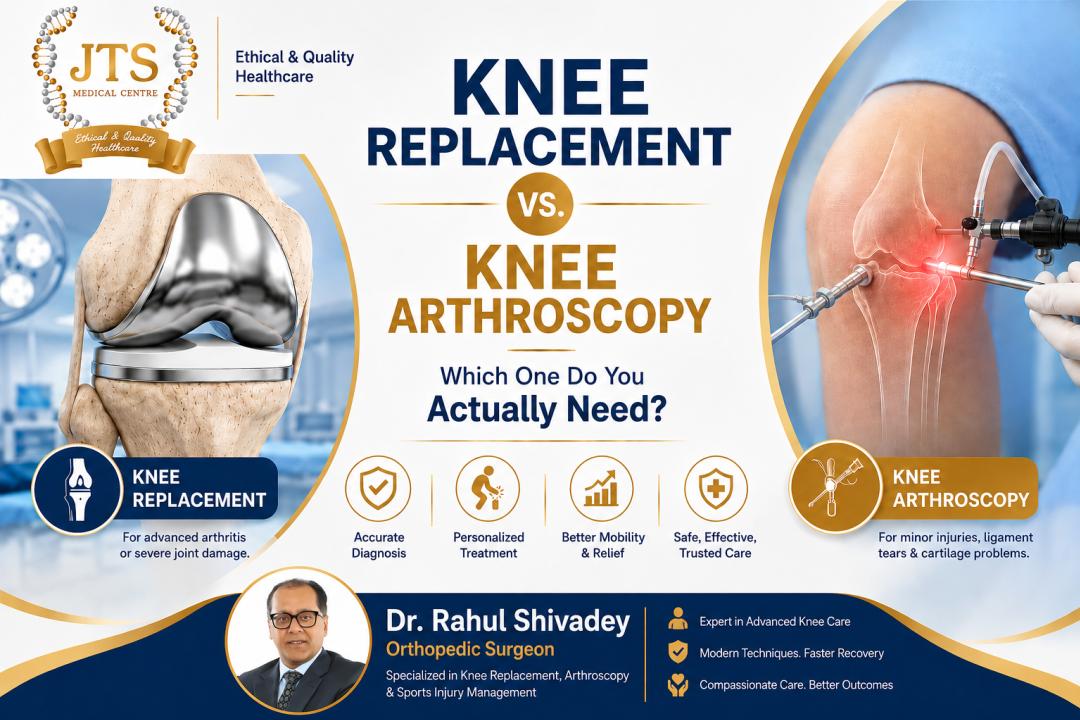
At some point, knee pain stops being background noise. It starts showing up in the small stuff: getting up from the sofa, taking the stairs instead of the lift, walking the dog around the block. Once physiotherapy and painkillers stop making a dent, the question most people end up asking is the same one: is this a "fix it" surgery or a "replace it" surgery?
That's really the difference between knee arthroscopy and knee replacement. Both get lumped together under "knee surgery," but they're built for completely different situations, and mixing them up can mean either going through surgery you didn't need, or putting off the one that would actually help. Here's how to tell them apart.
Knee Arthroscopy, In Plain Terms
Arthroscopy is keyhole surgery. The surgeon makes a couple of tiny cuts we're talking under a centimetre and slides in a thin camera along with some slim instruments. Everything gets projected onto a screen in the operating room, so the surgeon is working with a live, magnified view of the inside of your joint without ever having to open it up.
It's generally the go-to for:
A torn meniscus that needs trimming or repair
ACL tears or other ligament reconstruction
Loose bits of bone or cartilage floating around and catching in the joint
Rough or damaged cartilage that needs smoothing
Figuring out what's actually causing unexplained pain, swelling, or a knee that locks up
Cartilage damage caught early, before it turns into something bigger
It tends to suit younger, more active people, athletes, or really anyone who's picked up a specific injury (a bad twist, a fall, a sports mishap) while the rest of the knee is still in decent shape.
Because the incisions are so small, people bounce back quickly. Most are walking with some support within a few days, and back to their usual routine within a few weeks, though that obviously depends on what was actually repaired.
Read More…https://jtsmedicalcentre.blogspot.com/2026/08/knee-replacement-vs-knee-arthroscopy.html