Market Overview
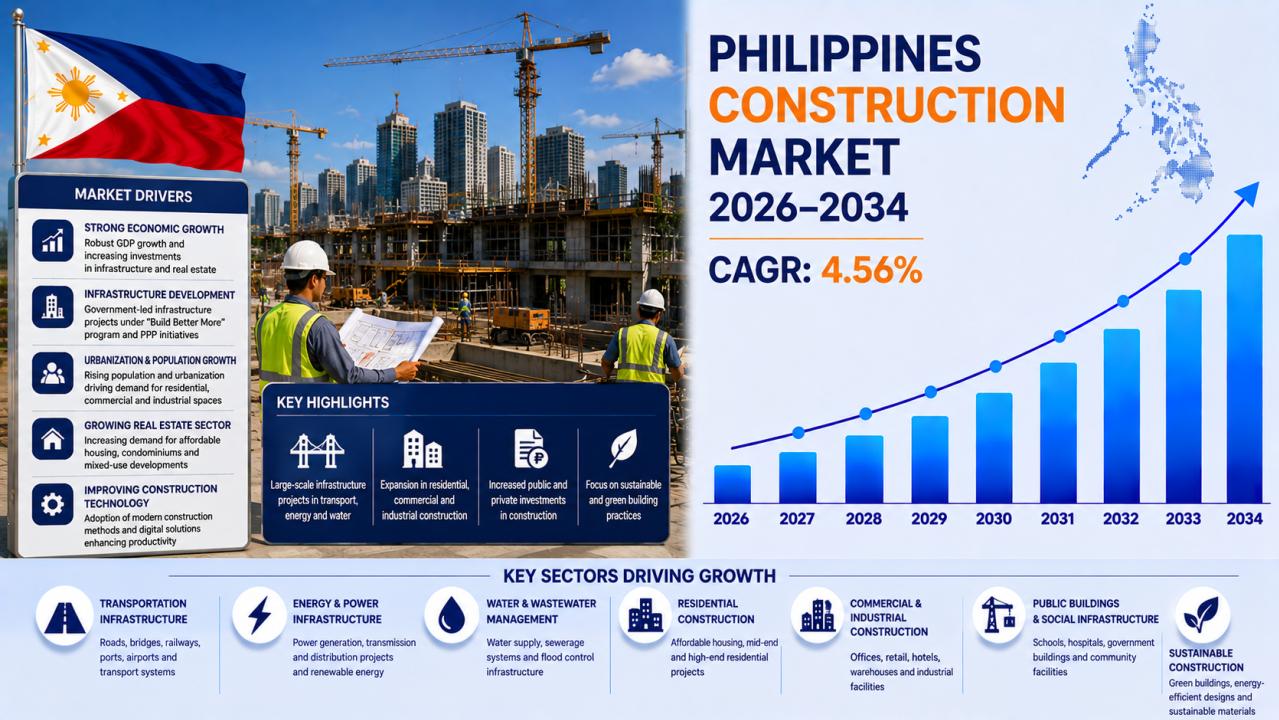
The Philippines construction market size reached USD
41.3 Billion in 2025 and is projected to reach USD 61.7
Billion by 2034, exhibiting a CAGR of 4.56% during
2026-2034. The rising infrastructure investments, rapid urbanization,
government-backed projects, growing foreign direct investments, increasing
demand for residential and commercial spaces, expansion of transport networks,
and technological advancements in construction methods are some of the factors
positively impacting the market share.
Request a Sample Report for In-Depth Market Insights: https://www.imarcgroup.com/philippines-construction-market/requestsample
Philippines Construction Market Summary
- The
Philippines construction market encompasses residential, commercial,
industrial, infrastructure (transportation), and energy and utilities
construction sectors, serving diverse development needs across Luzon,
Visayas, and Mindanao.
- These
projects are valued for their role in providing housing, commercial
spaces, industrial facilities, and essential infrastructure supporting
economic growth and urbanization.
- The
ecosystem includes construction firms, developers, government agencies
(DPWH, PPP Center), material suppliers, and technology providers.
- Major
segments identified in the market include sector (residential, commercial,
industrial, infrastructure, energy and utilities) and region.
- The
market is benefiting from government infrastructure initiatives, emphasis
on sustainable and green building practices, and urban housing boom.
- On
October 17, 2024, President Ferdinand Marcos Jr. led the groundbreaking
ceremony of the MTerra Solar Project, recognized as the world's largest
integrated solar and battery storage facility.
PORTER'S FIVE FORCES ANALYSIS
- Competitive
Rivalry: High, with numerous local and international construction
firms competing on project scale, technology, and cost. Business
implication: Companies must differentiate through technology,
sustainability, and project management.
- Supplier
Power (Materials and Equipment): Moderate. Suppliers of
construction materials and equipment have some leverage, but the presence
of multiple suppliers and large-scale contracts moderates this
power. Business implication: Firms should maintain
diverse supplier relationships.
- Buyer
Power (Government and Developers): Moderate to high. Large
government agencies and developers have significant bargaining power
through tenders and volume purchasing. Business implication: Contractors
must focus on cost-efficiency, quality, and innovation.
- Threat
of Substitutes: Low. While alternative building methods exist,
traditional construction remains essential for large-scale projects. Business
implication: The industry should emphasize efficiency and
sustainability benefits.
- Threat
of New Entrants: Moderate. Higher barriers for large-scale
contractors (scale, expertise, capital), but lower barriers for niche and
specialized entrants. Business implication: Established
players should build defensible positions through scale, technology, and
government relationships.
MARKET GROWTH DRIVERS
Government Infrastructure Initiatives
The Philippines
construction market is driven by large-scale infrastructure programs
aimed at improving connectivity and economic growth. The government-funded
projects focus on transportation, water resources, energy, and digital
infrastructure. Public-private partnerships (PPPs) stimulate foreign
investments in infrastructure development with modernized facilities and
services. The PPP Center announced the roll-out of 173 infrastructure projects
worth about USD 56 Billion. The Society of Construction Law Philippines and the
DTI-CIAP signed a MoU to create standardized contract templates and start
awareness campaigns on construction rules.
Emphasis on Sustainable and Green Building Practices
Increasing environmental awareness and evolving industry
standards are positively influencing the market outlook. Green building
practices reduce energy consumption, waste, and consumption of resources.
Developers are using eco-friendly building materials such as recycled concrete,
bamboo, and low-carbon cement. Smart building systems are being adopted,
including light automation, ventilation control, and water management. On
November 28, 2024, the DTI-CIAP convened the 5th Philippine Construction Congress
to promote sustainable and innovative building practices.
Urban Housing Boom
Rapid urbanization is propelling a huge growth in
residential development, particularly in urban areas. Growing population
density and a growing middle class are fueling the demand for both
budget-friendly housing and high-rise condominiums. Developer-backed affordable
housing programs and government subsidies target low to mid-income households.
This expansion enhances living conditions and greatly increases market demand,
necessitating substantial quantities of materials, skilled labor, and
cutting-edge construction techniques.
PHILIPPINES CONSTRUCTION MARKET SEGMENTATION
Sector Insights:
- Residential
Construction
- Commercial
Construction
- Industrial
Construction
- Infrastructure
(Transportation) Construction
- Energy
and Utilities Construction
Regional Insights:
- Luzon
- Visayas
- Mindanao
COMPETITIVE LANDSCAPE
The Philippines construction market features a competitive
landscape of numerous local and international construction firms competing on
project scale, technology, and cost. Competition is intensifying as companies
invest in technology, sustainability, and project management. Differentiation
occurs through technology, sustainability, and project management.
Key players mentioned in the report context include:
The report provides a comprehensive analysis of the
competitive landscape, including market structure, key player positioning, top
winning strategies, competitive dashboard, and company evaluation quadrant.
Detailed profiles of all major companies are provided in the complete report.
REGIONAL ANALYSIS
- Luzon: The
largest market, driven by the concentration of economic activity,
population density, and infrastructure development in Metro Manila and
surrounding provinces. Luzon hosts the majority of infrastructure
projects, commercial developments, and residential construction,
benefiting from advanced connectivity and access to resources.
- Visayas: A
growing market with expansion driven by increasing urbanization,
tourism-related construction, and infrastructure development in Cebu and
other urban centers. The region benefits from strategic location and
growing economic activity.
- Mindanao: An
emerging market with growth potential, supported by improving
infrastructure, increasing investment in agriculture and mining, and
growing urbanization in Davao and other urban centers. The region
represents significant opportunities for infrastructure and residential
development.
RECENT INDUSTRY DEVELOPMENTS
September 2026: The Philippine government said it is
accelerating infrastructure spending after delays caused by reviews of
government construction contracts. President Marcos said public spending is
expected to catch up in the coming months, with faster project implementation
intended to support employment and economic activity.
September 2026: The Department of Public Works and
Highways had awarded only 32% of its 2026 project allocation, equivalent
to ₱146.41 billion of the ₱459.89 billion program. Of more than
17,000 planned national projects, 15,031 had been advertised or opened for
bidding, highlighting significant implementation delays.
August 2026: The value of construction projects
covered by approved building permits reached ₱74.34 billion in June, up 22%
year-on-year. Non-residential construction value increased 56.4% to
₱43.80 billion, while residential construction value declined 25.8% to
₱20.24 billion.
August 2026: The number of construction projects
approved through building permits fell 0.3% year-on-year to 17,081 in June
2026. Residential projects declined 2% to 11,392, while
non-residential projects increased 5% to 3,352, indicating a shift
toward stronger non-residential construction activity.
August 2026: The Philippine government continued
emphasizing stronger infrastructure project controls while seeking to
accelerate implementation. The DBM said it expects public construction to
rebound from Q3 2026, combining faster procurement with stricter project
scrutiny and accountability following the flood-control controversy.
Key Aspects Required for the Philippines Construction Market
- Market
Performance: USD 41.3 Billion in 2025, with a projected
trajectory to USD 61.7 Billion by 2034.
- Market
Outlook: A 4.56% CAGR through 2034 indicates robust growth across
sectors and regions, driven by government infrastructure, urbanization,
and sustainable building practices.
- Growth
Drivers: Government infrastructure initiatives; emphasis on
sustainable and green building practices; urban housing boom; industrial
and economic zone expansion; foreign direct investments; and
public-private partnerships.
- Competitive
Landscape: A competitive market with local and international
construction firms. Differentiation occurs through technology,
sustainability, and project management.
- Value
Chain Analysis: From design and engineering through material
supply and construction to project delivery and maintenance, with
government policy and economic trends shaping market dynamics.
- Industry
Trends: Government infrastructure initiatives; emphasis on
sustainable and green building practices; urban housing boom; tourism
infrastructure growth; rural development projects; and technological
integration.
- Strategic
Recommendations: Invest in sustainable and green building
practices; adopt advanced technologies (BIM, prefabrication); pursue
public-private partnerships; expand into emerging regions and rural
development; and focus on affordable housing and infrastructure projects.
Note: If you need any specific information that is not currently covered within the scope of the report, we will provide the same as a part of customization.
Speak to an analyst: https://www.imarcgroup.com/request?type=report&id=28749&flag=C
Report Format, Delivery, and Customization Details
- Report
Format Mode: PDF and Excel (Editable version in PPT/Word format
available on special request)
- Report
Delivery Mode: Online Delivery, Physical Delivery
- Report
Delivery Time: Report delivered over email within 24 to 48 hours.
If requested by the client, a physical copy will be delivered within three
to ten days.
- Report
Confirmation Mode: Yes, via email
- Report
Customization Mode: Yes, via Email / Call
- Report
Table of Content: Yes
- Report
List of Figures: Yes
- Report
Methodology Mode: Yes
- Request
For Sample Report: Yes
About Us
IMARC Group is a global management consulting firm that
helps the world's most ambitious changemakers to create a lasting impact. The
company provides a comprehensive suite of market entry and expansion services.
IMARC offerings include thorough market assessment, feasibility studies,
company incorporation assistance, factory setup support, regulatory approvals
and licensing navigation, branding, marketing and sales strategies, competitive
landscape and benchmarking analyses, pricing and cost research, and procurement
research.
Contact Us
IMARC Group
134 N 4th St, Brooklyn, NY 11249, USA
Email: sales@imarcgroup.com
Tel No: (D) +91 120 433 0800
United States: +1-201-971-6302