Introduction
AI agents are evolving beyond simple conversational interfaces. Businesses increasingly need agents that can retrieve enterprise data, interact with external applications, execute workflows, and coordinate tasks across multiple systems. However, connecting an agent to these resources often involves custom integrations, inconsistent interfaces, and complex permission management. MCP server development services can help businesses establish standardized connections between AI agents, external tools, enterprise data, and business workflows.
The Model Context Protocol (MCP) provides a standardized way for AI applications to connect with external tools and context sources. By implementing MCP servers, organizations can expose business capabilities through structured interfaces that AI agents can discover and use when needed.
A successful MCP server implementation requires more than exposing a collection of API endpoints. Developers need to plan the architecture, design reliable tools, integrate existing systems, establish authentication and authorization, and test agent workflows under real-world conditions. This guide explains how to approach these decisions and build MCP servers that support practical, secure AI agent applications.
1. Why AI Agents Need External Tools and Context
An AI agent can reason about a task, but completing that task often requires access to information and systems beyond its model. For example, a sales agent may need to retrieve CRM records, check inventory, update customer information, or generate a report from a business database.
Without a standardized integration layer, developers may need to build and maintain separate connections for different models and applications. MCP addresses this challenge by defining a common protocol for exchanging context and invoking tools.
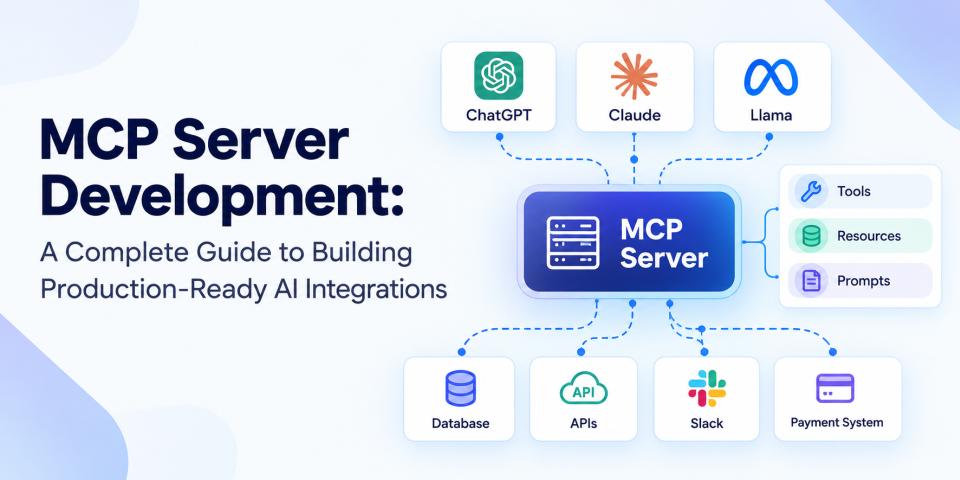
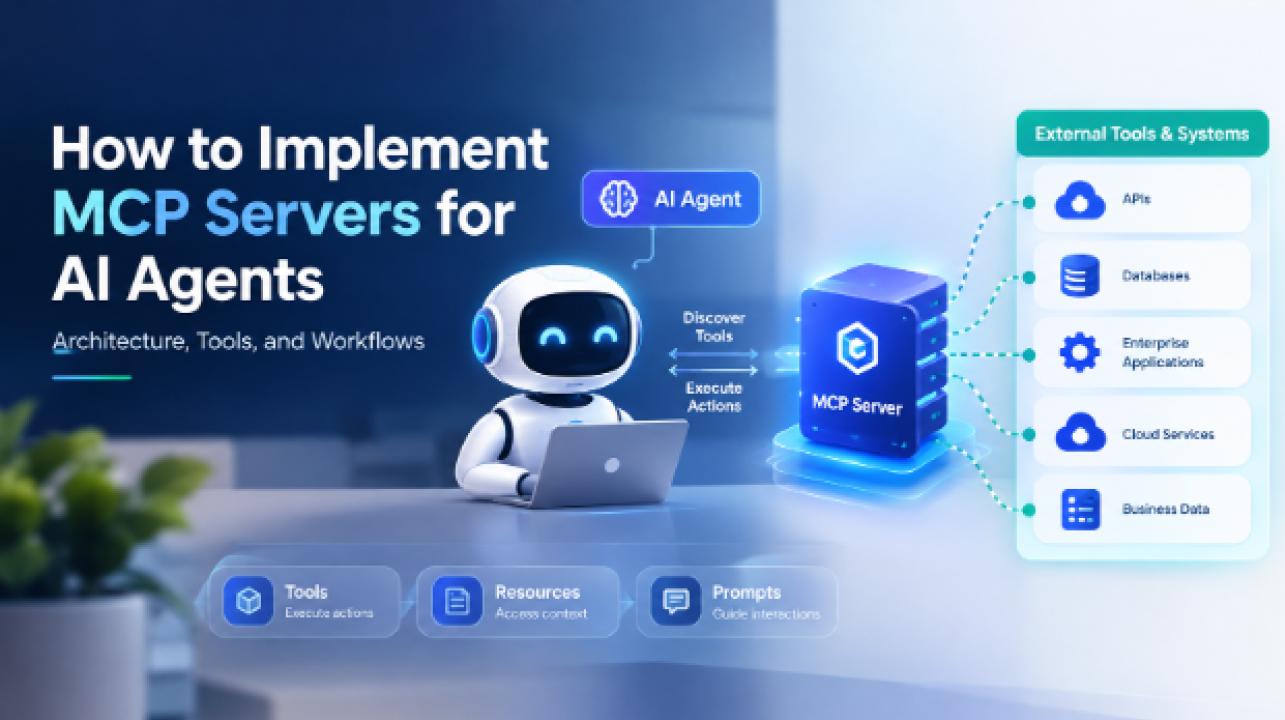
MCP servers can expose three primary capabilities:
- Tools: Executable functions that let agents perform actions, such as searching records or creating an order.
- Resources: Contextual information, such as documents, database records, or structured content.
- Prompts: Reusable templates that guide specific interactions and workflows.
This separation allows an AI application to connect with multiple systems without embedding every integration directly into the agent's logic.
2. Understanding MCP Client and Server Architecture
MCP uses a host-client-server architecture. The host is the AI application that manages the model and its interactions. It creates MCP clients, with each client connecting to a particular MCP server. Servers expose capabilities and communicate with external systems.
How the architecture works
- MCP host: The AI application coordinates agent interactions and manages connections to MCP servers.
- MCP client: The client handles protocol communication with a particular server and makes its capabilities available to the host.
- MCP server: The server exposes tools, resources, and prompts that the AI application can access.
- External systems: APIs, databases, and enterprise applications provide the underlying business data and operations.
MCP uses JSON-RPC for communication and supports transports such as stdio for local integrations and Streamable HTTP for remote deployments. The right transport depends on deployment requirements, network access, and the security boundaries of the application.
3. How AI Agents Discover MCP Tools
Tool discovery allows an agent application to identify the functions available through a connected MCP server instead of requiring every capability to be hardcoded into its workflow.
During connection setup, the client and server establish protocol compatibility and negotiate supported capabilities. The client can then request the server's available tools, including their names, descriptions, and input schemas.
For example, an inventory MCP server might expose:
- search_inventory: Find available products using specified filters.
- check_stock: Retrieve current stock levels for a product.
- create_reservation: Reserve an item subject to authorization and business rules.
Clear descriptions and precise input schemas help the model understand when and how to use each function. Tool availability should also respect access permissions, so callers only receive capabilities they are authorized to use.
4. Designing MCP Tools for Agent Workflows
Effective MCP tools should represent well-defined business actions rather than simply exposing every underlying API endpoint. Each tool should have a clear purpose, a predictable input structure, and an understandable result.
For example, instead of providing one broad tool that performs every customer operation, a CRM server might separate customer lookup, order history retrieval, and contact updates into distinct tools.
Good tool design should include:
- Descriptive names and concise explanations.
- Validated input parameters and structured outputs.
- Consistent error responses and clear failure conditions.
- Appropriate timeouts and limits for expensive operations.
- Explicit handling of sensitive or irreversible actions.
Keep tools focused and avoid exposing unnecessary implementation details. A well-designed interface helps an agent select the right operation while reducing ambiguity and unintended actions.
5. Connecting MCP Servers to APIs and Databases
Many businesses already have established APIs, databases, and enterprise platforms. An MCP server can act as an integration layer between these systems and an AI agent, translating tool requests into controlled operations against existing infrastructure.
A typical integration process includes:
- Identify the systems and business data the agent needs to access.
- Map each required operation to a specific MCP tool or resource.
- Implement server-side logic to call the relevant API or query the appropriate database.
- Validate inputs, enforce access controls, and handle failures.
- Return structured results that the agent can interpret and use.
For example, a customer support agent could retrieve an order's delivery status from an order management system, read the relevant customer record, and prepare a response. The MCP server handles the controlled system interaction, while the host application manages the agent's reasoning and workflow.
Organizations planning these integrations can explore AI agent development services to understand how tool connectivity, orchestration, and enterprise systems fit into broader agent development projects.
6. Separating Read and Write Operations
One of the most important decisions in MCP server development is determining which operations can retrieve information and which can modify business data.
Read operations, such as retrieving a customer record or checking stock, are generally less consequential than write operations, such as issuing a refund, deleting a record, or submitting a payment.
A practical implementation should separate these capabilities and apply different permissions and safeguards to each.
Read operations
Read operations should use narrowly scoped access, return only necessary information, and avoid exposing sensitive data without a business need. For example, an inventory agent may be permitted to check stock availability without accessing supplier payment records.
Write operations
Write operations should validate the requested change, enforce authorization, and consider confirmation steps for sensitive or irreversible actions. Where appropriate, use transaction controls, idempotency keys, and audit logs to help prevent duplicate or unauthorized changes.
MCP tools can be model-controlled, but applications can require human approval before an agent executes a sensitive action.
7. Implementing MCP in Multi-Agent Systems
In a multi-agent system, different agents may specialize in tasks such as research, customer support, financial analysis, and workflow automation. MCP can provide these agents with access to shared tools and business context through specialized servers.
For instance, a business workflow might use a research agent to gather information, an analysis agent to interpret it, and an operations agent to update an internal system after authorization.
A practical architecture can assign each agent access to only the MCP servers and tools required for its responsibilities. The host or orchestration layer coordinates the agents, manages task handoffs, and controls which operations can be performed.
Importantly, MCP provides a way to expose and invoke capabilities; it does not automatically implement multi-agent orchestration. Developers must design the coordination logic, shared state, failure handling, and delegation rules separately.
8. Authentication, Permissions, and Agent Identity
Security should be considered from the beginning of an MCP implementation, especially when agents access enterprise information or execute business operations.
For remote HTTP-based deployments, MCP defines an authorization framework based on OAuth-related standards. Implementations should follow the relevant specification requirements, validate access tokens, and enforce permissions at the server boundary. Local stdio deployments generally use a different credential-management approach.
A production implementation should account for:
- Authentication: Verify the identity of the caller before allowing access to protected capabilities.
- Authorization: Restrict tools and resources according to the user's or workload's granted permissions.
- Credential management: Store secrets securely and avoid embedding long-lived credentials in agent prompts or source code.
- Auditability: Record important tool invocations and security-relevant events.
- Data protection: Limit exposure of sensitive information and apply appropriate retention and encryption controls.
Agent identity is also becoming a significant area of protocol development. The MCP maintainers' August 2026 roadmap identifies agent identity and enterprise-ready security as priority areas. Implementation teams should verify the current status of relevant standards and SDK support rather than assume every proposed capability is already available.
For businesses defining how agentic technology fits into their wider digital plans, AI strategy consulting can help frame integration priorities, implementation requirements, and governance considerations.
9. Error Handling, Guardrails, and Testing
An MCP server must behave predictably when an API is unavailable, a database query fails, a request exceeds its limits, or an agent submits invalid parameters.
Build error handling into the server so that failures return clear, structured messages without leaking credentials, internal system details, or sensitive records. Use timeouts, rate limits, retry policies where appropriate, and circuit breakers for dependencies that may become unavailable.
Guardrails should include input validation, permission checks, output sanitization, and safeguards against unexpected tool use. Treat retrieved content as untrusted input: data from external systems can contain misleading instructions that should not override the application's policies.
Testing should cover individual tools and complete agent workflows. Include schema validation, permission testing, integration tests, failure scenarios, and checks for unintended side effects. Also verify that the agent receives understandable results and handles unsuccessful operations safely.
The official MCP tools specification calls for input validation, access controls, rate limiting, and output sanitization. It also recommends that clients use appropriate confirmation and oversight for sensitive operations.
10. Example: An AI Agent Connected to an MCP Server
Consider an AI-powered procurement assistant that helps employees check product availability and prepare purchase requests.
A typical workflow could look like this:
- An employee asks the agent to find a product and check its availability.
- The agent identifies the relevant inventory tools through MCP tool discovery.
- The host application authorizes the request, and the agent calls the inventory server.
- The server retrieves the relevant information from the inventory API and returns structured results.
- The agent presents the available options and prepares a purchase request if the employee chooses to proceed.
- The application requests any required approval before the procurement server executes the purchase operation.
This architecture separates the agent's reasoning from business-system access while keeping sensitive actions subject to explicit authorization and approval.
11. MCP Server Implementation Checklist
Before deploying an MCP server for AI agents, review these core implementation requirements:
- Define the agent's business use cases and integration requirements.
- Choose the appropriate MCP transport and deployment architecture.
- Design focused tools, resources, and prompts.
- Implement tool discovery and validate input and output schemas.
- Connect the server to approved APIs, databases, and enterprise systems.
- Separate read and write permissions.
- Configure authentication, authorization, and secure credential management.
- Establish human approval requirements for sensitive operations.
- Implement error handling, logging, monitoring, and rate limiting.
- Test tool behavior, security controls, and complete agent workflows.
- Document deployment, maintenance, and incident-response procedures.
Conclusion
Implementing MCP servers for AI agents requires a thoughtful approach to architecture, tool design, system integration, security, and workflow testing. By exposing well-defined capabilities through a standardized interface, businesses can make existing systems more accessible to AI applications without tightly coupling every integration to an individual agent.
The key is to treat MCP as part of a broader agent infrastructure strategy. Start with clearly defined use cases, build focused and permission-aware tools, and validate the complete workflow before expanding access to additional systems or agents.
Mobisoft Infotech offers MCP server development services to help businesses plan and implement MCP-based integrations, connect AI agents with enterprise systems, and develop secure, scalable workflows. Explore the service to see how a tailored MCP implementation can support your AI initiatives.