A great-looking online store doesn't guarantee a successful one. Plenty of beautifully designed stores struggle with slow checkouts, disconnected inventory, or poor mobile experiences, all because the implementation strategy behind them missed a few critical pieces.
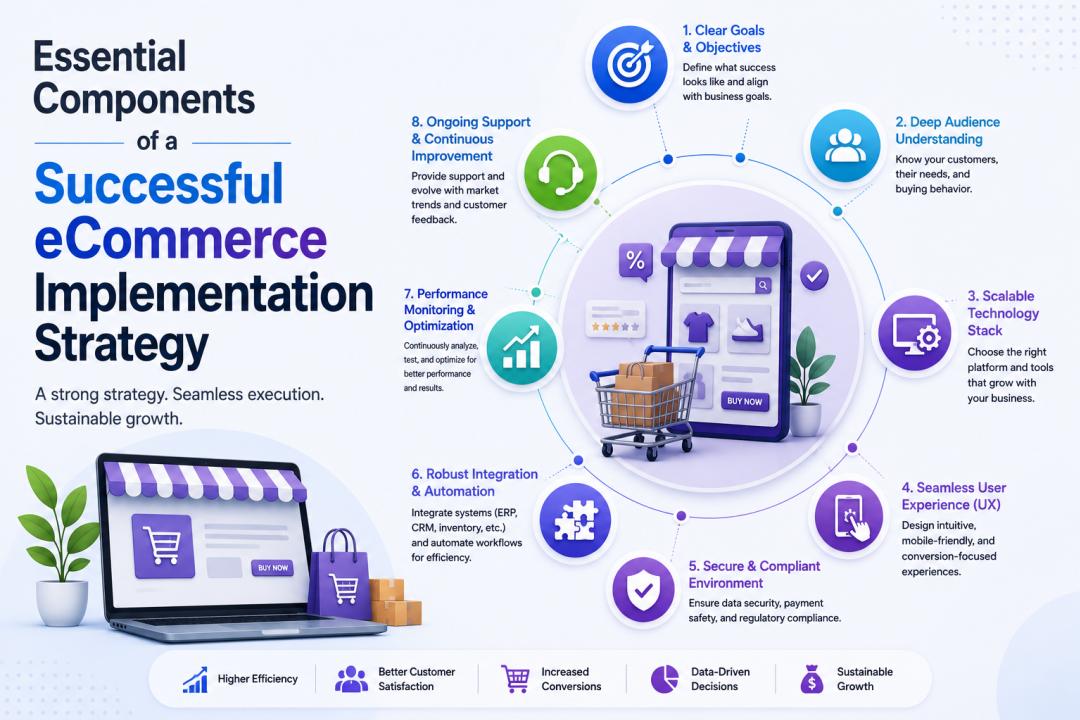
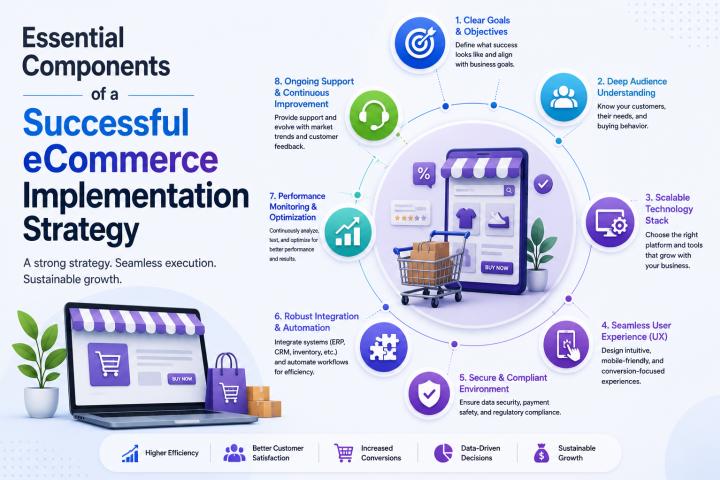
A truly successful eCommerce implementation strategy isn't just about picking a platform and building a website. It's a combination of business planning, technology choices, user experience, security, and ongoing optimization, all working together. Miss one component, and the rest of the project can suffer, even if everything else was done right.
In this guide, we'll walk through the essential components every implementation strategy needs, and why each one matters more than businesses often expect.
1. Clear Business Goals and Requirements
Every strong implementation strategy starts with clarity, not code. Before any platform decisions or design work begins, you need clear answers to:
What are we trying to achieve: more sales, better margins, international expansion, B2B capability?
Who is our target customer, and how do they shop?
What systems (inventory, accounting, CRM) need to connect to the store?
What's our realistic budget and timeline?
What does success look like 6 and 12 months after launch?
Skipping this step is one of the most common reasons projects go off track. Without documented goals, it's easy for scope to creep, priorities to shift mid-project, and budgets to balloon. A strategy built on clear requirements gives every other decision platform, design, features a reference point to be measured against.
2. The Right Platform Fit
Not every business belongs on the same platform, and choosing based on popularity alone is a common mistake. The right platform depends on:
Catalog size and complexity (a 50-product store has very different needs than a 50,000-SKU catalog)
B2B vs. B2C requirements
Expected traffic and growth trajectory
Internal technical resources available to manage the platform
Budget for licensing, hosting, and development
Options range from hosted platforms like Shopify and BigCommerce, to open-source solutions like WooCommerce, to enterprise-grade systems like Adobe Commerce (Magento) or headless, API-first architectures. A successful strategy treats platform selection as a business decision, not just a technical one, because the wrong fit often means a costly replatform within a few years.
3. User Experience (UX) and Design Strategy
Design isn't just about looking good; it directly affects whether visitors convert into customers. A solid UX strategy considers:
Intuitive navigation and category structure
Fast, clear product pages with strong imagery and information
A streamlined, low-friction checkout process
Consistent design across devices
Checkout friction in particular has an outsized impact on revenue. Optimized mobile checkouts and fewer form fields are directly linked to higher conversion rates, with brands using digital wallets and streamlined forms pushing mobile conversion rates above 3%, compared to the broader industry average that typically sits closer to 1.4–4.2% depending on category. A strategy that treats UX as an afterthought something to "fix later" almost always costs more in lost sales than it would have cost to design correctly from the start.
4. Mobile-First Optimization
Mobile shopping isn't a secondary channel anymore for most stores; it's the primary one. A successful implementation strategy treats mobile as the default experience, not an adaptation of the desktop site. This means:
Designing for smaller screens first, then scaling up
Optimizing page load speed specifically for mobile networks
Supporting mobile-friendly payment options like Apple Pay, Google Pay, and Shop Pay
Testing checkout flows specifically on mobile devices
Stores that delay mobile optimization until after launch often see it reflected directly in their conversion data, since mobile traffic frequently makes up the majority of visits but historically converts at lower rates when the experience isn't built with mobile shoppers in mind from day one.
5. Data Migration and Integrity Planning
If your implementation involves moving from an existing platform, data migration deserves its own dedicated strategy, not just a checklist item. This includes:
Auditing existing data quality before migration (duplicate records, outdated SKUs, incomplete customer data)
Mapping data fields between old and new systems
Planning for SEO continuity, preserving URLs, redirects, and metadata
Running test migrations before the final cutover
Validating data accuracy after each migration phase
This component is consistently underestimated. Migration and replatforming projects are widely recognized as carrying real budget and timeline risk, which is exactly why a deliberate, phased migration plan rather than a rushed one-time transfer is one of the most important parts of any implementation strategy.
6. Seamless Third-Party Integrations
A modern eCommerce store rarely operates alone. A complete implementation strategy maps out every system that needs to connect to the storefront, including:
ERP systems for inventory and order synchronization
CRM platforms for customer relationship management
Accounting software for financial reconciliation
Email and SMS marketing platforms
Shipping, fulfillment, and logistics tools
Analytics and customer data platforms
Without planning these integrations early, businesses often end up duct-taping systems together after launch, leading to manual data entry, sync errors, and inconsistent inventory counts. A strong strategy identifies these integration points during planning, not as an afterthought once the store is already live.
7. Security and Compliance
Customer trust is built or broken around how securely a store handles payments and personal data. Security needs to be baked into the implementation strategy from day one, covering:
PCI DSS compliance for payment processing
SSL certificates and secure checkout flows
Data privacy compliance (GDPR, CCPA, or other regional regulations relevant to your customers)
Regular security testing and vulnerability scanning
Secure handling of customer accounts and stored payment information
Security isn't a one-time setup task; it requires ongoing monitoring as platforms update and new threats emerge. Businesses that treat compliance as a checkbox rather than an ongoing responsibility put both customer trust and their own liability at risk.
8. Personalization Capabilities
Personalization has moved from a competitive advantage to a baseline expectation. Shoppers respond strongly to relevant, tailored experiences: research shows the large majority of consumers prefer brands that personalize their experience, and personalized product recommendations alone can account for a significant share of total ecommerce revenue for stores that implement them well, according to data compiled by Ringly's ecommerce personalization research.
A strategy that incorporates personalization should plan for:
Product recommendation engines based on browsing and purchase behavior
Personalized email and marketing flows
Dynamic on-site content based on customer segments
Behavior-triggered offers, like cart abandonment recovery
Even basic personalization like "customers also bought" recommendations or abandoned cart emails can meaningfully lift conversion rates and average order value when implemented correctly from launch.
9. SEO and Content Strategy
An online store with great products but poor discoverability won't generate the traffic it deserves. SEO needs to be part of the implementation strategy itself, not a separate marketing task added after launch. Key elements include:
Clean, descriptive URL structures
Optimized product titles, descriptions, and metadata
Proper redirect mapping (especially critical during migrations, to preserve existing search rankings)
Fast page load speeds, since site speed directly affects both rankings and user experience
Structured data markup to help search engines and AI-driven answer engines understand your content
Because more discovery now happens through AI-powered search and answer engines, in addition to traditional search results, building clean, well-structured content and metadata from the start also helps your store surface accurately in those newer discovery channels.
10. Performance, Speed, and Scalability
A store that looks great but loads slowly will lose customers before they ever see a product page. Performance considerations need to be part of the strategy from day one:
Choosing hosting and infrastructure that can handle traffic spikes (sales events, holidays, viral moments)
Image and asset optimization
Caching strategies
Load testing before major sales periods
Planning for scalability as catalog size and traffic grow over time
A platform or architecture that works fine at launch but can't scale with the business often becomes the very reason a company needs to replatform within a few years, which is far more expensive than planning for scale upfront.
11. Staff Training and Internal Enablement
Even the most well-built store creates ongoing friction if the internal team doesn't know how to operate it. A complete strategy includes training your team on:
Day-to-day product, inventory, and order management
Running promotions and discount campaigns
Using built-in analytics and reporting tools
Basic troubleshooting before escalating to developers
This component is often overlooked because it doesn't feel as urgent as design or development. But businesses that skip it tend to stay dependent on external developers for simple tasks long after launch, increasing costs and slowing down day-to-day operations.
12. Post-Launch Monitoring and Continuous Optimization
A successful implementation strategy doesn't end at launch; it includes a plan for what happens afterward. This means:
Monitoring site performance, uptime, and error rates
Reviewing analytics to identify drop-off points in the customer journey
A/B testing key pages and checkout flows
Iterating on personalization and marketing based on real customer behavior
Planning for future feature rollouts as the business grows
Stores that treat launch as the finish line tend to plateau quickly. The businesses that grow fastest treat their eCommerce platform as a living system that's continuously refined based on real performance data.
Bringing It All Together
Each of these components goals, platform fit, UX, mobile optimization, data migration, integrations, security, personalization, SEO, performance, training, and post-launch optimization plays a distinct role. But they only deliver real results when they're planned together, as part of one coordinated strategy, rather than handled separately by disconnected vendors or teams.
This is exactly the value a dedicated eCommerce implementation services provider brings to the table: making sure none of these components are treated as an afterthought, and that they all work together toward the same business goals from day one.
Final Thoughts
A successful eCommerce implementation strategy isn't built around a single big decision; it's built around dozens of smaller, well-coordinated ones. Choosing the right platform matters, but so does planning your data migration carefully, securing customer data properly, optimizing for mobile shoppers, and training your team to actually run the store once it's live.
Businesses that approach implementation with this full picture in mind consistently launch smoother, scale faster, and avoid the costly fixes that come from treating eCommerce as just "building a website." Whether you handle this in-house or bring in an experienced eCommerce implementation company, making sure every one of these components has a clear owner and a clear plan is what separates a store that simply exists online from one that actually grows your business.
Frequently Asked Questions
Q: What's the most commonly overlooked component in eCommerce implementation strategies?
Staff training and post-launch optimization are frequently overlooked. Businesses tend to focus heavily on design and development, but neglecting team enablement and ongoing performance monitoring often causes problems months after launch.
Q: How important is mobile optimization compared to desktop design?
Very important. Mobile traffic makes up a large share of ecommerce visits for most businesses, and a poor mobile experience directly limits conversions, regardless of how well the desktop site performs.
Q: Should security and compliance be handled before or after launch?
Security should be built into the implementation from the very beginning, not added afterward. Retrofitting security and compliance measures into a live store is more complex, riskier, and often more expensive than planning for them upfront.
Q: Does personalization require advanced AI tools to be effective?
Not necessarily. Basic personalization — like product recommendations and abandoned cart emails — can deliver meaningful results. AI-driven personalization adds further lift, but it isn't a requirement to start seeing benefits.
Q: How do I know if my implementation strategy is missing something important?
A useful test is checking whether each of the twelve components above has a clear plan and owner. If goals, security, training, or post-launch optimization don't have a defined approach, your strategy likely has gaps worth addressing before launch.