Mid-market SaaS companies are between a rock and a hard place. They are not big enough to be carefree nor small enough to be delayed for months and then shipped. Development cycle time is not only technical – it's a competitive advantage. In 2026, as AI-assisted engineering continues to mature, the companies that are making it work are the ones who aren't just thinking of it as a productivity boon, but as a fundamental shift in the way software is built.
What "Development Cycle Time" Actually Means for SaaS Teams
It is helpful to define it first before discussing steps on how to reduce it.
Development cycle time is the time it takes for a feature to make it from the active development stage into production. That means coding, coding review, QA, staging and deployment.
For mid-market SaaS platforms, the typical bottlenecks are:
- Boilerplate work while creating full stack builds
- Long feedback cycles between product, engineering and QA
- Poorly written code that increases review time
- When connecting to third party APIs/services, integration overhead.
With intentional application, AI-assisted engineering can be used to solve each of these.
How AI Development Services Are Shortening Build Cycles in 2026
AI-Assisted Code Generation and Review
The first benefit is the ability to leverage AI coding tools for more than just code autofill; it's structured code generation. When engineering teams collaborate with a strong AI development company, they create their own tooling to produce uniform module patterns, compose unit tests together with feature code, and identify potential problems prior to the PR even opening.
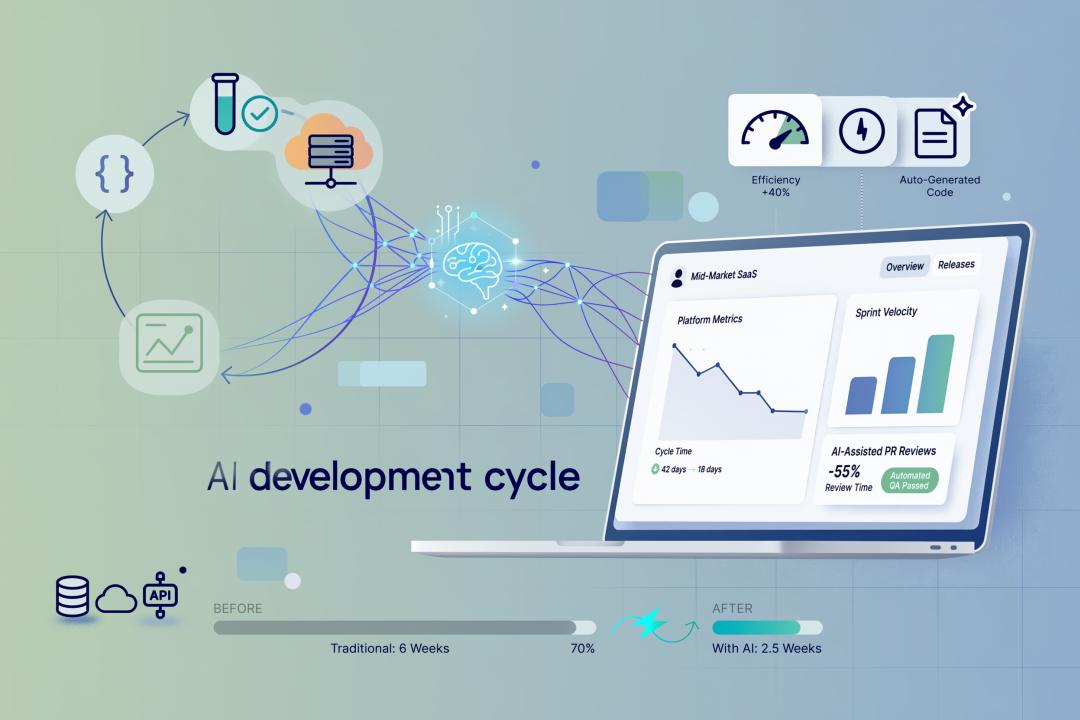
Industry benchmarks from GitHub and McKinsey Digital estimate that teams adopting this method are saving 30 to 40 percent on their initial development time, on average, in 2026. This is because the review cycle is shorter with more predictable code, the gains compound.
Automated QA and Testing Pipelines
One of the most recalcitrant factors for long release cycles is manual QA. Today, AI-powered testing tools can provide regression tests based on user behaviour data, edge case simulation of complex SaaS workflows that haven't yet been tested, and more.
For SaaS teams that release several features every sprint, automated QA pipelines have been proven to have a measurable impact as part of custom AI development services. Contextual test generation, which knows the business logic of the product, is the issue, not just automation.
AI-Driven Code Documentation and Onboarding
The problem for mid-market businesses is often not so much the coding as the knowledge transfer. Onboarding slows when a senior engineer moves on or when a new team member joins. This drag is significantly mitigated by AI tools that keep codebases living and explainable:
AI integration services can make a difference here for a long time. It's not just one project to integrate, it is a on-going process that goes forward in every sprint.
Full-Stack AI Development: Where the Real Gains Are
The greatest unlock for mid-market SaaS is to do full-stack AI development, which means that the AI is integrated throughout the entire SaaS development process, not just as a standalone add-on to each tool.
This means:
- Frontend: AI-created scaffolding, accessibility testing and regression testing for visuals
- Backend: Smart API design recommendations, schema creation and anomaly detection in logs
- DevOps: Predictive deployment risk scoring, automated rollback triggers, and capacity planning based on usage patterns.
These systems work together to enable teams to go from ideation to production in less time, with fewer manual handoffs.
What to Look for When Choosing an AI Development Partner
Not every provider offering AI consulting services is positioned to help a mid-market SaaS business reduce cycle time. Here is what actually matters:
1. Depth of SaaS-specific experience Generic AI development doesn't necessarily fit well into the subscription model, which involves complex user entitlement and billing logic and a multi-tenant architecture. Find someone with experience in building in this environment.
2. Ability to audit your existing pipeline first Good AI consulting begins NOT with selling a solution you already have in mind. A good AI development company will take the time to map out your existing processes and make suggestions for the tools or changes that might be necessary.
3. Integration without full rewrites For mid-market businesses, the goal is usually faster delivery on existing infrastructure, not a ground-up rebuild. Providers experienced in AI integration services know how to layer AI capabilities onto stable stacks without introducing new risk.
4. Measurable success criteria Cycle time reduction is a quantifiable goal. Any substantial AI development engagement has to know what a successful outcome in terms of numbers, average PR review times, deployment frequencies and defect escape rates means and hold itself accountable.
2026 Trends Shaping AI-Assisted Engineering for SaaS
AI Powered Engineering is more accessible and impactful for mid-market companies this year thanks to a few developments:
Agentic development workflows are transitioning from experimental to production. Multi-step tasks such as writing a feature, testing, documenting and creating a PR without any humans in the loop are now possible with AI agents.
Context-aware AI models that have been trained on domain specific code bases are surpassing generalist tools. This is evident in the experience of companies that invest in the development of custom AI services, as finely tuned models generate much less hallucination when dealing with intricate business logic.
AI pair programming at scale is becoming a team-level practice rather than an individual one. Engineering managers are building AI-assisted review processes that standardize feedback patterns and catch issues before they reach human reviewers.
Prediction-based sprint planning will leverage historical velocity data and AI analysis to identify scope that is at risk of falling behind prior to the start of the sprint. This alone cuts down on the end-of-sprint scramble, which squeezes out QA time.
Practical Steps to Start Reducing Cycle Time Today
If you're the leader of a SaaS engineering team and need to get moving, this is a simple first step:
Measure first. That which is not defined cannot be reduced. Extract the past 6 months of data for the average time to get code into production. Divide it up into steps.
Pick one bottleneck. AI everywhere at once results in noise. Determine the one stage that is the most draggy and pilot that stage.
Evaluate your infrastructure readiness. For optimal performance, your codebase should be modular, you should require reasonable test coverage, and your CI/CD pipeline should be stable. If fundamentals are weak, work on fundamentals in parallel.
Engage expertise early. Mid-market teams typically make the attempt to do this themselves and waste many months. Working with a team that has experience with AI development services can greatly shorten the learning curve.
Final Thought
Shortening the development cycle time does not mean working faster. It's about eliminating unhelpful friction. Having the right AI engineering tools applied throughout the stack enables mid-market SaaS teams to ship consistently, not urgently. As AI tooling further evolves over the coming decade, the companies currently building that muscle will reap the structural benefits.