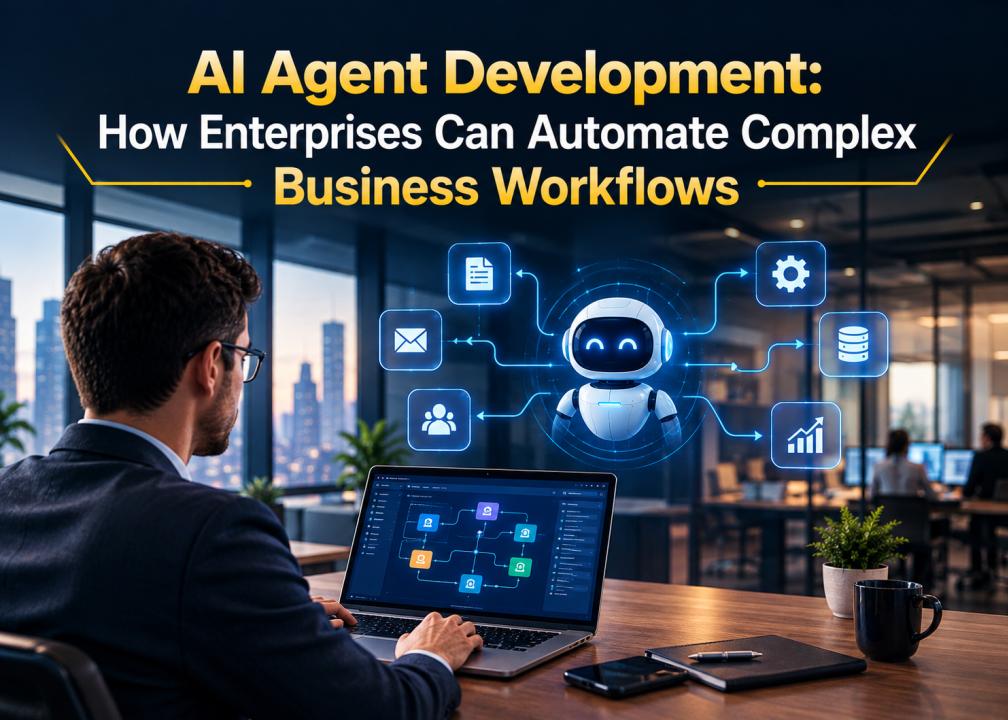
Enterprise automation is moving beyond fixed rules and repetitive task execution. Traditional workflow systems are effective when processes follow predictable paths, but modern business operations rarely remain that simple. Customer requests can arrive in different formats, supply chains can change unexpectedly, financial documents can contain inconsistencies, and employees often need information from several systems before making a decision.
AI agents introduce a different approach to automation. Instead of executing only predefined instructions, an AI agent can interpret an objective, reason over available context, retrieve relevant information, select appropriate tools, execute actions, and respond to changing conditions within defined boundaries.
This capability is particularly relevant for enterprises managing complex workflows across CRM, ERP, HR, finance, support, compliance, and operational systems. However, successful implementation requires more than connecting a large language model to business software. Enterprises need a clear workflow strategy, reliable data access, security controls, evaluation mechanisms, and human oversight.
Why Enterprises Are Moving Beyond Rule-Based Automation
Conventional automation typically depends on deterministic logic. A workflow might receive an input, check a condition, execute an action, and move the process to the next stage. Robotic process automation can further reduce manual work by interacting with existing applications.
These approaches remain valuable for structured processes. Their limitation appears when the workflow contains ambiguity or requires interpretation.
Consider an accounts-payable process. A basic automation system can extract invoice fields and compare them against predefined rules. An AI agent can go further by examining the invoice, purchase order, supplier information, payment history, contractual terms, and relevant correspondence. If the values conflict, the agent can identify the discrepancy, retrieve supporting information, and route the case to the appropriate employee.
The difference is not simply intelligence. It is the ability to combine reasoning with controlled execution.
An enterprise AI agent can operate across multiple stages of a workflow while maintaining context. It can determine what information is required, identify the appropriate system, invoke an approved tool, interpret the result, and decide whether another step is necessary.
This makes agentic automation suitable for workflows where the path is not completely known in advance.
Where AI Agents Can Deliver Practical Enterprise Value
AI agents are particularly useful where employees spend significant time interpreting information, switching between applications, coordinating activities, or handling exceptions. Organizations can use AI Agent Development Solutions to build workflow-specific agents that interact with enterprise systems rather than deploying generic conversational interfaces.
Potential applications span multiple business functions:
- Customer service: An agent can classify incoming requests, retrieve customer history, identify applicable policies, prepare a response, update the service ticket, and escalate cases that require human judgment.
- Finance operations: Agents can support invoice verification, reconciliation, collections research, expense analysis, and financial document processing by correlating information across business systems.
- Procurement: An agent can evaluate purchase requests, check supplier information, review contract conditions, compare available options, and initiate approval workflows.
- Supply chain: Agents can monitor inventory, shipment updates, purchase orders, and supplier communications to identify exceptions and coordinate appropriate responses.
- Human resources: Employee-service agents can assist with onboarding, policy queries, document collection, interview coordination, and routine HR workflows while restricting access to sensitive records.
- IT operations: Agents can enrich incident tickets, retrieve relevant knowledge-base information, investigate recurring problems, recommend remediation steps, and escalate incidents according to severity.
- Sales operations: An agent can summarize account activity, identify follow-up requirements, prepare CRM updates, and coordinate routine sales-support tasks.
The strongest opportunities are not necessarily the processes with the largest number of manual steps. They are workflows where contextual interpretation and system coordination create significant operational friction.
The Architecture Behind Enterprise AI Agents
A production-grade AI agent requires several components working together. The language model provides reasoning capabilities, but it should not independently determine everything the system is allowed to do.
A typical architecture can include an orchestration layer, retrieval infrastructure, enterprise data sources, tool integrations, identity controls, business rules, evaluation services, and observability.
The orchestration layer manages the workflow state and determines which action should occur next. Depending on the use case, the agent may follow a sequential workflow, use conditional branching, or dynamically select an appropriate tool.
Retrieval-augmented generation, commonly known as RAG, can provide the agent with relevant information from enterprise knowledge bases. Instead of depending exclusively on information encoded during model training, the system retrieves current documents, policies, records, or approved knowledge before generating an output.
Tool calling is another important architectural component. Agents can interact with CRM systems, ERP platforms, ticketing applications, databases, payment systems, internal APIs, and workflow engines through controlled interfaces.
This creates a separation between reasoning and execution. The model can determine that a customer record needs to be updated, but the actual update should occur through an authenticated tool with explicit permissions.
Memory can also be introduced when a workflow requires persistent context. However, memory should be designed carefully because retaining unnecessary information can increase privacy, security, and governance risks.
For more complex environments, enterprises may use multiple specialized agents. One agent might retrieve information, another could validate policy requirements, and an orchestration layer could coordinate the overall workflow. Multi-agent architecture should be introduced only when the additional separation provides a genuine operational or technical benefit.
Designing Guardrails Before Giving Agents Autonomy
Enterprise autonomy must be bounded. An agent capable of sending messages, modifying records, approving transactions, or triggering downstream processes requires stronger controls than an agent that only generates recommendations.
Organizations should define permissions and escalation conditions before deployment.
Important controls include:
- Role-based access control: Restrict the agent to the data and applications required for its assigned workflow.
- Tool-level permissions: Separate read operations from write or transactional actions and require additional authorization for sensitive activities.
- Approval thresholds: Require human approval for actions involving financial commitments, sensitive records, contractual changes, or other high-impact decisions.
- Input and output validation: Check retrieved information, generated responses, and proposed actions against predefined business constraints.
- Audit logging: Record meaningful tool calls, workflow transitions, approvals, failures, and system responses for investigation and compliance.
- Human escalation: Provide a clear route to employees whenever confidence is insufficient, information conflicts, or a policy exception occurs.
- Failure handling: Include retry mechanisms, fallback paths, timeouts, and controlled termination when connected systems fail.
Security teams should also account for risks such as prompt injection, excessive permissions, unauthorized data retrieval, insecure tool integrations, and sensitive information exposure.
The principle should be simple: an AI agent should have only the authority necessary to complete its assigned objective.
Connecting AI Agents With Existing Enterprise Systems
Most enterprises do not operate from a single technology platform. Data may be distributed across Salesforce, SAP, Microsoft systems, custom applications, databases, data warehouses, collaboration platforms, and internal services.
This makes integration one of the most important parts of agent development.
APIs provide a controlled mechanism for agents to communicate with business applications. Middleware and API gateways can enforce authentication, rate limits, logging, and access policies. Event-driven architecture can allow agents to respond to operational events without continuously polling systems.
For example, a delayed shipment event could trigger an agent workflow. The agent could retrieve the purchase order, identify the affected customer, review supplier communication, check inventory availability, and prepare a recommended response. Each action can remain subject to defined permissions and approval rules.
Data quality is equally important. An agent cannot reliably reason over incomplete, contradictory, or outdated enterprise information. Organizations therefore need data ownership, source prioritization, validation procedures, and clear retrieval strategies.
Integration should also avoid creating unnecessary dependencies on a single model provider. A modular architecture can make it easier to change models, retrieval systems, or orchestration components as requirements evolve.
Measuring Whether Agentic Automation Is Actually Working
A successful pilot should not be judged by how impressive an agent's responses appear. Enterprise automation needs measurable operational outcomes.
Evaluation should combine technical, workflow, and business metrics.
Useful measurements include task completion rate, exception frequency, escalation rate, factual accuracy, retrieval quality, tool-call success, response latency, manual intervention, and workflow cycle time.
Enterprises should establish evaluation datasets containing normal cases and difficult edge cases. These can include missing information, conflicting records, unusual requests, incorrect inputs, unavailable APIs, and policy exceptions.
Continuous evaluation becomes more important after deployment. Enterprise policies change, databases are updated, integrations evolve, and user behavior shifts. An agent that performs reliably during a pilot may require additional controls when exposed to production-scale variability.
Observability should therefore be treated as part of the architecture rather than an afterthought. Teams need enough telemetry to understand what happened during a workflow without unnecessarily storing sensitive information.
Moving From a Pilot to Production
A focused workflow is generally a more manageable starting point than attempting to automate an entire department. Enterprises can select a process with clear boundaries, measurable outcomes, and manageable risk.
The first stage should document the existing workflow, including triggers, decision points, data dependencies, manual handoffs, exceptions, and approval requirements. This provides a baseline against which automation can be evaluated.
The pilot should then use representative data and realistic operational scenarios. Testing should include both successful paths and failure conditions. Once the agent demonstrates consistent performance, controlled integration with production systems can begin.
Scaling requires more than adding additional agents. Organizations need reusable security policies, tool gateways, monitoring infrastructure, evaluation frameworks, model-management processes, and clearly assigned ownership.
The long-term value of enterprise AI agents comes from redesigning how work moves through an organization. Instead of simply replacing individual manual tasks, enterprises can connect information retrieval, reasoning, decision support, and system execution into coordinated workflows.
AI agents will not eliminate the need for business processes, controls, or human accountability. Their practical role is to make complex workflows more adaptive while keeping authority within clearly defined boundaries. Enterprises that combine agentic capabilities with strong architecture, integration, governance, and measurement can create automation that is not only faster, but also more manageable and accountable in production.