In today's highly competitive business environment, efficiency is no longer a luxury—it is a necessity. Organizations are constantly looking for ways to improve productivity, reduce operational costs, and deliver better customer experiences. However, many businesses struggle with workflow bottlenecks that slow down operations, create inefficiencies, and hinder growth. These bottlenecks can occur in various departments, including finance, sales, marketing, customer service, human resources, and operations.
Workflow bottlenecks are points within a business process where work accumulates faster than it can be completed. As a result, delays occur, productivity decreases, and employee frustration often increases. Left unresolved, these inefficiencies can affect customer satisfaction, profitability, and overall business performance.
This is where automation becomes a game-changer. Modern automation technologies are helping organizations streamline operations, eliminate repetitive tasks, and improve process efficiency. Businesses increasingly rely on a professional business automation consultant to identify operational inefficiencies and implement solutions that drive measurable results. Through advanced business process automation services, organizations can transform manual workflows into efficient, scalable systems that support long-term growth.
From automating approvals and document management to streamlining customer communication and data entry, automation is helping businesses overcome many of the challenges associated with traditional workflows. Companies such as Starters' CFO are assisting organizations in leveraging automation technologies to optimize operations, improve productivity, and enhance decision-making capabilities.
In this article, we will explore the most common workflow bottlenecks businesses face today and examine how automation solutions can effectively eliminate these obstacles, creating more efficient and scalable business processes.
Understanding Workflow Bottlenecks
Before addressing workflow bottlenecks, it is important to understand what they are and why they occur. A workflow bottleneck is any stage in a business process where work slows down due to limited resources, inefficient procedures, manual intervention, or poor communication. These bottlenecks disrupt the smooth flow of operations and often lead to delays, errors, and increased operational costs.
Bottlenecks can arise for many reasons. In some cases, employees may be overwhelmed by repetitive tasks that consume excessive time. In other situations, approval processes may require multiple layers of authorization, causing unnecessary delays. Data silos, outdated systems, and inconsistent communication can also contribute to operational inefficiencies.
The impact of workflow bottlenecks extends beyond internal operations. Delays in processing customer requests, invoices, purchase orders, or service tickets can negatively affect customer experiences and damage business relationships. Over time, these inefficiencies may limit a company's ability to scale and remain competitive.
A skilled business automation consultant begins by analyzing existing workflows to identify where delays and inefficiencies occur. Through process mapping and performance analysis, consultants can pinpoint specific bottlenecks and recommend targeted automation solutions. This approach enables businesses to optimize workflows and improve overall operational performance.
Modern business process automation services are designed to address these challenges by reducing manual intervention, improving visibility, and accelerating task completion. By automating repetitive activities and integrating systems across departments, organizations can create seamless workflows that support productivity and growth.
Understanding workflow bottlenecks is the first step toward building more efficient business processes. Once these obstacles are identified, automation technologies can be strategically implemented to eliminate inefficiencies and enhance organizational performance.
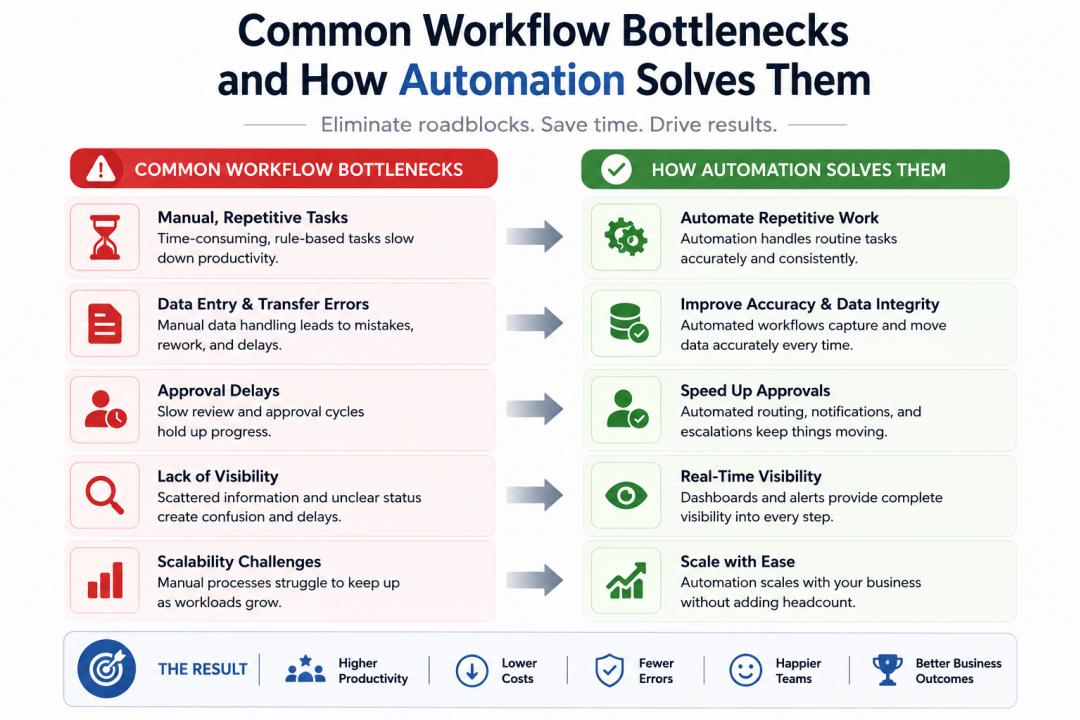
Bottleneck #1: Manual Data Entry and Information Processing
One of the most common workflow bottlenecks across industries is manual data entry. Employees often spend countless hours entering information into spreadsheets, databases, CRM systems, accounting platforms, and other business applications. While these tasks are essential, they are repetitive, time-consuming, and highly susceptible to human error.
Manual data entry creates delays because information must be collected, reviewed, entered, and verified before it can be used. In many organizations, employees must transfer data between multiple systems, increasing the risk of inconsistencies and duplication. Even minor errors can lead to significant operational challenges, including inaccurate reporting, customer dissatisfaction, and compliance risks.
Automation addresses this bottleneck by eliminating the need for repetitive data entry tasks. Modern business process automation solutions use technologies such as Optical Character Recognition (OCR), Artificial Intelligence (AI), and Robotic Process Automation (RPA) to capture, process, and transfer data automatically. Information can be extracted from forms, invoices, emails, and documents without requiring manual intervention.
For example, automated workflows can capture customer information submitted through online forms and instantly update CRM systems. Similarly, invoices can be processed automatically and transferred directly into accounting software. This significantly reduces processing times while improving accuracy.
A knowledgeable business automation consultant can evaluate existing data management processes and identify opportunities for automation. By implementing intelligent data processing solutions, businesses can eliminate repetitive tasks, reduce errors, and improve operational efficiency.
Organizations utilizing business process automation services often experience faster turnaround times, improved data quality, and greater employee productivity. Instead of spending time on administrative work, employees can focus on strategic activities that contribute to business growth.
As businesses generate increasing volumes of data, automating information processing has become essential for maintaining efficiency and scalability in modern operations.
Bottleneck #2: Slow Approval Processes
Approval workflows are essential for maintaining control and accountability within an organization. However, when approval processes rely heavily on manual communication and multiple layers of authorization, they often become significant workflow bottlenecks. Delays in approvals can affect purchasing, budgeting, hiring, project execution, customer service, and many other critical business functions.
Traditional approval workflows frequently involve emails, paper documents, spreadsheets, and verbal communication. Employees may spend valuable time following up with managers, tracking approval statuses, and waiting for responses. If key decision-makers are unavailable, the entire process can come to a standstill.
Automation transforms approval workflows by creating structured, rule-based processes that operate efficiently and transparently. Automated systems can route requests to the appropriate stakeholders, send notifications, track approvals in real time, and escalate pending actions when necessary. This eliminates the need for manual follow-ups and significantly reduces processing times.
For example, purchase requests can automatically move through predefined approval chains based on spending limits and organizational policies. Expense reimbursements, contract approvals, and leave requests can follow similar automated workflows. Stakeholders receive instant notifications and can approve requests from any device, accelerating decision-making.
A professional business automation consultant helps organizations redesign inefficient approval processes and implement automation solutions that align with business requirements. By reducing bottlenecks in approval workflows, businesses can improve responsiveness and operational agility.
Companies leveraging business process automation services often achieve faster cycle times, enhanced transparency, and better compliance with internal policies. Automated approval systems also provide comprehensive audit trails, making it easier to monitor performance and maintain accountability.
As organizations continue to seek greater efficiency, automating approval workflows remains one of the most effective ways to eliminate delays and improve overall business performance.
Key Benefits of Business Process Automation
As organizations eliminate workflow bottlenecks through automation, they begin to realize significant benefits that extend across every aspect of their operations. Business process automation is no longer viewed solely as a cost-saving initiative. It has become a strategic investment that enables organizations to improve productivity, enhance customer experiences, and support long-term growth.
One of the most immediate benefits is increased efficiency. Automated workflows eliminate repetitive manual tasks, allowing employees to focus on higher-value activities. Tasks that previously required hours or days can often be completed within minutes through automation.
Improved accuracy is another major advantage. Manual processes are prone to errors that can lead to financial losses, compliance issues, and customer dissatisfaction. Automated systems follow predefined rules consistently, reducing the likelihood of mistakes and improving data quality.
Business automation also enhances scalability. As organizations grow, transaction volumes and operational complexity increase. Automated workflows can handle higher workloads without requiring proportional increases in staffing, making growth more sustainable and cost-effective.
A professional business automation consultant helps businesses maximize these benefits by designing automation strategies aligned with organizational goals. Through carefully planned implementations, businesses can improve operational performance while maintaining flexibility and control.
Organizations investing in business process automation services frequently report improved employee satisfaction as well. Employees spend less time on repetitive administrative work and more time contributing to strategic initiatives. This often leads to greater engagement and productivity.
Additional benefits include better compliance management, stronger data visibility, faster decision-making, and enhanced customer service. Automated workflows create audit trails, improve accountability, and provide real-time insights that support continuous improvement.
As competition intensifies across industries, businesses that embrace automation are better positioned to adapt, innovate, and achieve sustainable success in an increasingly digital marketplace.
How Starters' CFO Helps Businesses Eliminate Workflow Bottlenecks
Successfully implementing automation requires more than simply purchasing software. Businesses must identify the right processes to automate, redesign workflows effectively, and ensure that technology aligns with organizational objectives. This is where Starters' CFO provides significant value.
As a trusted partner for business transformation, Starters' CFO helps organizations identify inefficiencies, streamline operations, and implement intelligent automation solutions that drive measurable results. By combining process expertise with modern technology, the company enables businesses to overcome workflow bottlenecks and achieve greater operational efficiency.
Starters' CFO begins by conducting a thorough assessment of existing business processes. This evaluation helps identify areas where delays, errors, and inefficiencies are impacting performance. Once bottlenecks are identified, customized automation strategies are developed to address specific operational challenges.
As an experienced business automation consultant, Starters' CFO helps businesses automate workflows across finance, operations, customer service, human resources, and other critical functions. From approval workflows and document management to reporting and data integration, automation solutions are tailored to each organization's unique needs.
The company's business process automation services focus on delivering long-term value rather than short-term fixes. By integrating systems, improving data flow, and reducing manual intervention, businesses can achieve higher levels of productivity and scalability.
In addition to implementation support, Starters' CFO provides ongoing guidance to ensure automation initiatives continue delivering results as business needs evolve. This strategic approach helps organizations maximize return on investment while maintaining operational flexibility.
For businesses seeking to improve efficiency, reduce costs, and accelerate growth, partnering with Starters' CFO provides access to the expertise and technology needed to build streamlined, future-ready operations.
Conclusion
Workflow bottlenecks are a common challenge for organizations of all sizes. Whether caused by manual data entry, slow approvals, poor communication, inefficient document management, customer service delays, inventory issues, or reporting challenges, these obstacles can significantly impact productivity and growth.
Automation provides a powerful solution by streamlining processes, eliminating repetitive tasks, improving accuracy, and enabling real-time visibility across business operations. Through strategic implementation of automated workflows, organizations can remove operational barriers and create more efficient, scalable systems.
Working with an experienced business automation consultant allows businesses to identify bottlenecks accurately and implement solutions that align with their goals. Modern business process automation services help organizations transform outdated workflows into intelligent processes that support agility, innovation, and long-term success.
As technology continues to evolve, automation will play an increasingly important role in helping businesses remain competitive. Organizations that proactively embrace automation will be better equipped to adapt to changing market conditions, improve customer experiences, and achieve sustainable growth.
With expert guidance from Starters' CFO, businesses can confidently navigate their automation journey and unlock new opportunities for efficiency, productivity, and operational excellence.