How Public Instagram Stories Are Becoming a Useful Research Signal for Brands
Instagram Stories are usually associated with casual, temporary social content. Yet for marketers, agencies, creators, journalists, and researchers, Stories can also provide useful short-term signals about what a brand, creator, or organization is doing right now.
A permanent Instagram profile can show how an account presents itself over time. Stories are different. They are frequently used for limited-time promotions, product launches, event announcements, creator collaborations, audience polls, customer reactions, and behind-the-scenes updates.
Because Stories disappear quickly, they can reveal activity that may never become part of a permanent feed.
This makes them increasingly useful as one part of a broader social media research workflow.
Why Instagram Stories Matter for Research
Traditional competitor research often focuses on websites, search rankings, advertising, pricing, and permanent social media posts.
Instagram Stories add another layer.
A company may use Stories to announce a temporary discount that never appears on its website. A creator may disclose a new brand partnership through a short-lived Story. A restaurant may promote a one-day menu. A software company may use Stories to tease an upcoming feature before publishing a formal announcement.
These individual signals may appear minor, but patterns across multiple accounts can reveal useful information about current positioning and campaign activity.
Researchers may be interested in questions such as:
- Which products are competitors promoting right now?
- Which creators are appearing repeatedly in sponsored content?
- Are several brands adopting the same campaign format?
- How frequently are promotions communicated through Stories instead of permanent posts?
- What topics are receiving more attention this week than last month?
Stories are particularly useful because they often reflect what an account considers important right now, rather than what it wants to preserve permanently.
Public Profiles Are the Appropriate Starting Point
Any discussion of Instagram research should clearly distinguish between public and private information.
Public profiles, public posts, and public Stories are intentionally visible to a broad audience.
Private accounts, Close Friends Stories, private messages, and other restricted information are different.
For legitimate market, creator, or competitor research, publicly available information should normally be the starting point.
This distinction is also useful when evaluating third-party Instagram tools.
Services that claim to reveal private Stories or bypass Instagram privacy controls should be treated cautiously. A legitimate public-profile research workflow does not require access to restricted information.
Why Some Researchers Prefer Browser-Based Instagram Tools
Instagram itself is designed as a complete social platform.
That works well for ordinary social use, but professional research is often narrower.
A researcher may simply want to:
- locate a public account,
- review its basic profile information,
- check recent public content,
- see whether public Stories are currently available,
- record relevant observations,
- move to the next account.
A specialized browser-based tool can make this process more focused by removing unrelated parts of the normal social-media experience.
This may be particularly useful for agencies or researchers reviewing many accounts, where repeatedly switching between feeds, recommendations, notifications, and messages can add unnecessary friction.
What “Anonymous Story Viewing” Actually Means
The term “anonymous” is often used too broadly.
In the context of a browser-based Instagram Story viewer, it usually means that the viewing process does not require the researcher to connect their own Instagram account.
It should not be interpreted as a guarantee of complete anonymity across the internet.
A more precise concept is account-independent viewing.
The user is not viewing the Story through their personal Instagram session, but they are still using an ordinary web service.
This distinction matters because realistic privacy descriptions are more useful than claims such as “completely invisible” or “100% untraceable.”
Common Research Use Cases
Competitor Monitoring
Stories can provide useful short-term information about competitor activity.
Researchers may observe:
- temporary discounts,
- product launches,
- campaign announcements,
- influencer collaborations,
- events,
- customer testimonials,
- polls,
- limited-time offers.
When tracked over time, these signals can help reveal how competitors use Instagram as part of their broader marketing strategy.
Creator and Influencer Research
Brands frequently evaluate creators before beginning a partnership.
Follower counts and permanent posts provide useful context, but Stories may show how creators communicate on a more frequent basis.
A researcher might examine:
- how frequently a creator posts Stories,
- which brands appear in recent content,
- how sponsorships are presented,
- whether content is mostly original or reposted,
- what subjects are receiving attention,
- how the creator interacts with current campaigns.
Stories therefore complement traditional profile analysis rather than replacing it.
Brand Partnership Screening
Before approaching a creator, business, or potential partner, a company may want a quick overview of that account's public presence.
Basic public information and recent Stories can provide useful context before deeper research is performed.
Journalism and Media Research
Stories may also contain updates that never become permanent posts.
For journalists and researchers following public figures, companies, organizations, or events, temporary content can therefore be relevant.
The challenge is timing.
A Story that is visible today may disappear tomorrow unless the account saves it as a Highlight.
This makes Story research closer to real-time observation than conventional archive research.
A Practical Public Instagram Research Workflow
An effective workflow does not need to be complicated.
Step 1: Build a List of Relevant Accounts
Start with public accounts related to the research question.
These might include:
- competitors,
- creators,
- brands,
- industry organizations,
- potential partners.
Step 2: Review Public Profile Information
Before focusing on Stories, establish some basic context.
Useful public information may include:
- username,
- display name,
- profile photo,
- biography,
- verification status,
- follower count,
- following count,
- post count,
- recent public posts.
This creates a basic profile of the account before more temporary signals are analyzed.
Step 3: Review Current Public Stories
Next, look for currently available public Stories.
Record only information that is relevant to the research objective.
For competitor research, this might include:
- promotions,
- product announcements,
- partnerships,
- campaign themes,
- events,
- calls to action.
Step 4: Record Structured Observations
Instead of collecting random screenshots, researchers can maintain a simple spreadsheet.
Possible columns include:
- date,
- account,
- Story topic,
- campaign type,
- featured product,
- partner or creator,
- call to action,
- notes.
Structured observations make comparisons easier.
Step 5: Look for Patterns
A single Story usually provides limited evidence.
Repeated behavior across several weeks or several accounts is more informative.
The objective is not to react to every temporary post, but to identify patterns.
ScanInsta as a Public Instagram Research Tool
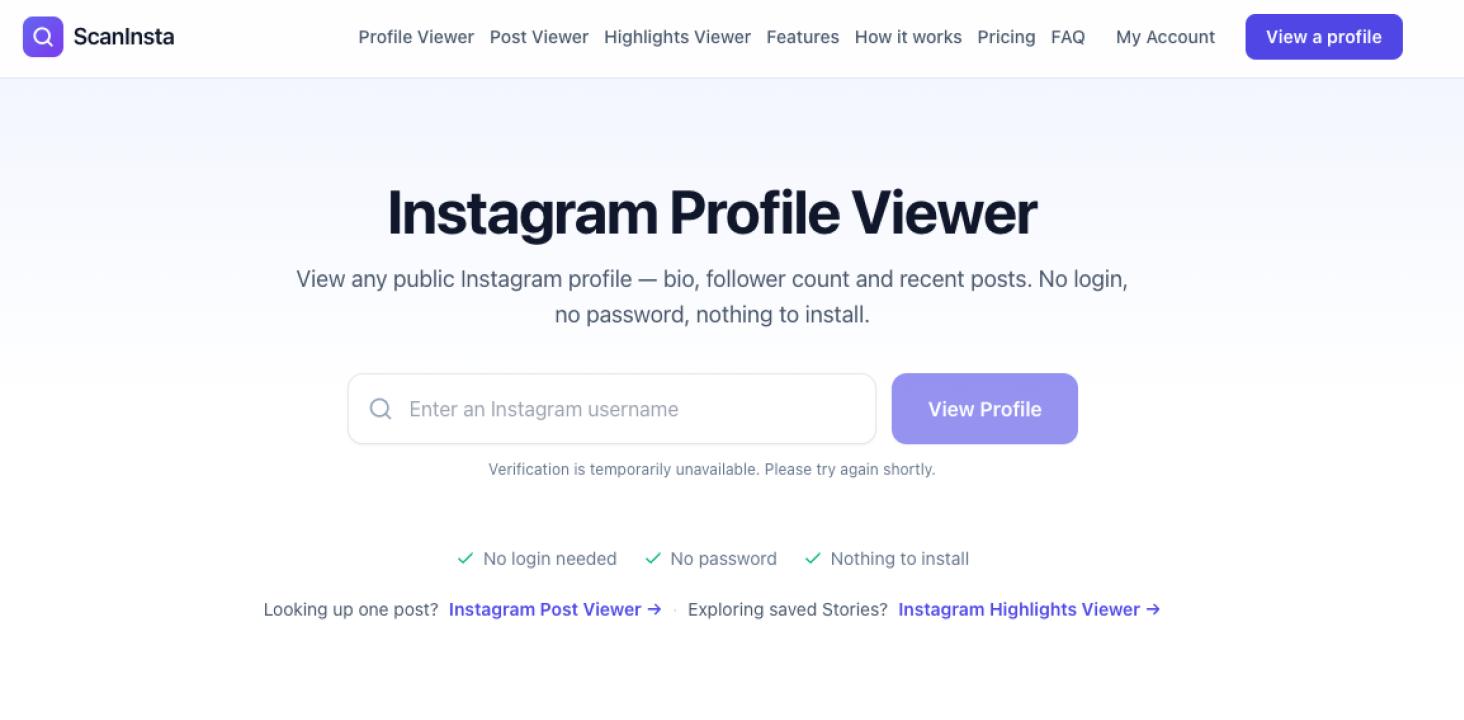
One browser-based service designed around this type of public Instagram research is ScanInsta:
ScanInsta focuses on publicly available Instagram information and provides tools for two related research tasks: understanding a public profile and checking currently available public Stories.
These functions can be used separately, but they are more useful when combined into a structured research process.
Public Instagram Profile Viewer
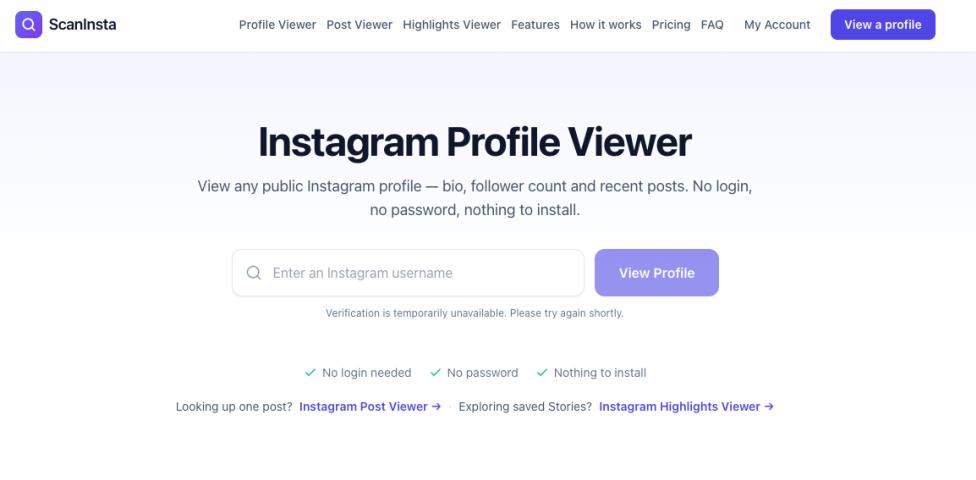
The main ScanInsta profile viewer provides a quick overview of publicly available Instagram profile information.
Depending on what is available publicly, users can review information such as:
- profile photo,
- display name,
- biography,
- verification status,
- follower count,
- following count,
- post count,
- recent public posts.
This can serve as an initial research step.
For example, a marketer comparing several creators may first review each profile's positioning, audience size, and recent activity before deciding which accounts deserve deeper analysis.
Similarly, a company researching competitors can use public profile information to establish context before looking at shorter-lived content.
Anonymous Story Viewer
ScanInsta also provides an Anonymous Story Viewer:
https://scaninsta.com/anonymous-story-viewer
This tool is focused specifically on currently available Stories from public Instagram profiles.
It does not require the visitor to sign in with an Instagram account, which makes it suitable for researchers who prefer to separate professional observation from their personal Instagram activity.
Public Stories may reveal information such as:
- limited-time promotions,
- product announcements,
- event updates,
- creator collaborations,
- polls,
- temporary campaign messages,
- behind-the-scenes activity.
The important limitation is that the tool is intended for public information.
It does not turn private Instagram content into public data.
Browser-Based Access
Another characteristic of ScanInsta is that the research workflow takes place directly in the browser.
Users do not need to install a separate desktop application or browser extension simply to perform a public profile or Story lookup.
This can be convenient for marketers, agencies, researchers, journalists, and creators who work across multiple devices or review many different accounts.
How the Two Functions Work Together
A researcher might use ScanInsta in the following sequence:
- Look up a competitor's public Instagram profile.
- Review its bio, verification status, public metrics, and recent posts.
- Check whether currently available public Stories exist.
- Record any relevant promotions, partnerships, launches, or campaign themes.
- Compare the observations with other competitors.
- Repeat the process over time to identify patterns.
Used in this way, ScanInsta is not simply a tool for viewing an isolated Story.
It becomes part of a broader public Instagram research workflow.
Public Data Boundaries Matter
The usefulness of social media research depends partly on respecting the distinction between public and restricted information.
Private accounts, private messages, Close Friends Stories, and other non-public information should not be treated as freely accessible research material.
This is also a useful criterion for evaluating tools.
A service that clearly explains its limitations is generally more credible than one promising access to content that users deliberately restricted.
For professional research, there is already a large amount of useful information available publicly.
The challenge is usually not obtaining secret information.
It is organizing public signals effectively.
Instagram Stories Should Not Be Analyzed in Isolation
Stories are only one source of information.
A stronger competitor or market research process may combine:
- public Instagram profiles,
- permanent posts,
- public Stories,
- company websites,
- landing pages,
- SEO data,
- search trends,
- newsletters,
- advertising activity,
- creator partnerships,
- pricing changes.
The relationship between these signals is often more valuable than any one source alone.
For example, imagine a competitor:
- begins teasing a product through Instagram Stories,
- updates its website several days later,
- starts working with several creators,
- launches paid advertising,
- publishes a permanent Instagram post.
Viewed separately, each event provides limited information.
Viewed together, they reveal a much clearer product-launch strategy.
The Difference Between Stories and Highlights
Researchers should also distinguish Instagram Stories from Highlights.
Stories are temporary content.
Highlights are Stories that an account owner deliberately chooses to preserve on the profile.
This difference can itself provide useful information.
Stories may show immediate activity.
Highlights may indicate which topics, products, services, or messages the account considers important enough to preserve over time.
For brand research, both can provide useful but different signals.
What to Look for in a Browser-Based Instagram Viewer
When evaluating a third-party viewer, researchers should consider several factors.
Clear Public-Data Limits
The tool should clearly explain whether it works only with public content.
No Unnecessary Instagram Credentials
A public-profile research tool should not casually require the user's Instagram password.
No Unrealistic Private-Account Claims
Claims about automatically unlocking private accounts should be treated cautiously.
Browser Accessibility
A simple research task should not necessarily require unrelated software installations.
Clear Functional Limitations
Tools should distinguish between:
- public and private profiles,
- current and expired Stories,
- Stories and Highlights,
- ordinary public content and restricted content.
Focused Functionality
For research users, a focused workflow may be more useful than a large social-media application containing many unrelated features.
Research Quality Depends on Method, Not Just Tools
Tools can make information easier to access, but they do not automatically produce good research.
Researchers still need to ask useful questions.
For example:
- What exactly are we trying to learn?
- Which accounts are relevant?
- What time period should we observe?
- Which signals are meaningful?
- Are we comparing similar accounts?
- Are repeated patterns visible?
- Could there be another explanation for the observed behavior?
Without a structured method, collecting more public data can simply create more noise.
The value comes from interpretation.
The Larger Shift: Social Platforms as Research Sources
Instagram is still primarily a social platform, but public social media information is increasingly used as a source of market context.
Different parts of an Instagram account provide different signals.
A profile can reveal positioning.
Permanent posts can reveal long-term content strategy.
Stories can reveal immediate activity.
Highlights can show which temporary content the account chose to preserve.
Follower and following counts provide additional context.
None of these signals should be considered complete on their own.
Together, however, they can contribute to a broader understanding of a creator, competitor, or market.
Final Thoughts
Instagram Stories are temporary, but that does not make them irrelevant to research.
For marketers, agencies, journalists, creators, and businesses, public Stories can provide useful short-term signals about promotions, partnerships, launches, events, and campaign activity.
Browser-based tools can make this type of observation more focused, particularly when researchers do not need the full Instagram social experience.
ScanInsta illustrates this approach by combining public profile research with a dedicated Anonymous Story Viewer, allowing researchers to move from permanent public profile information to short-lived Story activity within the same broader workflow.
The most important principle, however, is not the tool itself.
Effective social media research depends on respecting public-data boundaries, recording observations consistently, comparing patterns over time, and combining Instagram activity with other market signals.
Used in that context, public Instagram profiles and Stories can provide a small but useful source of real-time market intelligence.