Instagram follower counts are easy to see, but the number alone tells researchers very little about the audience behind an account.
For marketers, agencies, creators, researchers, and businesses, the more useful question is often not simply “How many followers does this account have?” but rather:
- Who makes up the visible audience?
- How can follower information be organized?
- How can multiple audiences be compared?
- Can public follower data be reviewed in a spreadsheet instead of one profile at a time?
- How can researchers avoid collecting more information than they actually need?
This is where structured follower exports become useful.
Turning publicly available Instagram follower information into a CSV does not automatically produce marketing insights. However, it can transform an otherwise repetitive research task into a dataset that can be sorted, filtered, compared, and incorporated into a broader research workflow.
Why Follower Counts Alone Are Limited
Follower count is one of the most visible metrics on Instagram.
It is also one of the easiest metrics to misinterpret.
Two accounts may each have 50,000 followers while serving very different audiences. One may attract creators and professionals, while another may have a broad consumer audience. A single number cannot show those differences.
For audience research, marketers may want to understand characteristics such as:
- usernames,
- public names,
- verified status,
- profile links,
- available follower metrics,
- recurring types of accounts within an audience.
The objective is not necessarily to inspect every follower individually.
Instead, the goal is often to convert scattered public information into a format that is easier to organize.
Why CSV Still Matters
CSV is an old format, but it remains useful because almost every data workflow can work with it.
A CSV file can be opened in:
- Microsoft Excel,
- Google Sheets,
- Numbers,
- database tools,
- Python or R,
- business intelligence platforms,
- internal marketing systems.
For many small research projects, a spreadsheet is enough.
A marketer can sort rows, remove duplicates, compare lists, add notes, create filters, or combine the data with information collected from other sources.
This makes follower exporting less about the file itself and more about what structured data enables afterward.
Common Uses for Structured Follower Data
Competitor Audience Research
One of the clearest use cases is competitor research.
A business may already know who its direct competitors are, but understanding the public audiences around those competitors can provide additional context.
For example, researchers may compare several competitor follower lists to look for:
- accounts appearing across multiple competitors,
- creators or businesses repeatedly associated with a niche,
- verified accounts within an audience,
- potential partnership candidates,
- accounts worth investigating further.
Follower data alone should not be treated as proof of customer intent.
However, it can provide a starting point for discovering which people and organizations are publicly connected to a particular market.
Influencer and Creator Research
Follower exports can also support influencer research.
A creator's follower count is easy to see, but brands often need more context before deciding whether deeper research is worthwhile.
A structured follower list can help researchers organize publicly available audience information and identify accounts for further manual review.
This may be useful when comparing several creators in the same niche.
The export does not replace qualitative evaluation. Researchers still need to consider content quality, audience relevance, engagement, brand fit, and other signals.
Market Mapping
In smaller industries, repeated follower relationships can help researchers map parts of an online community.
Suppose several niche brands, creators, and industry organizations attract overlapping public audiences.
By organizing those audiences, a researcher may discover:
- recurring creators,
- related businesses,
- industry publications,
- community accounts,
- possible partners,
- new competitors.
This is closer to discovery than definitive analytics.
The value comes from identifying what deserves further investigation.
Outreach Preparation
Structured data may also be useful before outreach.
A marketing team can organize accounts in a spreadsheet, add research notes, classify them, and decide which profiles deserve manual review.
However, follower exports should not be treated as automatic mailing lists.
Responsible outreach requires context, relevance, and compliance with applicable laws and platform policies.
Bulk spam is not a legitimate research strategy.
A Better Workflow: Profile First, Export Second
Follower exports can involve many paginated requests, especially for larger accounts.
A useful design principle is therefore to separate the initial profile check from the actual export.
Instead of immediately beginning a potentially large follower request, a research tool can first determine basic information about the target account.
A practical workflow looks like this:
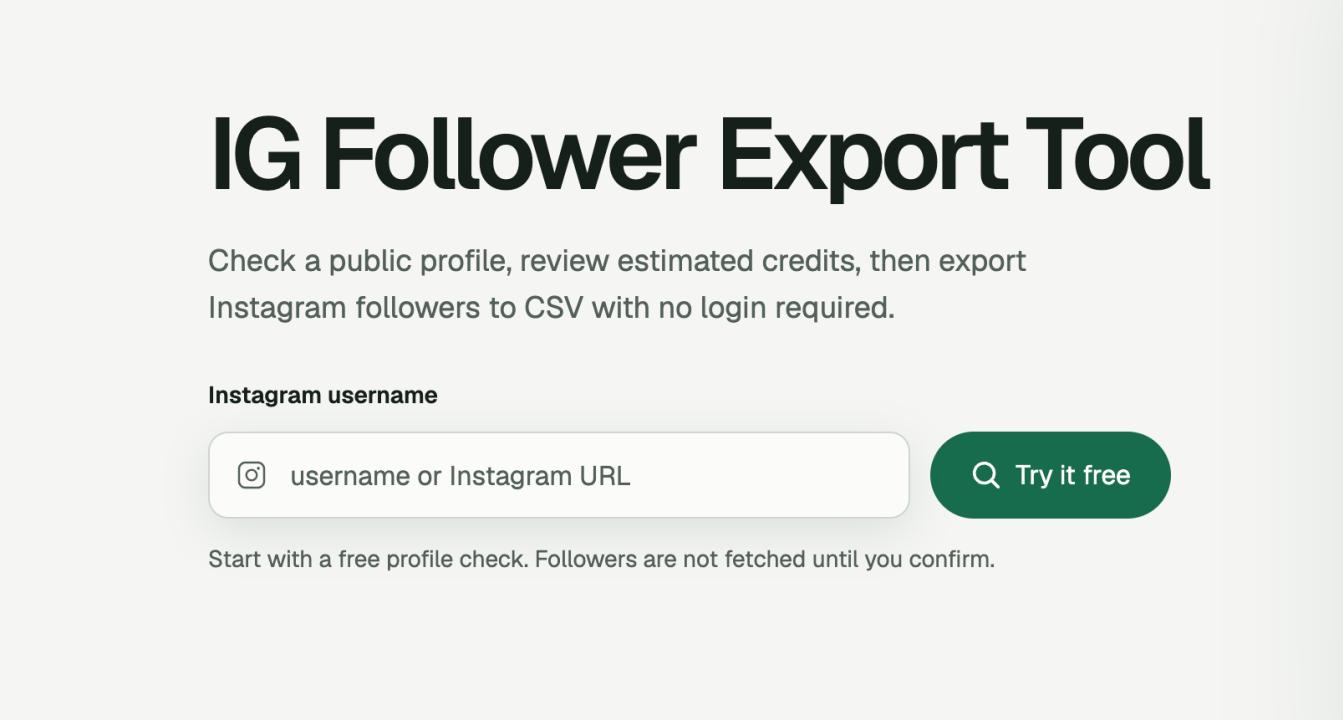
- Enter an Instagram username or profile URL.
- Check the public profile.
- Review the follower count.
- Estimate the size or cost of the export.
- Decide whether the export is worth running.
- Start the follower export only after confirmation.
- Download the resulting CSV.
This approach gives the researcher more control over the process.
It also makes the cost and scope of a data request easier to understand before it starts.
IGFollowerExporter as an Example of This Workflow
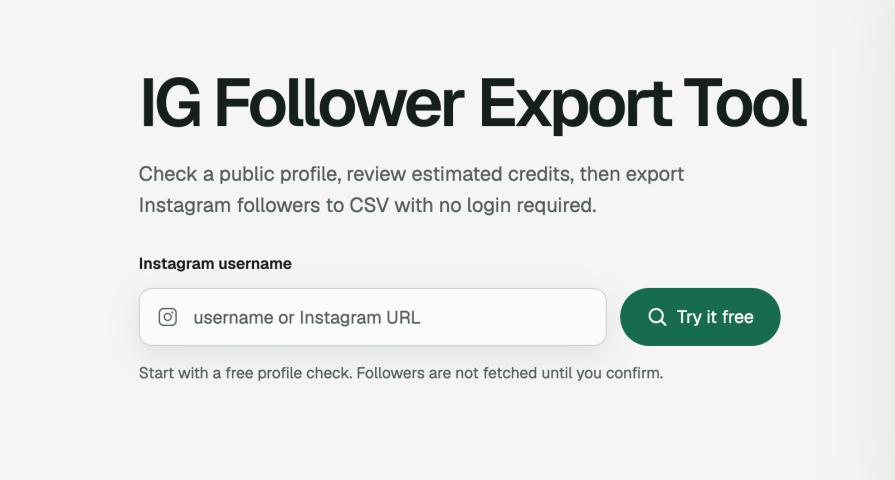
One browser-based implementation of this approach is IGFollowerExporter:
https://igfollowerexporter.com/
The service is designed around exporting follower information from publicly accessible Instagram profiles into CSV format.
Rather than immediately requesting follower pages, the tool begins with a public profile check.
Users can enter:
- an Instagram username,
- an @username,
- or an Instagram profile URL.
The input is normalized, and the service retrieves available public profile information before beginning the follower export.
This allows users to review the account and estimated export requirements first.
Profile Check Before Follower Requests
The profile-first design is one of the more practical aspects of the service.
Follower lists may require multiple pages of data.
IGFollowerExporter therefore separates the initial lookup from follower pagination.
The process is:
1. Check the Profile
The tool retrieves the available public profile and follower count.
2. Review the Estimate
Before starting the export, users can see an estimate of the follower pages and credits that may be required.
3. Confirm the Export
Follower pages are requested only after the user explicitly starts the export.
This makes the process easier to evaluate before a larger request is made.
Exporting Followers to CSV
After confirmation, follower pages are retrieved and processed into a CSV.
Depending on the information available in the source response, fields can include:
- username,
- full name,
- follower count,
- profile URL,
- avatar URL,
- verification status.
Not every record will necessarily contain every field.
A responsible export should preserve that uncertainty rather than inventing missing values.
The resulting CSV can then be opened in a spreadsheet for filtering, sorting, labeling, or further analysis.
No Instagram Login Required
Another characteristic of IGFollowerExporter is that the workflow does not require users to connect their personal Instagram account.
The site does not ask for an Instagram username and password combination for authentication.
This is relevant because third-party social media tools that request platform passwords introduce additional security considerations.
For public-profile research, an account-independent workflow can reduce the need to expose personal Instagram credentials to an external service.
It also separates professional research from the researcher's personal Instagram session.
Browser-Based Access
IGFollowerExporter operates through a web browser.
There is no need to install desktop software or a browser extension to use the current version of the service.
The workflow can also be accessed through modern mobile browsers.
A desktop computer may still be more convenient when reviewing a large CSV, but the actual profile check and export process does not depend on desktop-only software.
This can be useful for researchers working across multiple devices.
Public Profiles and Privacy Boundaries
The distinction between public and private Instagram information is important.
IGFollowerExporter is designed for publicly accessible account data.
It does not treat being personally approved to follow a private account as permission for the external service to access that account's private follower data.
Private profiles therefore cannot be exported through the normal follower-export workflow.
This limitation is important.
Audience research does not require bypassing privacy settings, and tools that promise unrestricted access to private social data should be treated cautiously.
Transparent Export Limits
Another useful research principle is acknowledging that exports may not always be complete.
Large follower lists require pagination and processing time.
An export can therefore stop because:
- no additional follower pages are available,
- a configured page limit is reached,
- the server approaches its processing time budget.
In those situations, a partial dataset can still be useful as long as the limitation is clearly communicated.
A research tool should not describe a partial sample as a guaranteed complete follower list.
Understanding the limits of a dataset is part of responsible analysis.
Free and Paid Export Sizes
IGFollowerExporter provides several levels based on the number of follower rows required.
The current free option supports up to 500 follower rows, allowing users to test the basic workflow before paying.
Larger research jobs can use one-time export packs or a recurring plan.
At the time of writing, the site lists:
- Free — up to 500 follower rows
- Starter Export Pack — up to 3,000 rows
- Advanced Export Pack — up to 8,000 rows
- Pro Monthly — up to 8,000 follower rows per month with repeat-export benefits
This model reflects an important aspect of follower research: not every user needs unlimited data.
Someone researching a small creator may need only a few hundred rows, while an agency researching larger audiences may require a higher limit.
Why Cost Estimates Matter
Behind a follower export are multiple data requests.
For that reason, IGFollowerExporter displays an estimated request cost before follower pagination begins.
The site currently describes a profile lookup as one credit and follower pages as an estimated five credits per live page, although cached responses and actual provider results can affect the final reported usage.
The precise credit system is less important than the design principle:
show the expected cost before beginning the expensive part of the task.
This allows users to decide whether the research question justifies the export.
That is preferable to starting an unbounded request and revealing the cost afterward.
Data Safety in Spreadsheet Exports
CSV files may look harmless, but spreadsheet exports have their own security considerations.
Certain values beginning with spreadsheet formula characters can potentially be interpreted as formulas when opened in spreadsheet software.
IGFollowerExporter states that its server-generated CSV is protected against common spreadsheet formula-injection risks.
This is a relatively technical detail, but it illustrates a broader point:
Data-export tools should consider not only how information is collected, but also how exported files behave when users open them in downstream applications.
A Practical Audience-Research Workflow
Follower-export tools are most useful when incorporated into a repeatable process.
For example:
Step 1: Define the Research Question
Do not begin by exporting data simply because it is available.
Start with a question such as:
- Which accounts appear in the audiences of several competitors?
- Which creators should we investigate further?
- What types of businesses follow brands in this niche?
- Are there visible audience similarities between two competitors?
Step 2: Select Relevant Public Accounts
Choose a small number of accounts that genuinely relate to the research objective.
Step 3: Check the Profiles
Review account size and public profile information before exporting follower rows.
Step 4: Export an Appropriate Sample
Do not assume that more rows automatically produce better insight.
For some questions, several hundred well-selected records may be enough to identify useful leads for further research.
Step 5: Clean and Organize the CSV
Use spreadsheet tools to:
- remove duplicates,
- sort accounts,
- create categories,
- add research notes,
- flag verified profiles,
- identify accounts for manual review.
Step 6: Verify Important Findings Manually
A CSV should be treated as a research starting point.
Important profiles, partnerships, or business conclusions should be verified using current public information.
Follower Data Should Be Combined With Other Signals
Follower lists are only one part of Instagram audience research.
A stronger workflow may also examine:
- profile biographies,
- permanent posts,
- Stories,
- engagement,
- creator partnerships,
- company websites,
- search visibility,
- newsletters,
- advertising,
- public business information.
Consider a creator who appears in the follower lists of several competing brands.
That overlap may be interesting.
But the researcher should still inspect the creator's public profile, recent content, relevance to the niche, and existing partnerships before drawing conclusions.
Structured follower data helps identify questions.
It does not automatically answer them.
What Follower Exports Cannot Tell You
It is equally important to understand what the data does not prove.
A person following a brand does not automatically mean:
- they are a customer,
- they purchased a product,
- they endorse the company,
- they belong to a specific demographic,
- they are interested in receiving marketing messages.
Following is simply one observable public relationship.
Researchers should avoid turning limited signals into stronger claims than the evidence supports.
Avoiding Spam-Oriented Use
One temptation with structured follower data is to treat every row as a sales lead.
That approach is both analytically weak and potentially problematic.
Good audience research should prioritize relevance and context.
A better process is:
- identify potentially relevant accounts,
- review them manually,
- understand why they may matter,
- determine whether legitimate outreach is appropriate,
- follow applicable privacy, marketing, and platform rules.
Exporting public information does not remove the responsibility to use it appropriately.
The Larger Trend: From Social Browsing to Structured Research
Tools such as IGFollowerExporter illustrate a broader shift in how social media information is used.
Traditional Instagram usage is interface-driven.
Users open the app, browse profiles, scroll feeds, and inspect accounts one at a time.
Research workflows increasingly require something different.
Researchers want to move from:
individual pages → structured information → comparison → analysis
CSV export is a simple example of that transition.
It converts information that is difficult to analyze manually into a format compatible with familiar research tools.
Tools Are Only the First Step
An exporter can reduce the mechanical work involved in collecting and organizing public follower information.
It cannot determine what that information means.
Good research still depends on:
- selecting appropriate accounts,
- asking clear questions,
- understanding sampling limitations,
- verifying important findings,
- respecting privacy boundaries,
- interpreting relationships cautiously.
The quality of the methodology matters more than the size of the CSV.
Final Thoughts
Instagram follower counts provide a quick measure of audience size, but structured follower information can support deeper forms of audience and competitor research.
Exporting public follower data into CSV makes it possible to organize, filter, compare, and review information using familiar spreadsheet and data-analysis workflows.
IGFollowerExporter demonstrates one approach to this process through a profile-first workflow: users check a public account, review the expected export size and cost, explicitly confirm the request, and then receive available follower information as a CSV.
The service also emphasizes several practical boundaries: no Instagram password is required, private follower lists are not treated as publicly accessible, exports have defined limits, and users can begin with a smaller free dataset before deciding whether a larger export is necessary. IG Exporter
The larger lesson is that audience research should not be about collecting the maximum possible amount of data.
It should be about converting relevant public signals into structured information, understanding the limitations of that information, and using it to decide what deserves deeper investigation.
For researchers, marketers, agencies, and creators, a follower export is therefore not the final analysis.
It is a structured starting point.