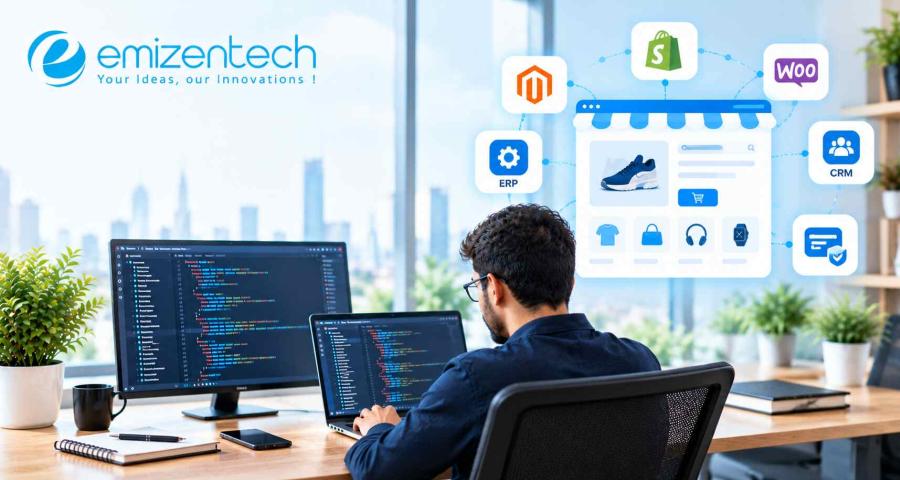
A store built on the wrong platform gets expensive fast. Product data moves twice, integrations are rebuilt, and launch dates slip. A free 60-minute call with EmizenTech’s eCommerce experts settles those questions before any code is written. With 12+ years behind it, 500+ online stores delivered and 30+ industries served, the team uses that hour to match your goals to the right technology. Here is what the session covers, what it costs to move forward and how to arrive prepared.
What the Hour Gives You
Think of the call as a planning session, not a sales pitch. You describe the store you run or want, and the experts reply with a direction you can act on. If the plan fits, the same experts can carry it forward through eCommerce development services, from platform setup to launch.
Platform fit. Shopify, Adobe Commerce, Shopware, WooCommerce and BigCommerce each suit a different catalog size and customisation need. The call narrows that list so you stop comparing feature tables on your own.
Requirements and architecture. Business needs and technical needs are mapped together, so the structure holds up as traffic, products and sales channels grow.
Digital strategy. Goals, customer journey and operations are tied to a technology plan, which keeps the build aligned with how you actually sell.
Risk and roadmap. Feasibility gaps surface early, followed by a growth path you can budget against instead of a vague wish list.
Projects That Began With the Right Plan
Every build below started with a platform and scope decision, not a template. The outcomes differ because the problems. These briefs show how far the same planning habit can stretch.
B2B at scale
Fondriest needed a store handling thousands of SKUs, ERP integration, rentals and quotes, and the team delivered it on Adobe Commerce. Brand Gifts received a scalable Shopware B2B store with ERP integration, custom pricing and streamlined ordering. Reading Medical got an Adobe Commerce store that simplified medical equipment purchasing and fulfilment.
Marketplaces
Buitanda wanted a platform with multiple vendors and multiple warehouses. The finished marketplace drove 50% user growth.
Product discovery
EST Bogensport, a Berlin archery and crossbow retailer, received four guided buyer paths covering recurve, compound, crossbow and bow-hunting. Mirror Home, a premium designer mirrors and décor seller, gained faster pages and easier product discovery.
Client feedback
A forklift retailer in Germany noted that whenever a result missed expectations, the team came back quickly with an alternative. That responsiveness is part of why the team holds a 4.9 rating on Clutch and a 98% client retention rate.
Platforms and Services Worth Raising
You do not need a finished brief to join. A rough idea of what you sell and how you sell it is enough. Knowing what is on the table simply helps you ask sharper questions.
Platforms
The team works across Shopify and Shopify Plus, Adobe Commerce, Shopware, WooCommerce, BigCommerce, Salesforce Commerce Cloud, Odoo, PrestaShop and OpenCart.
Services
Options run from custom storefronts, UX and UI design, and mobile commerce apps to PWAs, payment gateway links and ERP and CRM connectivity. Moving off an old platform? Ask about migration, since product data, customers, order history and search rankings all need a safe route across.
AI features
The list includes a shopping assistant, personalised recommendations, intelligent search, inventory forecasting, dynamic pricing, customer segmentation, support automation and fraud detection. Mention any that fit your roadmap.
Security
Expect SSL encryption, secure authentication, role-based access, PCI-compliant payment integrations and regular security updates. If you handle sensitive customer data, say so early.
How a Build Moves After the Call
The consultation is the start of a clear sequence, not a one-off chat. Once the plan is approved, the work runs from strategy and design to testing, launch and post-launch support. Knowing the stages in advance lets you plan internal approvals and content in parallel.
- Strategy: Goals and market demands are connected to technology, so the build matches how you actually sell.
- Design: Clean layouts and a smooth checkout keep shoppers moving from product page to purchase.
- Development and integration: Features, ERP and CRM links and payment gateways come together on the chosen platform.
- Testing: Speed, responsiveness, browser compatibility, payment gateways and security are verified before go-live.
- Launch: The store goes live with real-time monitoring to catch issues early.
- Post-launch maintenance: Updates, bug fixes and performance work keep the store stable and secure.
Because strategy comes first, the later stages rarely need rework.
Cost, Timeline and Hiring Options
Budget surprises sink more projects than bad code does, so numbers belong in the first conversation. These are the published starting points, shared openly so you can plan before you book.
| Item | Starting point |
|---|---|
| Basic eCommerce store | From $5,000 |
| Standard website build | 10 to 14 weeks |
| Hourly developer | From $20/hour |
| Part-time developer | From $1,200/month |
| Full-time developer | From $7,000/month |
Enterprise-grade builds cost more and run longer, depending on platform, custom features and integrations. If your roadmap outgrows your in-house team, you can hire ecommerce web developers from a pool of 100+ vetted specialists. Each passes a six-stage process covering sourcing, technical screening, a live coding challenge, a communication assessment, a trial period and ongoing performance reviews.
Three engagement models are available. Outstaffing adds certified developers directly to your team. Outsourcing gives you a dedicated unit without building a department. Full-stack hiring covers front end, back end, database and cloud under one roof. The process itself is short: share requirements, interview developers, pick the right fit, finalise terms and launch. A 14-day money-back guarantee backs the hire.
Get Ready in Five Steps
Twenty minutes of preparation makes the hour sharper. Rough numbers are fine, and so are gaps. The aim is to arrive at facts rather than polish.
- Note your current platform and store URL, or the platform you are leaning toward.
- List connected tools: ERP, CRM, payment gateways, and shipping providers.
- Write down the three biggest frustrations with your present setup.
- Set a target launch date and a rough budget range.
- Pick one or two stores you admire and note why.
Submit the enquiry form afterward, and a reply arrives within 24 hours. Offices in the USA, Australia, UK, India and UAE keep the conversation within reach of most time zones.
Final Thoughts
An hour is a small ask for a decision that shapes your store for years. Come with your numbers, your frustrations and your deadline, and leave with a direction you can defend in front of your own team. You will know which platform fits, what the build is likely to cost, how long it should take and which risks need attention first. Emizentech offers this session free, and a reply follows within 24 hours of your enquiry. Book the call, bring your questions, and turn a rough idea into a plan you can start executing.
FAQs
1. Is the 60-minute consultation free?
Yes. The session is offered free of charge, and the enquiry form gets a reply within 24 hours.
2. How long does a standard store take to build?
A standard eCommerce website generally takes 10 to 14 weeks. Enterprise- or highly customised builds can run for several months.
3. What does it cost to get started?
A basic store starts at $5,000. Developer hiring begins at $20 per hour, with monthly options for part-time and full-time support.
4. Can my existing store move to a new platform?
Yes. Migration covers products, customer data, order history and SEO, with minimal downtime.
5. What if the developer is not the right fit?
Hiring is backed by a 14-day money-back guarantee, subject to its published terms.