Automated Shading Systems Market Size
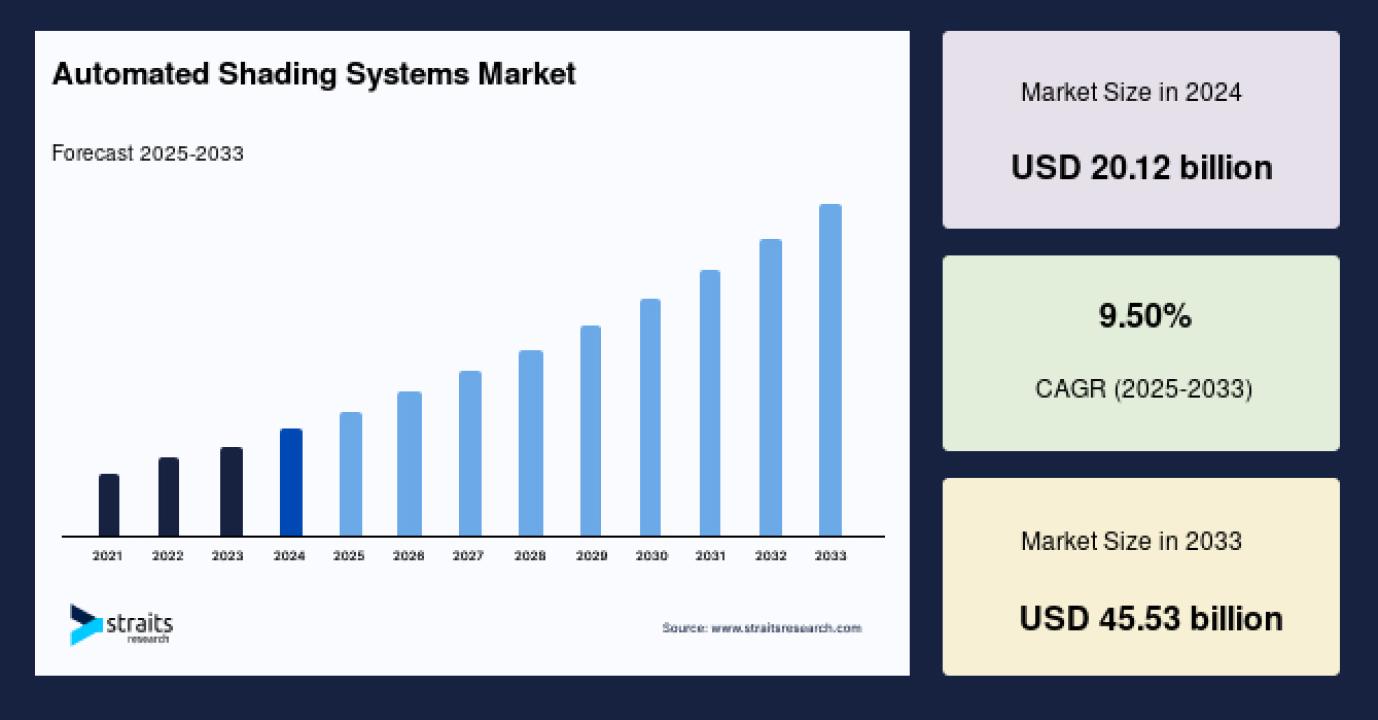
The global automated shading systems market is experiencing rapid expansion driven by increasing demand for energy-efficient solutions and smart building integration. Valued at USD 20.12 billion in 2024, the market is projected to grow from USD 22.03 billion in 2025 to reach USD 45.53 billion by 2033, exhibiting a CAGR of 9.50% during the forecast period.
For comprehensive market insights and detailed analysis, access the full report at https://straitsresearch.com/report/automated-shading-systems-market/request-sample.
Market Drivers
The automated shading systems market is propelled by several key factors. The surge in smart city initiatives worldwide is encouraging the integration of advanced building technologies, including automated shading, as part of energy-efficient urban development. These systems are increasingly being deployed in commercial spaces such as offices, educational institutions, and healthcare facilities to optimize indoor lighting and reduce HVAC loads.
The rise in consumer preference for convenience and enhanced life>
The global push toward sustainability and energy efficiency is a key driver as automated shading helps reduce energy consumption by optimizing natural light and minimizing the use of HVAC systems, aligning with eco-friendly building practices. Growing urban population and rising disposable incomes are further contributing to the market's expansion, especially in residential construction.
Market Challenges
Despite robust growth prospects, the market faces significant obstacles. High initial investment cost and complex installation process pose the most substantial challenge, as these systems often require significant upfront expenditure for components such as motors, sensors, controllers, and integration with smart home platforms. Installation demands skilled professionals, which further adds to labor costs and logistical challenges.
For many consumers, particularly in developing regions or cost-sensitive markets, this creates a barrier to adoption despite long-term energy-saving benefits. Retrofitting automated shading systems into existing buildings can be technically demanding and expensive, discouraging potential buyers from transitioning from traditional manual solutions to advanced automated alternatives.
Purchase the complete study at https://straitsresearch.com/buy-now/automated-shading-systems-market.
Market Segments
According to Straits Research analysis, the market is segmented across multiple dimensions:
By Product Type:
Motorized Blinds (popular for convenience and energy efficiency)
Shades
Shutters
By Technology:
Wireless (gaining traction due to easy installation and flexibility)
Wired
By Control System:
Remote Control Systems (widely preferred for simplicity)
Smartphone Apps
Voice Control
By End-Use:
Residential (dominant segment due to consumer focus on comfort and energy efficiency)
Commercial
Industrial
By Installation:
New Construction (significant driver as builders integrate smart technologies)
Retrofit
The residential segment dominates the market due to rising consumer focus on comfort, convenience, and energy efficiency at home. Motorized blinds are particularly popular as they allow precise light control and privacy without manual effort, supporting various fabrics and materials for diverse interior decors.
Regional Analysis
North America remains the largest market, holding approximately 35% of global revenue, benefiting from widespread adoption of smart home technologies and strong consumer preference for energy-efficient solutions. The region benefits from a mature construction sector that embraces smart building integration, with products like Lutron's Serena Shades and Hunter Douglas' PowerView increasingly popular in residential and commercial sectors.
Asia Pacific represents the fastest-growing region, experiencing rapid expansion due to accelerated urbanization and growth in high-rise residential and commercial construction. Countries like China and India are witnessing substantial growth driven by smart city initiatives and increasing smart home penetration in urban areas.
Europe captures around 28% of the market share, with growth driven by stringent energy efficiency regulations and increasing emphasis on green building certifications. The region demonstrates strong commitment to sustainable architecture, which includes integration of automated shading systems for thermal comfort and reduced energy consumption.
Top Players Analysis
The automated shading systems market features several key players implementing diverse strategies. Major companies include Hunter Douglas, Somfy Group, Lutron Electronics, MechoShade Systems, Springs Window Fashions, and BTX.
Hunter Douglas maintains market leadership through its diversified product portfolio, offering innovative window coverings known for energy efficiency and aesthetic appeal. The company's PowerView system provides seamless smart home integration.
Somfy Group is a global leader headquartered in France, specializing in motors, controls, and connected devices for blinds, curtains, awnings, and shutters. Founded in 1969, Somfy integrates IoT technology to enhance energy efficiency, comfort, and security in residential and commercial buildings.
Lutron Electronics focuses on advanced control and automation solutions, offering integrated systems that emphasize seamless integration, scalability, and intuitive user interfaces for both residential and commercial markets.
These companies are collectively investing in R&D to develop advanced smart technologies, enhancing product integration with IoT and home automation platforms while expanding their global distribution networks.
Market Outlook
The automated shading systems market is positioned for sustained growth, driven by partnerships between manufacturers and smart home technology companies that enable integration with platforms like Amazon Alexa and Google Assistant. Despite challenges, the market remains resilient due to continuous innovation and increasing adoption of energy-efficient solutions across residential and commercial sectors.
About Us
Straits Research is a market intelligence company providing global business information reports and services. Our exclusive blend of quantitative forecasting and trends analysis provides forward-looking insight for thousands of decision-makers. Straits Research Pvt. Ltd. provides actionable market research data, especially designed and presented for decision making and ROI.
Frequently Asked Questions
What are automated shading systems?
Automated shading systems are smart building solutions that control blinds, shades, and shutters using motors, sensors, and smart controls to optimize natural light, temperature, and privacy automatically based on environmental conditions.
How big is the automated shading systems market?
The market was valued at USD 20.12 billion in 2024 and is projected to reach USD 45.53 billion by 2033, growing at 9.50% CAGR during the forecast period.
What drives market growth?
Key drivers include smart city initiatives, IoT and AI integration, energy efficiency demands, rising disposable incomes, and increasing adoption of home automation solutions.
Which region dominates the market?
North America holds the largest market share at 35%, while Asia Pacific is the fastest-growing region due to rapid urbanization and smart city developments.
What are the main challenges?
High initial investment costs, complex installation processes, and the need for skilled professionals pose significant barriers to adoption.
Who are the key players?
Major companies include Hunter Douglas, Somfy Group, Lutron Electronics, MechoShade Systems, Springs Window Fashions, and BTX, focusing on smart technology integration and energy-efficient solutions.