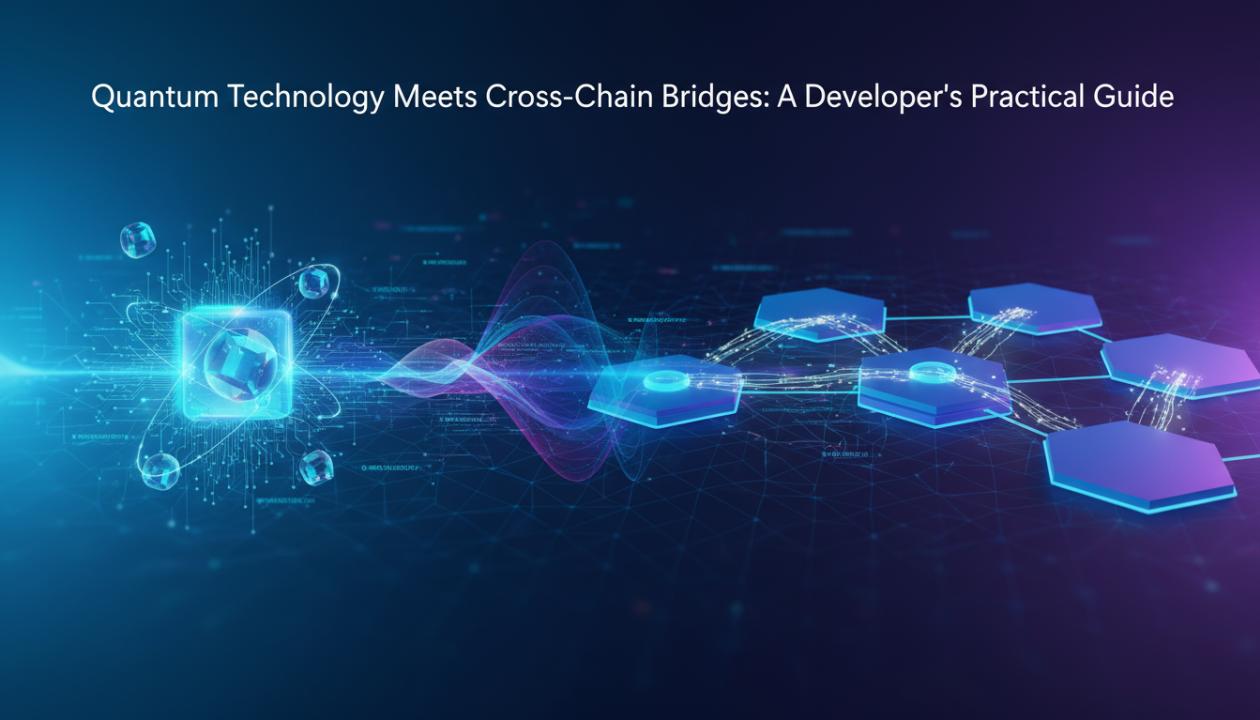
Most blockchain developers thinking about quantum computing focus on one thing: the threat. Quantum computers might break our cryptography, so we need quantum-resistant algorithms. That's true, but it's only half the story. Quantum technology isn't just a threat to defend against—it's an opportunity to build fundamentally better bridge infrastructure.
Beyond Defense: Quantum Enhancement
While the blockchain community worries about quantum attacks, researchers are already using quantum properties to improve security in ways classical systems can't match. Three quantum technologies are ready for integration into cross-chain bridges today: Quantum Key Distribution, Quantum Random Number Generation, and Post-Quantum Cryptography.
These aren't theoretical concepts. Companies are deploying them in production systems right now. The question isn't whether quantum-enhanced bridges are possible—it's how to implement them practically and cost-effectively.
Quantum Key Distribution for Bridge Validators
Quantum blockchain Key Distribution sounds exotic, but the concept is straightforward. Two parties exchange cryptographic keys using quantum states, typically photons. The quantum mechanics is simple: measuring a quantum state changes it. If someone intercepts the key exchange, both parties know immediately because the quantum states get disturbed.
This provides information-theoretic security, meaning it's secure based on the laws of physics rather than computational assumptions. No amount of computing power, classical or quantum, can break it without detection.
For cross-chain bridges, QKD offers a powerful tool for validator coordination. Consider a bridge with validators in different geographic locations securing billions in assets. These validators need to communicate and coordinate their signatures, and that communication channel is a potential weak point.
With QKD, validators establish quantum-secured keys for their communications. Even if all blockchain data is public, their coordination remains private and provably secure. This matters most for institutional bridges and high-value transfers where security requirements justify the additional infrastructure cost.
The practical challenges are real but manageable. QKD works best over relatively short distances using fiber optic cables, typically 50-100 kilometers. For global validator networks, satellite-based QKD is emerging as a viable solution, though it's expensive. Most practical implementations start with QKD between nearby validators and expand the network as costs decrease.
True Randomness from Quantum Mechanics
Randomness is everywhere in cryptographic systems. You need random numbers to generate keys, create transaction nonces, and select validators. The problem is that computers are deterministic machines. What we call "random" numbers are usually pseudo-random, generated by algorithms that look random but are actually predictable if you know the internal state.
This creates subtle but serious vulnerabilities. If an attacker can predict your random number generator, they might be able to predict validator selection, guess private keys, or replay transactions. Traditional solutions involve gathering entropy from various system sources, but this still relies on complexity rather than true unpredictability.
Quantum Random Number Generators solve this fundamentally. They use quantum processes like photon behavior or quantum tunneling to generate numbers that are provably random according to quantum mechanics. The randomness isn't algorithmic—it's baked into the fabric of reality.
Integrating QRNG into bridge infrastructure is surprisingly straightforward. USB-connected quantum random number generators are commercially available and relatively affordable. You connect one to your validator node, use it to seed your entropy pool, and suddenly all your random number generation has quantum-grade security.
The impact on bridge security is significant. Validator rotation becomes truly unpredictable. Key generation has maximum entropy. Transaction nonces are genuinely unique and unguessable. These aren't incremental improvements—they eliminate entire categories of attacks that exploit weak randomness.
Implementing Post-Quantum Signatures
Post-quantum cryptography is the foundation that makes everything else work. Your bridge needs signatures that quantum computers can't break, and that means moving beyond ECDSA.
The leading candidate for blockchain applications is CRYSTALS-Dilithium, recently standardized by NIST. It's based on lattice mathematics that remains hard for quantum computers. The signatures are larger than ECDSA—about 2.4 KB versus 65 bytes—but the performance is acceptable for most bridge operations.
The practical implementation strategy is hybrid signatures. Require both ECDSA and Dilithium signatures for bridge transactions. This provides quantum resistance without breaking compatibility with existing infrastructure. Your bridge is immediately quantum-safe, and you maintain backward compatibility with current tooling.
The gas cost issue is real but solvable. On Ethereum mainnet, verifying large post-quantum signatures is expensive. The solutions involve layer-2 processing, signature aggregation, and batch verification. Process multiple transactions together and amortize the verification cost. Use rollups or sidechains for actual signature verification and only submit compact proofs to mainnet.
For developers, implementing this is mostly a matter of using the right libraries and optimizing carefully. The Open Quantum Safe project provides production-ready implementations of post-quantum algorithms. You can integrate them into your bridge code, test thoroughly, and deploy with confidence.
Real-World Architecture Patterns
Let's talk about how this looks in practice. A quantum-enhanced bridge might operate in tiers based on transaction value. Small transfers below $10,000 use optimized hybrid signatures—quantum-resistant but cost-efficient. Medium transfers add QRNG-generated nonces for extra security. Large transfers above $1 million trigger full quantum enhancement with QKD-secured validator consensus.
This tiered approach balances security and cost. Most transactions process quickly and cheaply. High-value transfers get maximum protection. Users can choose their security level based on needs and budget.
Another practical pattern is progressive quantum migration. Start by implementing post-quantum signatures alongside classical crypto. Add QRNG for critical operations. Deploy QKD between geographically close validators and expand the network over time. Eventually phase out classical cryptography entirely as quantum computers mature.
This gradual approach manages risk while staying ahead of threats. You're not making a sudden, risky leap to unproven technology. You're methodically building quantum resistance as the technology becomes production-ready.
Performance and Cost Considerations
The honest truth is that quantum enhancements come with overhead. Larger signatures mean higher gas costs. Additional infrastructure for QKD and QRNG requires investment. The question is whether the security benefits justify the costs.
For high-value bridges, institutional applications, or regulated financial infrastructure, the answer is clearly yes. The security guarantees from quantum enhancement justify premium costs. For consumer DeFi applications processing thousands of small transactions, you need careful optimization to make it economically viable.
Benchmarking shows that Dilithium signatures add 10-20% overhead to bridge throughput for simple transaction processing. Layer-2 optimization reduces this to negligible levels. Gas costs on Ethereum mainnet are 5-10x higher for post-quantum verification, but rollup processing makes this manageable.
The real barrier isn't technology—it's implementation complexity and infrastructure investment. Building a quantum-enhanced bridge requires specialized knowledge, careful testing, and willingness to work with newer, less mature technologies.
Getting Started: Your Action Plan
If you're building or upgrading a bridge, start with post-quantum signatures. Implement hybrid ECDSA-Dilithium signatures in a test environment. Measure the performance impact. Optimize for your specific use case. This single step provides immediate quantum resistance with manageable complexity.
Next, integrate QRNG for critical randomness. Connect a quantum random number generator to your validator infrastructure. Use it to seed entropy pools for key generation and nonce creation. This is relatively inexpensive and eliminates randomness vulnerabilities.
Finally, evaluate QKD for high-value operations. If your bridge handles institutional money or very large transfers, QKD might justify its infrastructure costs. Start with a pilot between nearby validators and expand as the technology matures and costs decrease.
Throughout this process, prioritize cryptographic agility. Build your bridge so you can swap algorithms without major rewrites. The quantum landscape is evolving rapidly, and you need flexibility to adapt as standards mature and new optimizations emerge.
The Quantum Future Is Now
Quantum computing isn't a distant future concern—it's a present-day engineering challenge. The technology to build quantum-enhanced bridges exists today. The algorithms are standardized. The hardware is available. What's missing is awareness and implementation.
The bridges that integrate quantum enhancements now will dominate the high-security, institutional market as quantum awareness grows. They'll be ready when quantum computers arrive, while others scramble to retrofit security. More importantly, they'll offer genuinely superior security today based on physics rather than computational assumptions.
Cross-chain interoperability is a critical infrastructure for the blockchain ecosystem. That infrastructure needs to be quantum-ready. Start building your quantum-enhanced bridge today, because the quantum future isn't coming—it's already here.