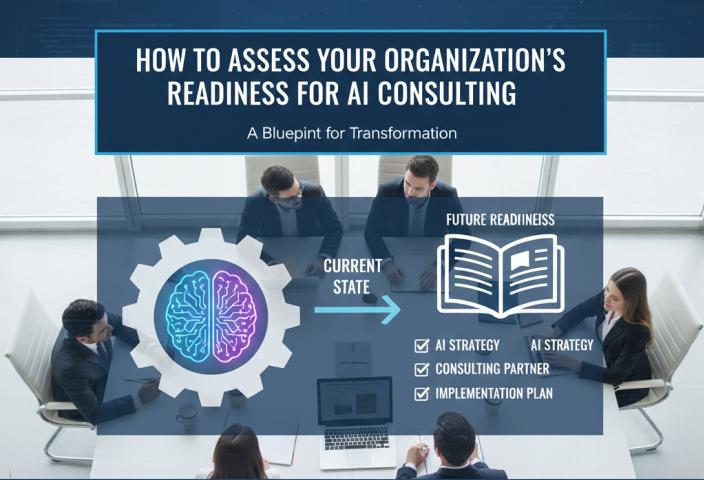

Generative AI is rapidly redefining how enterprises approach automation, innovation, and data-driven decision-making. Yet, developing scalable AI systems requires more than just adopting new tools; it demands deep expertise in data science, infrastructure, and business alignment. This is where AI Consulting Services play a pivotal role.
For global enterprises and fast-growing startups, partnering with an experienced AI Consulting Company helps bridge the gap between experimental AI initiatives and real-world business outcomes. By guiding strategy, architecture, and deployment, AI consultants ensure that generative AI applications are not only intelligent but also scalable, reliable, and ROI-driven.
How Do AI Consulting Services Help Enterprises Adopt Generative AI Efficiently?
Enterprises often face fragmented data systems and complex operational challenges when implementing generative AI models. AI consultants streamline this process by aligning technology with business priorities, ensuring that every project supports measurable goals like process optimization, cost efficiency, or customer engagement.
AI Consulting Services typically provide end-to-end support, including:
AI readiness assessments to evaluate infrastructure and data maturity.
Strategic planning to identify high-impact use cases.
Data architecture design for scalable model training.
Technology stack selection based on operational scalability.
Model monitoring and governance for compliance and performance assurance.
By following this structured approach, enterprises reduce implementation risks and achieve faster deployment timelines. A strategic consulting partner ensures that AI investments translate into long-term business growth rather than one-time innovation experiments.
What Makes Generative AI Applications Scalable for Enterprises?
Scalability in generative AI is about sustaining performance across increasing data loads, users, and evolving business demands. An AI Consulting Company ensures scalability through architectural planning and technology selection.
Key elements that define scalable generative AI applications include:
Robust data pipelines for continuous data ingestion and processing.
Modular architecture allows model components to evolve independently.
Elastic cloud infrastructure to manage dynamic workloads.
Model optimization for reduced computational overhead.
Continuous integration and deployment (CI/CD) for AI workflows.
For enterprises, this means being able to adapt AI models quickly as data grows or business needs shift. Consulting teams bring a system-level perspective that balances technical performance with operational efficiency.
Example: A global retail enterprise improved its demand forecasting accuracy by 28% through consultant-led infrastructure scaling that integrated generative AI models with its existing ERP systems.
How Do Custom AI and Machine Learning Consulting Services Improve ROI?
ROI from AI depends not only on technology but on strategic alignment with enterprise goals. Custom AI and machine learning consulting services tailor each solution to address the client’s specific needs, ensuring measurable outcomes such as revenue growth, cost savings, or customer retention.
Consulting teams focus on:
Identifying business processes most suited for AI automation.
Designing predictive and generative models aligned with business KPIs.
Developing custom training datasets for improved model accuracy.
Integrating AI with legacy systems for seamless adoption.
Establishing AI governance frameworks for responsible deployment.
This personalized approach maximizes value creation, helping enterprises turn AI into a core driver of business efficiency rather than an experimental technology investment.
How Does Full-Stack AI Development Support Long-Term Enterprise Growth?
To build truly scalable generative AI solutions, enterprises need more than models; they need full-stack capabilities covering everything from data engineering to deployment. That’s where Full-Stack AI Development comes in.
This approach covers the entire lifecycle:
Front-end interfaces that enable intuitive user interaction with AI tools.
Back-end systems that ensure data flow, integration, and computation.
APIs and microservices for interoperability with enterprise applications.
Continuous monitoring and optimization for performance tuning.
Full-stack AI development ensures sustainability and adaptability, allowing AI models to evolve as enterprise requirements grow. Partnering with a consulting firm offering these capabilities creates a foundation for continuous innovation helping companies stay competitive in fast-changing markets.
Why Are AI Consulting Companies Critical for Enterprise AI Strategy?
For most enterprises, the challenge isn’t developing AI models it’s integrating them strategically across operations. An experienced AI Consulting Company brings the cross-functional expertise needed to link AI strategy with real business impact.
The right consulting team helps enterprises:
Evaluate AI feasibility and roadmap alignment.
Identify key operational areas for AI-driven optimization.
Ensure ethical AI use and compliance with global data regulations.
Develop internal teams through AI skill-building programs.
Measure and refine AI success through continuous feedback loops.
In essence, consulting firms act as long-term innovation partners, ensuring that AI adoption remains both practical and profitable. Enterprises gain not only technical solutions but also strategic clarity to scale their AI initiatives effectively.
FAQs
1. What does an AI Consulting Company do for enterprises?
It helps enterprises plan, design, and implement AI strategies that align with their business goals. From assessing readiness to integrating full-stack solutions, these firms enable organizations to scale AI effectively.
2. Why are AI Consulting Services essential for startups?
Startups benefit from expert guidance that reduces trial and error. Consulting services ensure technology choices, architecture, and model designs align with growth objectives and budgets.
3. How do Custom AI and machine learning consulting services differ from generic solutions?
Custom consulting focuses on business-specific goals, data structures, and infrastructure. This approach delivers measurable outcomes, unlike off-the-shelf AI implementations.
4. What are the advantages of Full-Stack AI Development in enterprises?
It provides complete control over the AI lifecycle from data ingestion to model deployment ensuring scalability, interoperability, and long-term adaptability.
5. How do enterprises measure ROI in AI projects?
They track KPIs such as operational cost reduction, process efficiency, and customer satisfaction. Consultants help define these metrics during project planning.
Conclusion
Building scalable generative AI applications takes more than innovation it requires structure, experience, and strategic alignment. AI Consulting Services empower enterprises to transform AI potential into business performance by uniting technology and long-term vision.
Through a combination of full-stack development and custom consulting expertise, organizations can scale confidently, innovate continuously, and achieve measurable ROI.