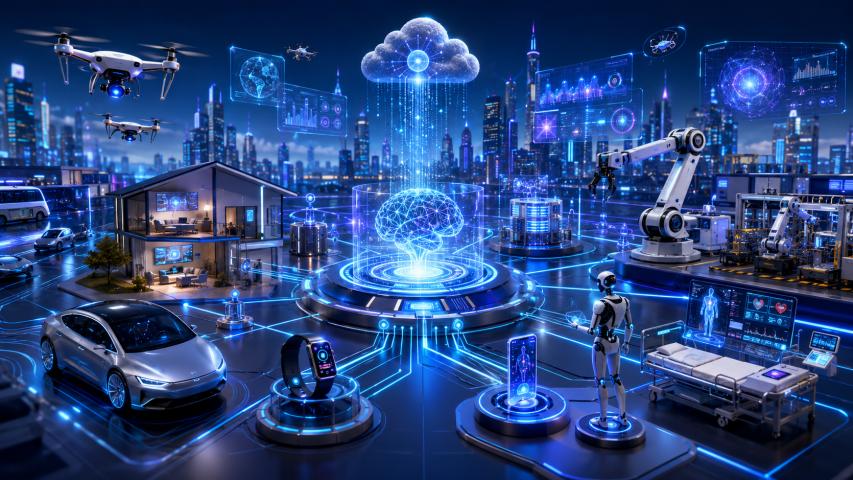
Mobile technology is going through a transformational phase where there is an amalgamation of the real and virtual worlds. With the growing number of connected smart devices, users are demanding that their mobile apps interact effectively with sensors, wearables, home appliances, vehicles, and enterprise systems. This change is a significant milestone where the idea of IoT Integration in Mobile Apps is no longer a futuristic idea but a required pillar in the current digital innovation. Companies in all sectors of the economy, including healthcare and manufacturing, retail, utilities, and logistics, are adopting IoT-based mobile solutions to enhance efficiency, offer individualized experiences, and make real-time automation possible.
The new generation of mobile applications is being defined as having data awareness, that is, not being an independent system. Instead, they receive constant feeds of information provided by devices connected to them, process pattern matching, and activate intelligent action without the intervention of the user . Whether it is a smartwatch that tracks health readings, a smart home that manages energy consumption, or an industrial IoT dashboard that streamlines the processes, in any case, mobile apps are becoming the focal point of accessing and controlling these connected systems.
With organizations scrambling into the digital transformation, mobile applications powered by IoT are helping them to create new sources of revenue, enhance their service delivery, and develop better customer loyalty. This blog will discuss how IoT is transforming the concept of mobile apps, the value it delivers, the main applications of IoT in various industries, and its development, and why future-ready firms need to invest in the IoT-enabled mobile platforms today.
Why IoT Integration Is Transforming the Mobile App Landscape
IoT is completely changing the form and the role of mobile applications. Applications were traditionally designed to perform single operations, such as communication, banking, navigation, etc. However, due to the arrival of IoT ecosystems, mobile applications are now the brain of a network of devices that are constantly gathering, processing, and transmitting data.
1. Real-Time Data Exchange
IoT-based applications can immediately synchronize data between the devices, sensors, and cloud databases. The smooth exchange enables businesses to delivertime-sensitive capabilities such as real-time tracking, predictive notifications, and smart automation.
For example:
- Logistics companies monitor the movement of the fleet in real time.
- Healthcare professionals can track patients online.
- The users of a Smart home are able to modify settings anywhere in the world.
2. Personalized and Context-Aware Experiences
IoT smart devices gather nonstop behavioral information: temperature preferences to exercise routines. Mobile applications, which are supported by IoT, use this data to provide a highly personalized user experience.
An example is that fitness apps will automatically change exercises depending on sleep patterns, heart rate performance, or daily activity intensity. Retail apps are customized product proposals provided by the location and behavioral data of the user.
3. Automation and Efficiency
IoT creates opportunities for hands-free app interactions. They make automatic adjustments or send commands without requiring manual input on the devices.
Examples:
- A smart thermostat is capable of adjusting itself depending on its presence.
- Machines in the industries indicate when they need maintenance.
- A car application will inform the owner about the tire pressure or possible errors.
Key Benefits of IoT-Enabled Mobile Applications
IoT-enabled mobile apps enhance visibility, improve engagement, reduce maintenance costs, boost productivity, and support smarter, data-driven decisions across business operations. Here is the descriptive overview of each one of these.
1. Enhanced Operational Visibility
Companies have full visibility of their activities. As an equipment status for the movement of employees to the use of resources, the IoT-driven mobile applications are able to gather actionable data that assists the decision-makers in streamlining processes.
2. Improved User Engagement
Interactive IoT applications keep the users connected. The user experience can be engaging and immersive thanks to features such as instant control over devices, instant notifications, and easy-to-use dashboards.
3. Cost Reduction Through Predictive Maintenance
The IoTs that have mobile monitoring opportunities are able to identify the abnormalities even before they become an expensive failure. This assists companies in saving on the cost of repairs and running.
4. Increased Productivity
Mobile apps fueled by the IoT automate repetitive workflows and simplify workflows. Organizations will be able to cut down on manual labor, decrease mistakes, and increase their overall productivity in the different departments.
5. Data-Driven Decision Making
Mobile apps are a source of analytical power, with the sensors constantly producing information. Businesses will be able to monitor trends, predict demands, and develop data-supported growth strategies.
Industries Being Revolutionized by IoT Mobile Integration
There are multiple industries that are being affected positively by the integration of the IoT mobile in their project. Here are some of the top ones that we have mentioned in this section to understand things better for the particular field. Have a look.
1. Healthcare
IoT medical devices, such as glucose monitors, ECG trackers, wearables, and oxygen sensors, along with mobile apps, can be used to monitor patients remotely, diagnose them earlier, and manage care better. Physicians have access to real-time patient information, thereby enhancing treatment accuracy.
2. Smart Homes & Real Estate
The IoT applications regulate lighting, temperature, security, and appliances. Individuals can control a whole household from their phones, create routines, and receive real-time notifications.
3. Automotive & Transportation
The connected cars are based on IoT integration. Mobile applications assist in monitoring the health of the vehicle, navigation, predictive maintenance, in-car entertainment, and locking/unlocking.
4. Manufacturing & Industry 4.0
IoT sensors are related to mobile apps to monitor machine performance and automate production lines, optimize inventory, and minimize downtime through predictive maintenance.
5. Retail & E-Commerce
IoT-enabled apps are utilized by retailers in beacon marketing, inventory control, smart checkout, and personalized shopping experiences.
6. Agriculture
Mobile IoT platforms enable smart agriculture by monitoring the soil chemistry, weather forecasting, computerized irrigation, and livestock location.
What Goes Into a Strong IoT-Integrated Mobile App?
The creation of an IoT-based mobile application needs proper planning, technical accuracy, and an implementation strategy. For most businesses, it would be teaming up with a competent supplier of IoT App Development Services, as IoT mobile applications require experience in mobile device connectivity, cloud computing, network security, and cross-platform development.
1. Hardware and Sensor Integration
The developers should make sure that there is a smooth connection between the app and the Internet of Things. Considerations such as compatibility and communication protocols, as well as power efficiency, become imperative.
2. Reliable Connectivity Protocols
IoT apps rely heavily on wireless communication technologies such as:
- Bluetooth Low Energy (BLE)
- Wi-Fi
- MQTT
- NFC
- Zigbee / Z-Wave
- Cellular networks (4G, LTE-M, 5G)
Choosing the right protocol ensures data transmission is fast, accurate, and secure.
3. Secure Data Handling
IoT applications work with huge amounts of sensitive information. Developers need to include:
- End-to-end encryption
- Secure APIs
- Multi-factor authentication
- Network segmentation
- Real-time threat monitoring
4. Scalable Cloud Infrastructure
The information produced by IoT has to be stored, processed, and analyzed in the cloud. The application must have the feature of being expanded with ease as more devices are integrated.
5. User-Friendly Interface
The UI should be easy to use and monitor device states, as well as manage devices. Responsive architecture, intuitive dashboards, and easy navigation are essential.
6. Multi-Platform Support
There should be a robust IoT application that supports both Android, iOS, and web platforms. This is why most companies are joining forces with organizations providing custom mobile app development services to create uniform cross-platform journeys.
Top Use Cases of IoT-Powered Mobile Apps in 2025 and Beyond
Smart Wearables- Mobile apps that are used together with the Internet of Things (IoT) wearables monitor fitness, sleep, stress, and health indicators, and provide real-time feedback.
Smart Homes- Applications that regulate lights, heating, cameras, lockouts, home assistants, and appliances are becoming the way of life.
Connected Cars- IoT will allow remote control of vehicles, monitoring their driver behavior, and intelligent navigation.
IndustrialIoT- Manufacturers will have real-time production, predictive maintenance, and automation.
Healthcare Monitoring Apps- Remote health apps will see fast growth, as the demand for telemedicine will rise.
Energy Management Systems- Smart meters and mobile applications enable the user to monitor consumption, track bills, as well as maximize usage.
The Future of IoT in Mobile App Development
With the maturity of 5G and edge computing, IoT-driven mobile applications will be even quicker, smarter, and more autonomous. The implementation of AI will allow applications to understand the behavioral patterns, predict, and perform automated activities without human interference. IoT applications used with augmented reality (AR) will drive immersive experiences in games, shopping, education, and industrial training.
Companies making investments today will gain an early advantage in innovation, cost-effectiveness, customer interactions, and market competence.
Conclusion
IoT will reinvent the future of mobile apps, with unlimited opportunities for automation, personalization, and smartness. IoT-enabled mobile applications are helping businesses to achieve efficiency and customer satisfaction never seen before in smart homes, connected cars, and remote healthcare. The companies that will adopt this change will have a significant competitive advantage within the digital economy.
The need to create enterprise IoT systems or consumer-oriented connected applications; there are numerous ways in which collaboration with the best Android app development company can enable you to provide dependable, scalable, and futuristic solutions that best match your business objectives. With the ever-growing use of IoT technology, the number of people who would want advanced, convenient, and reliable mobile apps will continuously increase, making the integration of IoT a key approach to the development of digital business in the future generation.