Quick Overview
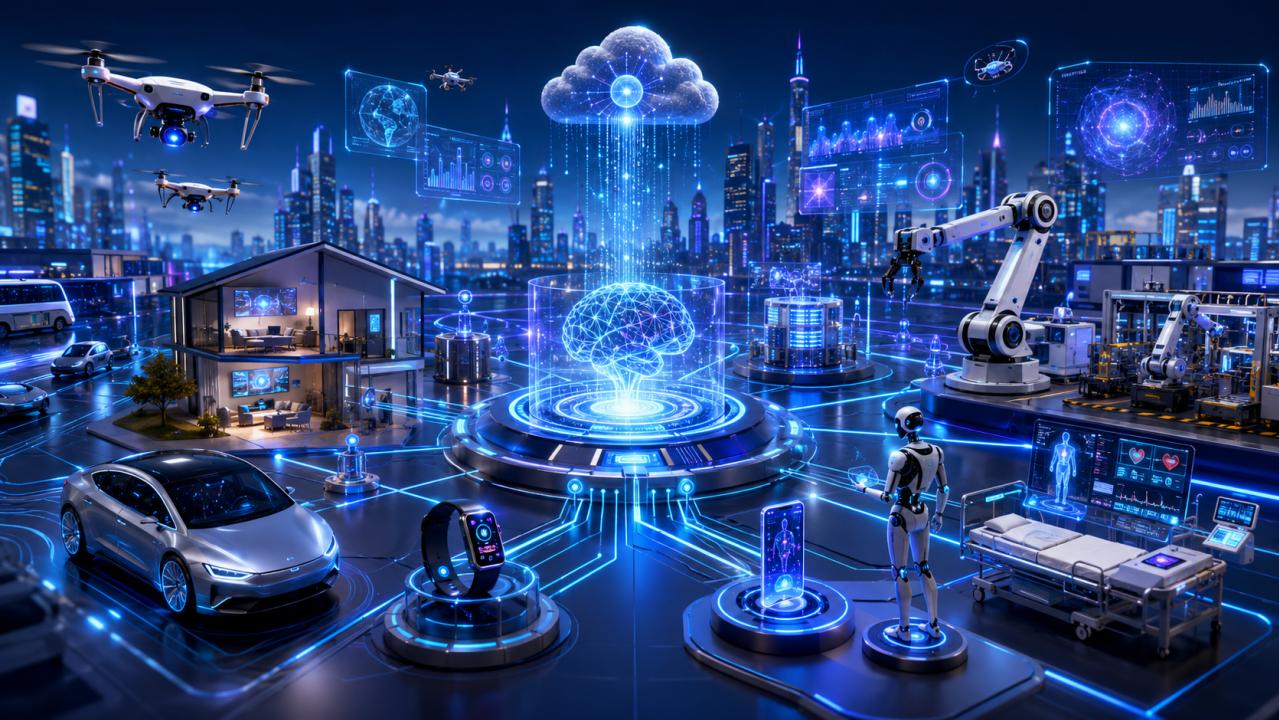
IoT is changing from simply collecting data to making smart, real-time decisions at the network edge.
Edge AI eliminates the need for cloud computing by processing data directly on IoT devices.
Autonomous systems are increasingly relying on IoT sensor networks that operate without human intervention.
Major challenges are limited power, security risks, and compatibility issues across different networks.
New standards like Matter and MQTT 5.0 are changing how IoT systems talk to each other.
AI-based predictive maintenance and anomaly detection have become essential in industrial settings.
Your smart factory floor goes dark at 2 AM, not due to a power cut, but because a legacy sensor failed silently and no system caught it in time. That scenario is exactly what the next generation of IoT architecture aims to prevent. Connected devices now do more than just collect data and send it upstream. They think, decide, and act, often before a human operator even opens a dashboard.
The blend of artificial intelligence, edge computing, and autonomous control loops is changing what it means to build connected systems. For developers, engineers, and businesses investing in this area, understanding the technology's direction is essential. It is vital.
The Shift from Connected to Intelligent
For most of IoT's first decade, the architecture was simple. Devices collected data, the cloud processed it, and dashboards displayed the results. That model had real limitations, including latency, high bandwidth costs, single points of failure, and privacy risks.
The future of IoT development completely changes that model. Intelligence is shifting to the edge. Instead of sending every sensor reading to a central server, modern IoT systems include inference engines directly on constrained hardware. A temperature sensor on a manufacturing line no longer just reports readings. It classifies anomalies, triggers local actuators, and only sends data to the cloud when necessary.
This architectural shift is also driving demand for specialized IoT development services. These services go beyond device provisioning. They include model deployment, firmware-level optimization, and real-time telemetry pipelines that can support inference at sub-millisecond latency.
Edge AI: Processing Where the Data Lives
Edge AI is one of the most important technical developments in IoT right now. The core idea is simple: run trained machine learning models on the device itself rather than offloading computation.
The implementation is not simple, though. Deploying a neural network on a microcontroller with 256KB of RAM and no active cooling needs strong model compression.
The main techniques include:
Quantization, which reduces the numerical precision of model weights from 32-bit floats to 8-bit integers, significantly reduces the memory footprint.
Pruning, which removes unnecessary neurons and connections without significantly losing accuracy.
Knowledge distillation, which trains a smaller "student" model to mimic the behavior of a larger "teacher" model.
Frameworks like TensorFlow Lite, ONNX Runtime, and Edge Impulse are developing quickly. They allow developers to deploy computer vision, keyword detection, and predictive analytics models on hardware costing less than $5 per unit.
The benefits are significant:
Latency drops from hundreds of milliseconds to under one millisecond.
Bandwidth consumption decreases dramatically.
Systems stay operational even when connectivity fails.
For industrial applications, such as conveyor belts that can't wait for a round-trip API call, this is not optional. It is a strict requirement.
Autonomous Systems and the Role of IoT Sensor Fusion
Autonomous systems, from warehouse robots to self-regulating HVAC grids, rely on a strong, dependable flow of environmental data. The Internet of Things (IoT) provides the sensory layer that allows for autonomy.
Sensor fusion is central to this. One sensor offers a data point. Several different sensors, such as lidar, IMU, pressure transducers, and thermal cameras, provide situational awareness. The challenge is to combine those streams into a clear world model in real time while correcting for noise, drift, and timing mismatches.
This is where top AI development companies are investing heavily. The hard problems are not in the sensors themselves but in the middleware:
Deterministic data pipelines guarantee processing order and timing.
Fault-tolerant state machines handle missing or corrupted inputs gracefully.
Model architectures degrade predictably when sensor feeds drop out.
Federated learning is also gaining traction in this context. Instead of centralizing training data, which creates privacy and bandwidth issues, federated approaches train models locally on each device and share only gradient updates. The result is a global model that continues to improve without ever exposing raw sensor data.
Security and Interoperability: The Unsolved Problems
No discussion of IoT's future is complete without addressing its ongoing vulnerabilities.
The attack surface of a large IoT deployment is vast. Each endpoint is a potential entry point. Default credentials, unpatched firmware, and unencrypted data channels are still surprisingly common, even in enterprise environments. As IoT systems gain greater control over physical infrastructure rather than just monitoring it, the risks of a breach become more serious.
The industry is responding with several best practices:
Zero-trust networking, where every device continuously authenticates instead of relying on trust from its network segment
Hardware security modules, which are becoming standard in higher-value endpoints
Secure boot and attestation, which verify device integrity at startup before connecting to the network
Cryptographically signed OTA updates, which prevent tampered firmware from being widely distributed
Interoperability is another significant challenge. Many competing protocols, including Zigbee, Z-Wave, Thread, LoRaWAN, and NB-IoT, serve different purposes, creating fragmented ecosystems. The Matter standard, supported by Apple, Google, Amazon, and the Connectivity Standards Alliance, represents the most serious effort so far to create a unified application layer for smart devices. Its adoption is speeding up, although industrial IoT remains largely outside its reach.
What Developers Need to Build For
The practical implication for anyone working in this field is a change in the needed skills. Firmware optimization, RTOS configuration, and hardware-software co-design are now key skills, alongside the cloud-native skills that were essential in the last decade. Knowing about power budgets, duty cycles, and sleep-state management is vital when your device runs on a coin cell for 3 years.
At the systems level, the future of IoT development demands fluency in:
Event-driven architectures for handling asynchronous, high-frequency data streams.
Message broker patterns using MQTT and AMQP for reliable device-to-backend communication.
Time-series data management at scale with tools like InfluxDB and TimescaleDB, which are built for sensor workloads that can overwhelm traditional relational databases.
Digital twins are virtual replicas of physical devices. They are used for testing, simulation, and predictive modeling before changes affect production hardware.
Conclusion
IoT is rapidly evolving into greater complexity, with AI at the edge, autonomous control, and security shaping new architectures. Devices are smarter, systems more connected, and firmware choices impact entire environments. For those willing to manage this complexity and understand both its benefits and risks, significant opportunities exist. The next IoT phase replaces, not stacks on top of, the old model.
Frequently Asked Questions
1. What is the future of IoT development in the next five years?
The trend favors widespread edge AI, deeper integration with 5G private networks, and greater independence in industrial and logistics sectors. Initiatives like Matter and MQTT 5.0 aim to reduce fragmentation, while federated learning and on-device inference address bandwidth and privacy concerns.
2. How does edge AI differ from traditional cloud-based IoT processing?
Traditional IoT transmits raw sensor data to cloud servers, increasing latency and bandwidth costs. Edge AI processes trained models locally on devices or gateways, providing real-time inference without network communication. This is vital for time-sensitive or unreliable connectivity applications.
3. What are the biggest security challenges in modern IoT systems?
Main challenges are authenticating devices at scale, securing firmware updates, handling unencrypted data channels, and managing the large attack surface from diverse hardware. Best practices include zero-trust networking, hardware security modules, and cryptographically signed OTA updates.
4. What is sensor fusion and why is it important for autonomous systems?
Sensor fusion merges data from various sensors with different methods, sample rates, and noise levels into a clear environment model. Autonomous systems rely on sensor fusion because no single sensor provides sufficient reliability or coverage for safe, real-time decisions.
5. What programming languages and frameworks are most relevant for IoT development today?
C and C++ remain top choices for firmware and embedded systems. Python is popular for rapid prototyping and machine learning. Rust is gaining traction in safety-critical embedded applications because of its memory safety.