
In today’s rapidly evolving cybersecurity landscape,
enterprises face increasingly sophisticated threats that often evade
traditional detection mechanisms. To stay ahead, security teams are turning to
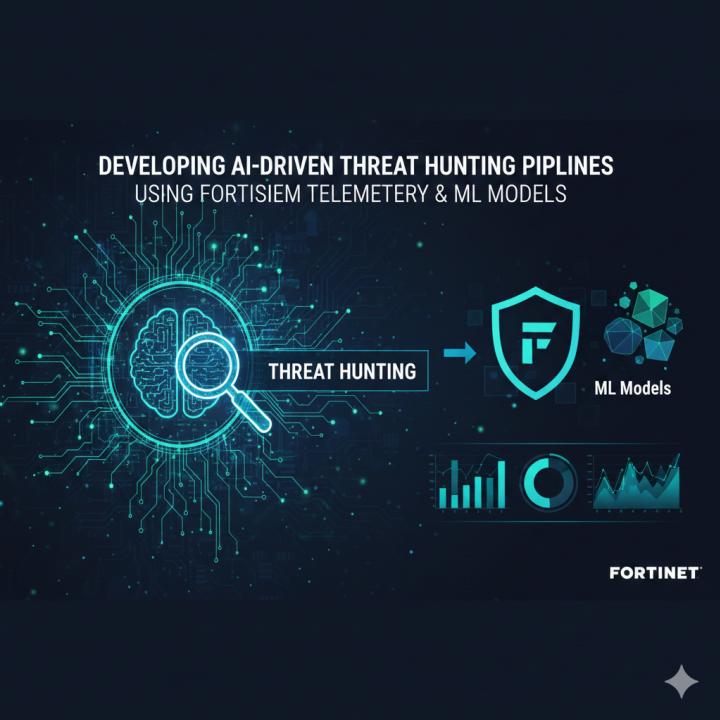
AI-driven threat hunting pipelines that leverage telemetry data and machine
learning models for proactive threat detection. FortiSIEM, Fortinet’s
comprehensive Security Information and Event Management platform, provides the
necessary infrastructure to collect, correlate, and analyze vast amounts of
security data in real time.
For Fortinet NSE 8 Course professionals, mastering AI-driven threat
hunting using FortiSIEM telemetry is essential. By combining advanced analytics
with machine learning, security teams can identify anomalous patterns, reduce
response times, and improve overall enterprise security posture.
Understanding AI-Driven Threat Hunting
AI-driven threat hunting combines the principles of
traditional threat hunting with artificial intelligence and machine learning.
Rather than relying solely on predefined signatures or rule-based alerts, AI
algorithms analyze network and security telemetry to uncover hidden threats,
insider attacks, and abnormal behaviors that may indicate a breach.
Key components of AI-driven threat hunting include:
- Data
Collection: Aggregating logs, events, and telemetry from endpoints,
network devices, and applications.
- Anomaly
Detection: Identifying deviations from normal patterns using
statistical models and machine learning.
- Correlation
and Contextualization: Linking events across multiple sources to
provide actionable insights.
- Automated
Response: Integrating with security orchestration tools to mitigate
threats proactively.
Using AI-driven pipelines significantly enhances an
organization’s ability to detect advanced threats that traditional systems
might miss.
Leveraging FortiSIEM Telemetry
FortiSIEM provides a unified platform for collecting and
analyzing security telemetry across the enterprise. Telemetry data includes
logs, flow records, endpoint events, and application activities, which are
vital for building AI-driven threat detection models.
Key advantages of using FortiSIEM telemetry for threat
hunting include:
- Centralized
Visibility: Aggregate data from multiple sources for holistic
analysis.
- Real-Time
Correlation: Detect potential threats as events occur, reducing dwell
time.
- Customizable
Dashboards: Monitor critical security metrics and threat indicators.
- Scalability:
Support large-scale enterprise deployments without sacrificing
performance.
By feeding high-quality telemetry into machine learning
models, FortiSIEM enables predictive threat detection and informed
decision-making.
Building AI-Driven Threat Hunting Pipelines
Developing effective AI-driven pipelines requires a
structured approach:
1. Data Preprocessing
Clean and normalize telemetry data to ensure consistency.
Remove duplicate entries, standardize formats, and enrich logs with contextual
information, such as geolocation or device type.
2. Feature Engineering
Select relevant features for machine learning models,
including network flows, login patterns, access events, and application usage
metrics. Well-defined features improve model accuracy and reduce false
positives.
3. Model Selection and Training
Use supervised or unsupervised machine learning algorithms
to detect anomalies. Supervised models require labeled datasets, while
unsupervised models identify deviations from established norms.
4. Integration with FortiSIEM
Deploy trained models within FortiSIEM to analyze real-time
telemetry. Automate alert generation for suspicious activity, and enable
security analysts to investigate incidents efficiently.
5. Continuous Improvement
Regularly retrain models using updated telemetry and threat
intelligence. Incorporate feedback from analysts to refine detection
capabilities and adapt to emerging attack techniques.
Best Practices for AI-Driven Threat Hunting
- Prioritize
High-Value Assets: Focus analytics on critical systems and sensitive
data.
- Maintain
Data Quality: Accurate, consistent telemetry ensures reliable model
performance.
- Implement
Layered Detection: Combine signature-based and AI-driven methods for
comprehensive coverage.
- Monitor
Model Performance: Track precision, recall, and false positive rates
to fine-tune detection accuracy.
- Collaborate
with SOC Teams: Analysts provide essential contextual knowledge to
enhance AI-driven insights.
Following these practices ensures that AI-driven threat
hunting pipelines deliver actionable results and strengthen enterprise security
defenses.
Why Fortinet NSE 8 Professionals Should Focus on
AI-Driven Threat Hunting
For Fortinet NSE 8 engineers, developing AI-driven threat
hunting pipelines using FortiSIEM telemetry is a strategic skill. Enterprises
require advanced capabilities to detect sophisticated threats, and leveraging
AI allows security teams to:
- Identify
anomalies faster and reduce dwell time.
- Automate
repetitive analysis tasks, freeing analysts for higher-value work.
- Correlate
disparate data sources to uncover complex attack patterns.
Mastering these techniques positions Fortinet NSE 8
professionals to implement next-generation security operations that proactively
defend against evolving cyber threats.
Conclusion
Developing AI-driven threat hunting pipelines using
FortiSIEM telemetry and machine learning models is a powerful approach to
enhancing enterprise security. For Fortinet NSE 8 Certification professionals, mastering this
methodology enables proactive detection, rapid response, and comprehensive
threat visibility. By integrating AI-driven analytics with FortiSIEM telemetry,
organizations can uncover hidden threats, reduce risk exposure, and maintain a
resilient security posture in today’s complex threat landscape.