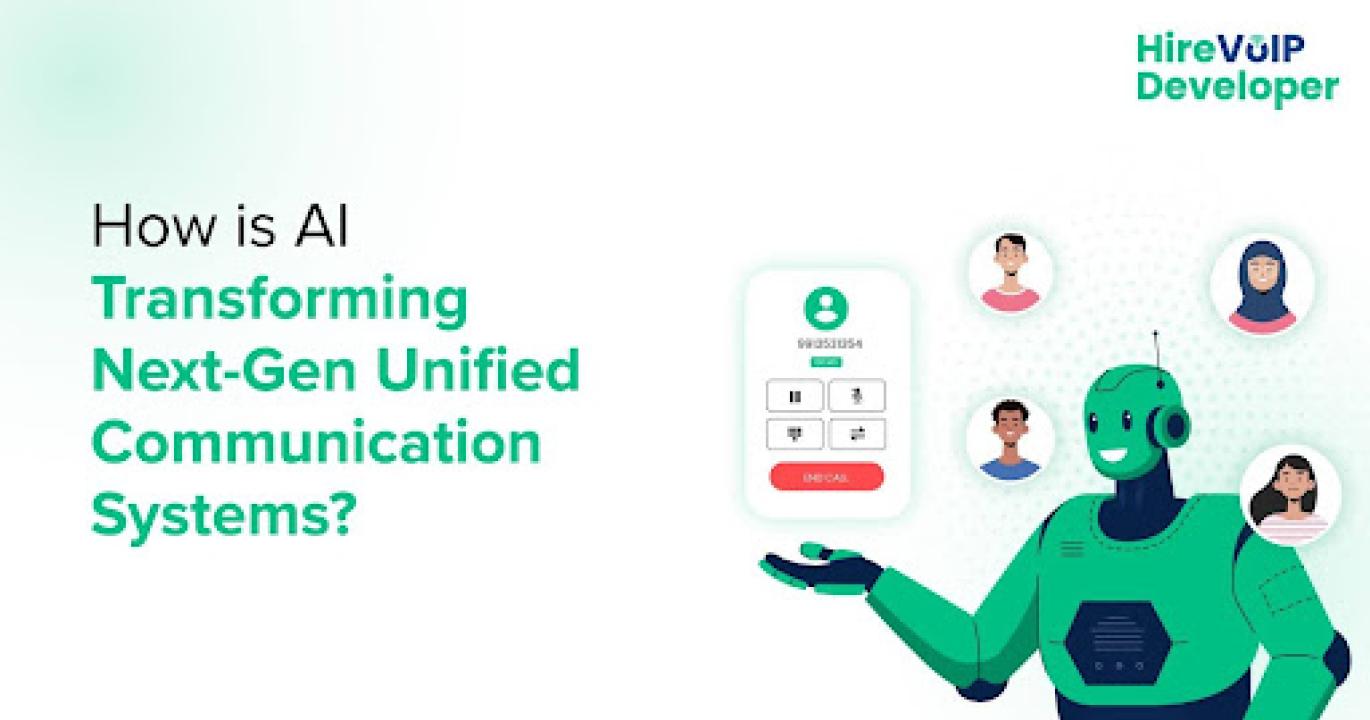
AI is most effective when it augments human intelligence, amplifying the impact of collaborative efforts. This principle is particularly evident in unified communications solutions, where AI enhances collaboration by learning from patterns, anticipating challenges, and enabling teams to focus on what truly matters.
With Unified Communication AI Integration, UCaaS platforms are no longer just about call routing and messaging; they are adaptive ecosystems capable of learning, predicting, and optimizing communication in real time.
AI for UC platforms can be valuable not only for automating repetitive tasks but also for enhancing the user experience, reducing costs, and improving reliability.
To understand the transformative potential, let’s first explore the role AI plays in next-generation Unified Communication Systems.
What Role Does AI Play in Next-Generation Unified Communication Systems?
AI for UC Platforms is no longer a peripheral enhancement; it is embedded into the core fabric of modern UCaaS design. Its role spans predictive analytics, adaptive quality of service, contextual insights, and advanced security.
In practice, AI in Unified Communication transforms into intelligent ecosystems that anticipate problems, optimize performance, and enhance protection. Below are the key areas where AI delivers measurable impact:
Predictive Network Management
AI continuously monitors network traffic and predicts potential issues before they impact users, enabling enterprises to proactively maintain call quality and system reliability.
Monitors SIP signaling and RTP traffic in real time using neural networks.
Predicts jitter, latency, or packet loss before it affects users.
Automatically switches codecs, reroutes traffic, or reserves bandwidth.
Impact: Prevents downtime, ensures call quality, reduces IT intervention.
Proactive QoS (Quality of Service) Assurance
AI ensures consistent service quality by continuously analyzing performance metrics and taking automatic corrective actions to prevent service degradation.
Continuously tracks call quality metrics like MOS ( Mean Opinion Score) and packet loss.
Uses anomaly detection to identify potential service degradation.
Automatically adjusts SD-WAN policies, UC packet priorities, or workload distribution.
Impact: Maintains SLA (Service Level Agreement) compliance and a consistent user experience, even under high load.
Contextual Intelligence in Collaboration
AI leverages natural language processing to analyze communication content, detect sentiment, and provide actionable insights that improve team collaboration and decision-making.
Applies NLP to voice and video calls to analyze content, detect sentiment, and categorize topics.
Highlights key action items and suggests follow-ups.
Supports multi-language transcription for global teams.
Identifies recurring collaboration patterns to optimize meeting schedules and enhance productivity.
Impact: Improves meeting efficiency, identifies collaboration bottlenecks, and streamlines workflows.
Adaptive Security Monitoring
AI protects UC systems from fraud, spam, and abnormal activity by continuously analyzing traffic patterns and automatically applying security measures to prevent these threats.
Detects fraud, spam, and abnormal SIP call patterns.
Flags suspicious call volumes, IP addresses, or login attempts.
Automatically triggers dynamic encryption, multi-factor authentication, or call blocking.
Impact: Protects UC systems from security threats without disrupting operations.
Enterprise Application Integration
AI connects UC platforms to enterprise systems, such as CRM, ERP, and ITSM, to provide intelligent workflows and faster, data-driven responses.
Connects UCaaS platforms with CRM, ERP, and ITSM tools.
Fetches customer records, predicts intent, and recommends responses.
Automates workflows such as opening service tickets when call quality drops.
Impact: Turns agents into problem-solvers, increases efficiency, and enhances customer satisfaction.
Automated Resource Optimization
AI dynamically manages system resources based on real-time traffic and usage patterns, ensuring seamless performance even during peak demand.
Monitors real-time traffic and usage patterns to dynamically allocate system resources.
Adjusts server loads, bandwidth, or compute power as needed to optimize performance.
Impact: Reduces operational costs, prevents overload, and ensures seamless communication even during peak times.
These AI-driven capabilities collectively transform UC systems from reactive tools into intelligent, self-optimizing communication ecosystems. Building on this foundation, we can now explore AI-driven features that proactively prevent network congestion and downtime, the next critical area of discussion for modern UCaaS platforms.
AI Features in Unified Communication That Prevent Network Congestion and Downtime
Downtime is one of the most costly pain points for enterprises. Traditional UC monitoring relies on reactive alerts, but AI in Unified Communication changes the paradigm with predictive resilience. The following capabilities demonstrate how AI transforms reactive UC monitoring into predictive, self-managing systems:
Traffic Forecasting with ML Models: Machine learning predicts high-volume call times, prompting pre-allocation of resources.
Dynamic Bandwidth Allocation: AI-driven SD-WAN reprioritizes VoIP packets and adjusts bandwidth automatically to maintain call quality.
Self-Healing Networks: Detects anomalies, such as packet drops, and reroutes traffic through alternate SIP trunks or media gateways.
Codec Adaptation: Dynamically switches codecs to preserve call quality while reducing bandwidth usage.
These proactive measures minimize downtime, improve workload distribution, and ensure a consistent user experience.
How Does AI in Unified Communication Integrate With Enterprise Apps?
AI delivers its full potential when UCaaS platforms seamlessly integrate with critical enterprise systems, such as CRM, ERP, and helpdesk software. Let’s explore how it links UCaaS platforms with core enterprise applications:
CRM Integration: AI syncs UC platforms with CRM, retrieves past interactions, analyzes sentiment, and suggests real-time responses.
ERP Connectivity: AI connects UCaaS to ERP, surfacing inventory or billing data during live calls, e.g., fetching delivery timelines for delayed orders.
Helpdesk Augmentation: NLP models analyze queries, auto-route tickets, and suggest knowledge-base articles or canned responses.
Workflow Automation: AI triggers workflows, such as creating ITSM (Information Technology Service Management) tickets when call quality drops or alerts are triggered.
These Unified Communication AI Integrations enhance operational agility, reduce manual intervention, and lay the groundwork for significant cost savings, underscoring the operational benefits of AI-driven UC.
How Can AI Reduce Operational Costs Compared to Traditional Unified Communication Systems?
As enterprises scale, operational costs in communication systems can quickly spiral, especially with traditional UC setups that rely on manual monitoring, static bandwidth allocation, and repetitive workflows. AI-driven UCaaS platforms address these challenges by automating routine tasks, dynamically managing resources, and predicting issues before they affect users, resulting in significant cost savings. The table below outlines the main distinctions between traditional UC systems and AI-powered UCaaS platforms:
Aspect | Traditional UC Systems | AI-Driven UCaaS | Impact / Benefit |
Monitoring & Troubleshooting | Manual alerts, reactive troubleshooting. | Predictive monitoring, self-healing networks. | Reduces IT intervention and downtime. |
Bandwidth & Resource Management | Fixed allocation, reactive adjustments. | Dynamic bandwidth allocation & codec adaptation. | Optimizes costs and preserves call quality. |
Workflow Automation | Manual ticket creation, repetitive tasks. | Automated workflows (CRM, ITSM, helpdesk) | Saves labor hours, reduces errors. |
Downtime Costs | High due to reactive maintenance. | Minimized via AI-driven predictive actions. | Reduces revenue loss from outages. |
Scalability | Manual scaling, high infrastructure costs. | AI-driven dynamic resource allocation. | Lowers operational expenses while supporting growth. |
By comparing these approaches, it’s clear that AI in UCaaS not only improves efficiency but also directly impacts the bottom line by reducing manual effort, preventing downtime, and optimizing infrastructure usage.
Which AI Features in Unified Communication Enhance the Customer Experience?
With AI evolving continuously, UC platforms are becoming more intelligent, more adaptive, and better equipped to enhance both user experience and operational efficiency. However, not all AI capabilities in UC deliver equal value. Enterprises should prioritize features that have a measurable impact on customer satisfaction and loyalty. Let’s understand the difference:
Must-Have Features:
Real-time Transcription with NLP for accurate meeting records.
Sentiment Analysis to measure customer tone and adjust responses.
Intelligent Call Routing to minimize wait times and connect users to the right agents.
Adaptive Quality Management to ensure seamless video and voice during peak loads.
Nice-to-Have Features:
Virtual Avatars for Meetings add novelty but provide limited ROI.
Predictive Employee Scheduling is helpful for planning, but not critical.
AI-generated Meeting Summaries are valuable but often duplicative of transcription services.
Focusing on “must-have features” ensures unified communications solutions deliver a premium business experience, maximizing the return on AI investments.
Conclusion
AI in Unified Communication is not just reshaping UCaaS; it is redefining enterprise collaboration. From predictive QoS and codec adaptation to CRM integration and adaptive security, AI for UC Platforms enables businesses to transform communication from a basic utility into a competitive differentiator.
For businesses ready to move from vision to execution, partnering with experts like Hire VoIP Developers ensures AI-powered UCaaS platforms are tailored to enterprise needs, fostering intelligent, resilient, and customer-focused communications.