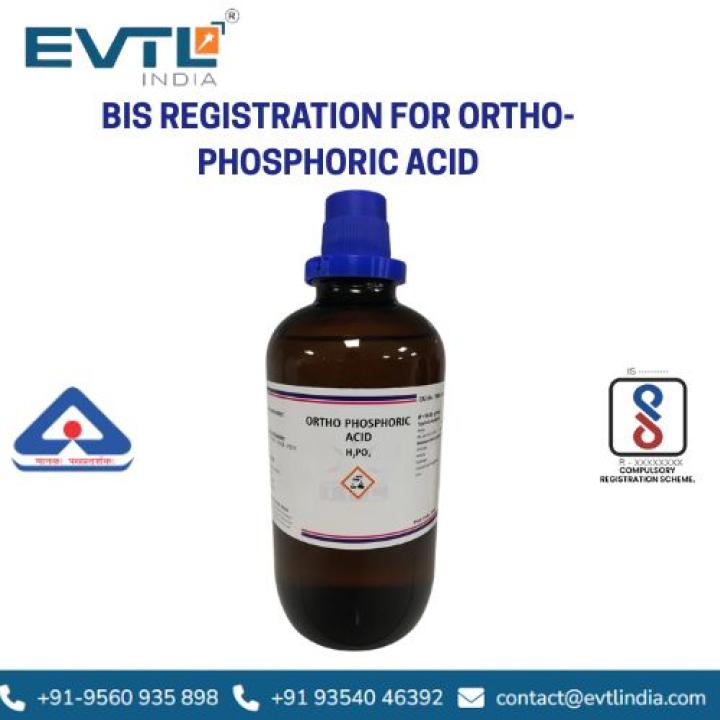
Ortho-phosphoric acid, commonly known as phosphoric acid, is a critical industrial chemical used across food processing, pharmaceuticals, fertilizers, and various manufacturing sectors. In India, the production, import, and sale of ortho-phosphoric acid are regulated under the Bureau of Indian Standards (BIS), making BIS certification for ortho-phosphoric acid mandatory for market compliance.
This comprehensive guide covers everything you need to know about BIS registration for ortho-phosphoric acid, the IS 798:2020 standard, CRS (Compulsory Registration Scheme) requirements, and how to navigate the certification process efficiently.
Understanding IS 798:2020 for Ortho-Phosphoric Acid
IS 798:2020 is the Indian Standard specification for ortho-phosphoric acid (food grade). This standard, published by the Bureau of Indian Standards, defines the quality parameters, purity requirements, testing methods, and packaging specifications for ortho-phosphoric acid intended for use in food and beverage applications.
The standard covers:
- Chemical composition and purity levels
- Physical properties (appearance, odor, specific gravity)
- Maximum permissible limits for impurities
- Heavy metal content restrictions
- Arsenic and lead limits for food safety
- Packaging and labeling requirements
- Sampling and testing methodologies
- Storage and handling guidelines
Compliance with IS 798:2020 ensures that ortho-phosphoric acid meets food safety standards and is suitable for applications in soft drinks, food acidulants, and pharmaceutical formulations.
Why BIS Certification for Ortho-Phosphoric Acid is Mandatory
The Bureau of Indian Standards has brought ortho-phosphoric acid under the Compulsory Registration Scheme (CRS), making BIS certification for ortho-phosphoric acid mandatory for:
Domestic Manufacturers:
- Cannot manufacture or sell ortho-phosphoric acid without valid BIS license
- Must display BIS Standard Mark (ISI) on products and packaging
- Required to maintain consistent quality as per IS 798:2020
- Subject to periodic surveillance and market testing
Importers:
- Cannot import ortho-phosphoric acid without BIS registration
- Must obtain BIS CRS certification for ortho-phosphoric acid before customs clearance
- Required to register foreign manufacturing facilities with BIS
- Subject to sample testing and quality verification at Indian ports
Market Impact:
- Retailers and distributors can only stock BIS-certified products
- Food and beverage manufacturers must source certified ortho-phosphoric acid
- Non-compliance attracts penalties, product seizure, and legal action
- Government procurement mandatorily requires BIS certification
The mandatory nature of this certification makes engaging a BIS consultant for ortho-phosphoric acid essential for timely and compliant market entry.
What is CRS Certification for Ortho-Phosphoric Acid?
The Compulsory Registration Scheme (CRS) is BIS's regulatory framework for products affecting public health and safety. CRS certification for ortho-phosphoric acid represents the mandatory compliance pathway under this scheme.
Key features of CRS certification:
Simplified Process: Unlike the traditional BIS licensing scheme, CRS offers a streamlined registration process with faster approvals, making it more accessible for manufacturers and importers.
Self-Declaration Based: Manufacturers self-certify compliance with IS 798:2020 based on their own testing or testing from BIS-recognized laboratories, reducing bureaucratic delays.
Mandatory Testing: Despite self-declaration, products must undergo testing at BIS-recognized laboratories to verify conformity with standard specifications.
Registration Validity: CRS certification for ortho-phosphoric acid is typically valid for one year and must be renewed annually with updated compliance documentation.
Surveillance Mechanism: BIS conducts market surveillance, random sampling, and testing to ensure ongoing compliance. Non-conforming products face immediate action.
Working with an experienced CRS consultant for ortho-phosphoric acid ensures proper understanding and implementation of these requirements.
BIS QCO for Ortho-Phosphoric Acid Explained
BIS Quality Control Order (QCO) is the legal notification that makes BIS certification compulsory for specific products. The BIS QCO for ortho-phosphoric acid mandates that:
- No manufacturer shall manufacture or store ortho-phosphoric acid for sale without a valid BIS license
- No dealer shall sell or distribute ortho-phosphoric acid without BIS certification
- Every package must bear the Standard Mark (ISI mark) with license number
- Importers must obtain registration before clearing goods from customs
- Violation attracts penalties under the BIS Act 2016
The QCO specifies:
- Effective date of mandatory certification
- Applicable product categories and grades
- Transition period for existing manufacturers
- Penalties for non-compliance
- Enforcement mechanisms
Understanding the BIS QCO for ortho-phosphoric acid is crucial for legal compliance and avoiding disruptions in manufacturing or import operations.
The BIS Registration Process for Ortho-Phosphoric Acid
Obtaining BIS registration for ortho-phosphoric acid involves several systematic steps:
Step 1: Product Testing and Analysis
Before applying, your ortho-phosphoric acid must be tested at BIS-recognized laboratories:
- Submit representative samples of your product
- Laboratory conducts comprehensive testing per IS 798:2020 parameters
- Testing includes purity analysis, heavy metal screening, chemical composition verification
- Receive detailed test report indicating compliance or deviations
- Address any non-conformities through process improvements
- Testing typically takes 7-15 days depending on laboratory workload
Step 2: Documentation Preparation
Compile comprehensive documentation required for BIS license for ortho-phosphoric acid:
Manufacturing Documents:
- Manufacturing process flow chart
- Quality control procedures and testing protocols
- Raw material specifications and supplier details
- Production capacity and annual output projections
- Factory layout plan showing production and storage areas
Technical Documents:
- Product specifications aligned with IS 798:2020
- Test reports from BIS-recognized laboratories
- Certificate of Analysis (CoA) for recent production batches
- Material Safety Data Sheet (MSDS)
- Technical data sheet with product properties
Legal Documents:
- Business registration certificates (GST, company incorporation)
- Factory license or import-export code (for importers)
- ISO certification (if available, though not mandatory)
- Authorization letter for BIS agent for ortho-phosphoric acid (if using consultant)
- Undertaking on company letterhead regarding compliance
Step 3: Online Application Submission
Access the BIS online portal and complete the registration process:
- Create account on BIS portal (www.manakonline.in)
- Select product category and applicable standard (IS 798:2020)
- Choose between manufacturer or importer registration pathway
- Fill in detailed application form with product and facility information
- Upload all required documents in specified formats
- Pay applicable fees through online payment gateway
- Submit application and receive acknowledgment with application number
Step 4: Factory or Facility Inspection
For manufacturers, BIS conducts factory inspection to verify capabilities:
- BIS inspectors visit manufacturing facility
- Evaluate production infrastructure and quality control systems
- Review testing equipment, calibration records, and laboratory facilities
- Assess raw material storage and finished product handling
- Verify documentation systems and record-keeping practices
- Interview quality control personnel about procedures
- Identify any gaps or non-conformities requiring correction
For importers, this may involve verification of foreign manufacturer's facilities or submission of certification from the manufacturing country.
Step 5: License Grant and Implementation
Upon successful evaluation:
- BIS grants registration/license for ortho-phosphoric acid
- Receive license number and authorization to use BIS Standard Mark
- Implement marking on product packaging per BIS guidelines
- Begin manufacturing or importing certified product
- Maintain detailed records for surveillance purposes
- Prepare for periodic renewal and compliance verification
An experienced BIS consultant for ortho-phosphoric acid can reduce this timeline from 3-6 months to 6-8 weeks by ensuring documentation accuracy and process efficiency.
How a BIS Consultant for Ortho-Phosphoric Acid Helps
Navigating the complex certification landscape requires specialized expertise. A qualified BIS consultant for ortho-phosphoric acid provides comprehensive support:
Pre-Certification Assessment:
- Evaluating your product's readiness for IS 798:2020 compliance
- Identifying gaps in quality systems or documentation
- Recommending process improvements to meet standard requirements
- Developing realistic timelines and budget estimates
Testing Coordination:
- Identifying appropriate BIS-recognized laboratories
- Preparing samples according to testing requirements
- Managing logistics and testing schedules
- Interpreting test results and planning corrective actions for any failures
Application Management:
- Preparing complete and accurate documentation packages
- Managing online application submission and tracking
- Responding to BIS queries and clarifications
- Following up on application status and expediting approvals
Inspection Preparation:
- Preparing facilities for BIS inspector visits
- Training staff on compliance requirements and procedures
- Organizing documentation for inspector review
- Accompanying inspectors and addressing observations
Compliance Maintenance:
- Managing annual license renewals
- Preparing for surveillance inspections
- Updating documentation for standard revisions
- Handling non-conformity resolution
Strategic Advisory:
- Advising on multi-product certification strategies
- Navigating regulatory changes and updates
- Implementing quality management systems
- Benchmarking against industry best practices
The expertise of a CRS consultant for ortho-phosphoric acid is particularly valuable for first-time applicants, importers unfamiliar with Indian regulations, and small manufacturers with limited regulatory experience.
Role of BIS Agent for Ortho-Phosphoric Acid
A BIS agent for ortho-phosphoric acid serves as your authorized representative in dealing with BIS authorities. This is particularly important for:
Foreign Manufacturers and Importers:
- Overseas manufacturers need an Indian agent for BIS communication
- Agent represents foreign company in all BIS-related matters
- Handles document submission, inspection coordination, and compliance maintenance
- Serves as the local contact point for BIS inspections and surveillance
Domestic Manufacturers:
- Can authorize agents to handle certification processes on their behalf
- Useful for companies with limited regulatory expertise
- Enables focus on core manufacturing while experts handle compliance
- Ensures professional management of BIS relationships
The agent must be formally authorized through proper documentation and power of attorney, legally empowering them to represent your company before BIS authorities.
Key Requirements of IS 798:2020 Standard
Understanding the technical requirements of IS 798:2020 ensures your product meets certification criteria:
Chemical Specifications
Purity Parameters:
- Ortho-phosphoric acid content (H₃PO₄): Minimum 75-85% by mass (depending on grade)
- Phosphorous pentoxide (P₂O₅) content specification
- Specific gravity at specified temperature
- Free sulfuric acid: Maximum permissible limits
- Chloride content: Maximum allowable concentration
- Sulfate content: Maximum permissible levels
Impurity Limits
Heavy Metals (Food Grade):
- Arsenic (As): Maximum 1 mg/kg
- Lead (Pb): Maximum 2 mg/kg
- Fluoride (as F): Maximum specified limits
- Heavy metals (as Pb): Maximum allowable concentration
- Iron: Maximum permissible content
- Mercury: Strict limits for food applications
Physical Characteristics
- Appearance: Clear, colorless or slightly yellowish liquid
- Odor: Odorless or characteristic slight odor
- Color: Within specified colorimetric standards
- Oxidizable substances: Within permissible limits
- Reducing substances: Maximum allowable levels
Packaging Requirements
- Containers must be clean, dry, and chemically resistant
- Proper labeling with product name, grade, batch number
- Manufacturing date and expiry/best before date
- BIS Standard Mark (ISI mark) with license number
- Manufacturer's name, address, and contact details
- Net quantity declaration
- Hazard warnings and safety precautions
- Storage instructions
Meeting these stringent requirements often requires process optimization and quality system enhancements, where a BIS consultant for ortho-phosphoric acid provides valuable technical guidance.
Common Challenges in BIS Certification for Ortho-Phosphoric Acid
Manufacturers and importers frequently encounter obstacles during the BIS certification for ortho-phosphoric acid process:
Testing Failures:
- Products failing to meet purity or impurity limits on first testing
- Heavy metal contamination exceeding permissible levels
- Inconsistent product quality across different production batches
- Difficulty sourcing raw materials meeting required specifications
Documentation Issues:
- Incomplete or incorrect application forms
- Missing technical documentation or test reports
- Inadequate quality control procedure documentation
- Language barriers in translating technical documents
Process Understanding:
- Confusion between CRS and traditional BIS licensing
- Misunderstanding of applicable standard requirements
- Uncertainty about testing protocols and sampling methods
- Lack of clarity on renewal procedures
Regulatory Compliance:
- Keeping updated with standard revisions
- Understanding QCO notification requirements
- Managing surveillance and market testing
- Responding to non-conformity observations
Cost and Timeline Concerns:
- Unexpected testing or retesting expenses
- Delays in laboratory testing during peak periods
- Extended application processing times
- Budget constraints for small manufacturers
An experienced CRS consultant for ortho-phosphoric acid anticipates these challenges and implements strategies to minimize delays and costs.
Investment Required for BIS Certification
Understanding the financial commitment for BIS license for ortho-phosphoric acid helps in planning:
BIS Fees:
- Application and processing fee: ₹5,000-₹10,000
- Marking fee based on annual turnover/production
- Inspection charges (if applicable): ₹10,000-₹20,000
- Annual renewal fees
Testing Costs:
- Laboratory testing fees: ₹15,000-₹35,000 per sample set
- Retesting costs for any non-conformities
- Periodic surveillance testing samples
Consultant Fees (Optional but Recommended):
- BIS consultant for ortho-phosphoric acid professional fees: ₹40,000-₹1,50,000
- Varies based on scope (documentation only vs. full-service)
- Often recovers costs through time savings and avoiding rejections
Infrastructure Development:
- Quality control laboratory setup (if required)
- Testing equipment procurement
- Calibration and maintenance
- Staff training and competency development
Operational Costs:
- Packaging and labeling modifications for BIS mark
- Documentation and record management systems
- Compliance maintenance and internal audits
For most manufacturers, total investment ranges from ₹75,000 to ₹2,50,000, with faster ROI through enhanced market access and credibility.
Maintaining Your BIS License for Ortho-Phosphoric Acid
After obtaining BIS registration for ortho-phosphoric acid, ongoing compliance is essential:
Regular Quality Testing:
- Conduct in-house or third-party testing of every production batch
- Maintain comprehensive test records and Certificates of Analysis
- Implement statistical process control for critical parameters
- Verify raw material quality from suppliers
Documentation Management:
- Maintain production records with batch traceability
- Keep updated quality control procedures and work instructions
- Document all deviations and corrective actions
- Preserve inspection and testing reports
Surveillance Preparedness:
- BIS conducts periodic market surveillance and testing
- Keep facilities inspection-ready at all times
- Cooperate with sample collection for verification testing
- Address any non-conformities immediately
License Renewal:
- Submit renewal applications 2-3 months before expiration
- Provide updated test reports and compliance documentation
- Pay renewal fees on time
- Update any changes in manufacturing process or facility
Continuous Improvement:
- Stay informed about standard revisions or updates
- Implement quality system enhancements
- Train staff on updated procedures
- Benchmark against industry best practices
Proactive compliance management prevents license suspension and builds lasting quality culture.
BIS Certification for Importers of Ortho-Phosphoric Acid
For companies importing ortho-phosphoric acid, BIS registration for ortho-phosphoric acid follows a specific pathway:
Foreign Manufacturer Registration:
- Register foreign manufacturing facility with BIS
- Submit manufacturing license from country of origin
- Provide test reports from BIS-recognized or accredited international laboratories
- Authorize an Indian agent/representative
Import Documentation:
- Obtain Import Export Code (IEC) from DGFT
- Register on BIS portal as importer
- Submit Bill of Lading, Commercial Invoice, Packing List
- Provide product test reports meeting IS 798:2020
Customs Clearance:
- Submit BIS registration certificate to customs authorities
- Each consignment may require testing at Indian ports
- Clearance contingent on compliance verification
- Non-certified products face rejection and penalties
Ongoing Compliance:
- Maintain valid BIS registration throughout import activities
- Submit periodic import data to BIS
- Ensure foreign manufacturer maintains quality standards
- Renew registration before expiration
A CRS consultant for ortho-phosphoric acid with import expertise can navigate complex customs procedures and BIS requirements efficiently.
Quality Control Requirements Under IS 798:2020
Robust quality control systems are fundamental to maintaining BIS certification for ortho-phosphoric acid:
Raw Material Control:
- Establish approved supplier list with quality agreements
- Test incoming raw materials for critical parameters
- Maintain supplier performance records
- Implement corrective action for non-conforming materials
In-Process Quality Checks:
- Monitor critical process parameters (temperature, concentration, pH)
- Conduct intermediate testing at key production stages
- Implement process controls to prevent contamination
- Document all process variations and adjustments
Finished Product Testing:
- Test every batch for IS 798:2020 compliance parameters
- Verify purity, impurity limits, and physical characteristics
- Issue Certificate of Analysis for each batch
- Retain reference samples for specified periods
Laboratory Requirements:
- Maintain calibrated testing equipment
- Use standardized testing methods per IS 798:2020
- Train laboratory personnel on testing protocols
- Participate in proficiency testing programs
Documentation and Traceability:
- Maintain batch-wise production records
- Implement unique batch numbering systems
- Enable complete traceability from raw materials to finished product
- Preserve records for minimum specified periods
These quality systems demonstrate commitment to consistent compliance and facilitate smooth BIS surveillance.
Future Trends in Chemical Regulation and BIS Standards
The regulatory landscape for chemicals like ortho-phosphoric acid continues evolving:
Digital Compliance:
- Online tracking systems for real-time compliance monitoring
- QR codes on packaging linking to digital certificates
- Blockchain-based traceability for supply chain transparency
Harmonization with International Standards:
- Aligning IS 798 with Codex Alimentarius and international food safety standards
- Mutual recognition agreements reducing duplicate testing
- Simplified import procedures for certified international manufacturers
Enhanced Safety Requirements:
- Stricter impurity limits as analytical capabilities improve
- Expanded heavy metal screening including emerging contaminants
- Environmental impact assessments for manufacturing processes
Sustainability Focus:
- Green chemistry principles in phosphoric acid production
- Recycling and circular economy approaches
- Reduced environmental footprint requirements
Staying ahead of these trends positions manufacturers for long-term regulatory compliance and market leadership.
Conclusion: Ensuring Compliance for Ortho-Phosphoric Acid
BIS certification for ortho-phosphoric acid under IS 798:2020 and the Compulsory Registration Scheme is mandatory for all manufacturers and importers operating in India. This certification ensures product quality, consumer safety, and legal compliance while providing market credibility.
Whether you're a domestic manufacturer, importer, or foreign supplier, understanding the BIS QCO for ortho-phosphoric acid, CRS certification requirements, and quality standards is essential for uninterrupted business operations. The certification process, while comprehensive, is manageable with proper preparation and expert guidance.
Engaging a qualified BIS consultant for ortho-phosphoric acid or CRS consultant for ortho-phosphoric acid dramatically simplifies the journey—reducing timelines, minimizing costs, avoiding rejections, and ensuring first-time success. These professionals bring specialized knowledge of chemical regulations, testing protocols, and BIS procedures that would otherwise require years to develop internally.
As regulatory enforcement strengthens and market surveillance intensifies, BIS registration for ortho-phosphoric acid has transitioned from bureaucratic requirement to business necessity. Manufacturers who invest in proper certification today avoid costly disruptions, legal penalties, and market exclusion tomorrow.
Start your BIS license for ortho-phosphoric acid journey today by assessing your product against IS 798:2020 requirements, engaging a certified testing laboratory, and consulting with regulatory experts. The investment you make in certification will pay dividends through enhanced market access, premium pricing, customer trust, and long-term business sustainability.