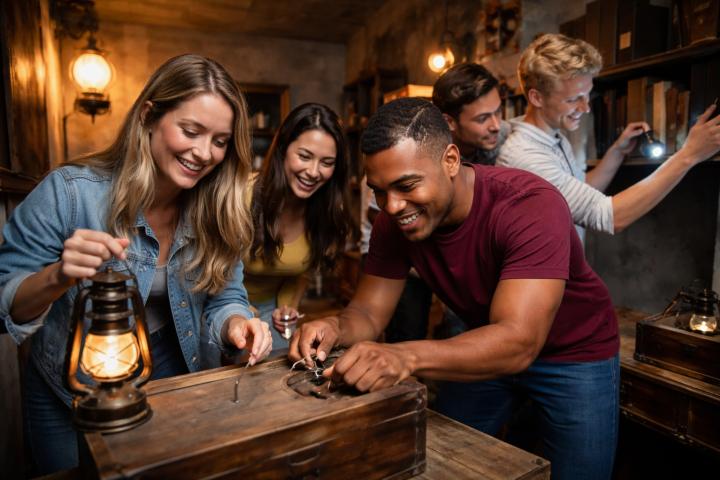

A good escape room experience is never based solely on the decorations. At the heart of a good escape room are puzzles in an escape room game designed to facilitate thought, allocate responsibility, and determine the nature of a group’s interaction. In Klemzig, where families and corporate groups look for a shared experience close to the CBD of Adelaide, the design of the puzzles influences whether the experience is cohesive or chaotic.
Learning about the design of the puzzles helps in understanding the nature of the experience.
The Structural Logic Behind Escape Room Puzzles
Well-designed escape room puzzles follow a deliberate cognitive pathway. They are rarely random riddles placed in sequence. Instead, a designer thinks through a multi-layered framework that includes observation, logic, communication, and collaboration.
In a quality adventure escape room, puzzles may be categorized as follows:
- Linear puzzles that provide a single next step to progress
- Puzzles that allow parallel problem-solving
- Puzzles that require convergence from multiple solved parts
This ensures that all players can participate. In a group scenario, especially where there is a range of ages, as is often seen with Klemzig bookings, puzzle layering prevents any single dominant player from taking over.
Designers also consider cognitive load. When the puzzle requires intricate calculation right after an exhausting search process, the group’s momentum will not build. Rather, the rhythm will switch between physical exploration and mental processing to maintain the entire group’s interest throughout the entire experience.
Psychological Engagement in an Immersive Escape Room
An immersive escape room experience goes beyond physical puzzles and numeric codes. Environmental narrative influences how players will process the puzzles and how they will work together as a team.
For instance, a puzzle embedded in a historical setting will prompt players to read and process the story, not just extract the numbers. This will cause a shift in priority from speed to comprehension for the group. Players debate meaning, cross-check interpretations, and assign roles organically.
Psychological engagement also relies on clarity. If the instructions are unclear without purpose, frustration replaces collaboration. Good puzzle design provides enough information to spark dialogue without overwhelming the group.
Klemzig has many first-timers in their groups, and immersion needs to feel intuitive. Good logic paths eliminate hesitation without sacrificing challenge, creating a collaborative effort out of curiosity rather than confusion.
How Puzzle Design Shapes Team Dynamics
Group play reveals social patterns quickly. Some players lead. Others observe. Strong escape room puzzles are structured to distribute participation.
Consider a puzzle requiring simultaneous actions in different parts of the room. It forces communication across space. A code discovered near one wall might correspond to symbols elsewhere. No single player can solve it alone.
This deliberate interdependence is central to adventure escape room design. Designers anticipate group psychology and prevent bottlenecks that isolate players.
Parallel puzzle paths also maintain momentum. When one subgroup works on decoding while another investigates physical mechanisms, idle time decreases. Shared progress is visible, and this encourages collaboration.
Lack of well-structured puzzles results in stagnation. For instance, if a group has to wait for another person to finish a task, this disrupts the social process.
Well-structured balance in Klemzig’s local experience landscape, where there are varied activities from birthday parties to corporate team-building activities, ensures accessibility without compromise.
For those interested in a well-structured immersive escape room experience, Klemzig offers a great example of how environmental factors and logic are utilized.
The Role of Spatial Design in Group Interaction
The design of the puzzle is closely linked with its physical arrangement. The architecture of the room is an important factor for player movement, clustering, and communication.
Too much clustering around a single puzzle reduces interaction. The distribution of clues promotes player movement and inter-room communication. Designers intentionally include sightlines that enable partial visibility between tasks, thereby encouraging communication.
Lighting is also an important aspect. Lighting is used to draw attention to certain areas without explicitly directing players. This subtle difference helps players decide what to search next.
An immersive escape room experience incorporates space into problem-solving. Hidden compartments, tactile mechanisms, and environmental props transform the room into a collaborative tool rather than a static setting.
For groups in Klemzig travelling from surrounding suburbs such as Walkerville or Windsor Gardens, this physical engagement distinguishes a structured escape experience from casual entertainment.
Pacing and Momentum in an Adventure Escape Room
Time constraint is the essence of the escape room genre, but pacing controls the emotional rhythm.
Initial puzzles are often created with discovery and exploration in mind.
Mid-game puzzles are created with coordination in mind, meaning the team must complete multiple puzzles.
The final puzzles are the culmination of the team's discoveries.
Good escape room puzzles are made in such a way that the level of difficulty does not jump drastically at any point. Instead, the level of difficulty increases smoothly, giving the team confidence before asking them to think on a deeper level.
The game's momentum can be built by ensuring that there is instant feedback on the solution of the puzzle. These micro-rewards strengthen collective morale.
Why Design Quality Matters for Local Group Experiences
For those living in Adelaide’s north-eastern suburbs, selecting an activity is often a matter of depth rather than uniqueness. A well-designed immersive escape room is an engaging experience compared to other forms of passive entertainment.
Design quality is evident in:
• The logical inclusion of clues
• The maintenance of a cohesive narrative thread
• The intellectual challenge level
• Cause and effect
When puzzles used in an escape room scenario are incorporated into a cohesive narrative thread, group experiences transition from a series of individual intellectual challenges to a shared objective.
This cohesion strengthens recall. Teams remember not only individual puzzles but the collective journey.
In Klemzig, where community gatherings and workplace outings frequently intersect, puzzle-driven collaboration creates structured interaction without forced facilitation.
FAQs
1. How are escape room puzzles designed to foster teamwork?
Multiple pieces of information are placed in various locations, encouraging communication. Many puzzles require simultaneous actions and/or pieces of information, ensuring no person can accomplish them alone.
2. Why do some puzzles lend themselves to group play better than others?
Some puzzles allow parallel processing and division of labor. Puzzles where a person is alone for a prolonged period will not keep them interested.
3. How does the pace of puzzles affect the group experience?
A balanced pace ensures there are periods of discovery and periods of analysis. A prolonged period of stagnation will affect communication and group morale.