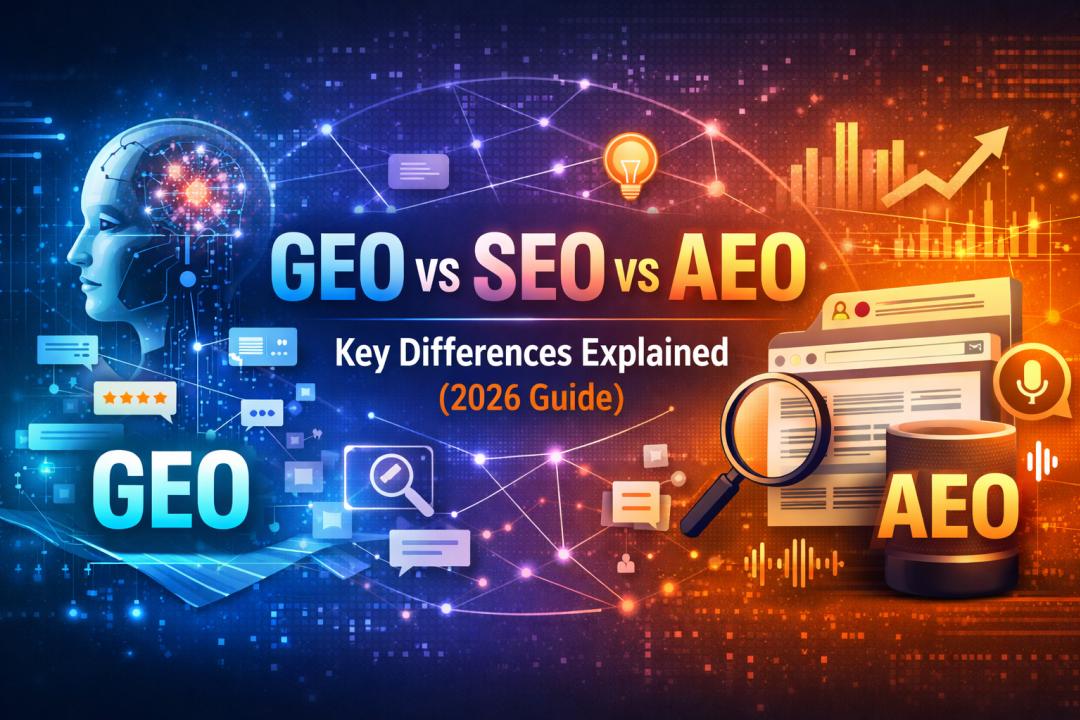
Search has evolved beyond traditional search engines. Today, users interact with information through conversational AI, voice assistants, and AI-generated summaries. This shift has introduced three important optimization approaches: Search Engine Optimization (SEO), Answer Engine Optimization (AEO), and Generative Engine Optimization (GEO).
While these approaches share common foundations, they differ significantly in goals, content structure, and visibility outcomes. Understanding these differences is essential for businesses that want to stay visible in both search engines and AI-driven discovery platforms.
Understanding SEO (Search Engine Optimization)
SEO is the traditional and most established practice of improving a website’s visibility in search engine results pages. Its primary objective is to rank webpages for relevant keywords so users click through to your website.
SEO revolves around aligning content with search intent and meeting algorithmic ranking factors. These include keyword optimization, backlinks, technical performance, content depth, and user experience. When executed well, SEO helps businesses appear in organic search listings, featured snippets, local packs, and other SERP features.
For example, when someone searches for “CRM development company,” SEO ensures that your service page appears prominently in the results, driving organic traffic and potential leads.
Despite the rise of AI-driven search, SEO remains foundational because it helps search engines discover, index, and evaluate your content.
Understanding AEO (Answer Engine Optimization)
AEO focuses on helping search engines extract precise answers from content rather than ranking entire pages. It is closely associated with voice search, featured snippets, and “People Also Ask” results.
The main goal of AEO is to position your content as a direct response to user questions. This requires a different writing >
AEO relies heavily on question-based content, structured data markup, and conversational language. FAQ sections, step-by-step guides, and definitions are especially effective.
For instance, if a user asks “What is CRM?”, AEO helps your content appear as the definition shown in a featured snippet or spoken by a voice assistant.
In essence, AEO is about visibility without clicks. It strengthens brand authority by making your content the trusted answer.
Understanding GEO (Generative Engine Optimization)
GEO is the newest paradigm, driven by generative AI platforms such as ChatGPT, Google AI Overviews, Gemini, and Perplexity. Unlike traditional search or answer extraction, generative engines synthesize responses from multiple sources to create comprehensive answers.
GEO focuses on ensuring your expertise, insights, and brand are represented within these AI-generated outputs. Instead of ranking pages or extracting short answers, GEO influences how AI systems understand, trust, and reference your content.
This requires a shift from keyword optimization to entity and knowledge optimization. AI engines evaluate topical authority, expertise signals, semantic relationships, and real-world credibility.
For example, if someone asks, “Best CRM strategies for healthcare organizations,” a generative AI might combine insights from multiple sources. GEO ensures your content contributes to that synthesis, even if users never directly visit your website.
GEO reflects the transition from search visibility to knowledge visibility.
Key Conceptual Differences Between SEO, AEO, and GEO
- SEO is fundamentally about discoverability. It ensures that search engines can find and rank your webpages based on relevance and authority. The user journey typically involves clicking a search result and consuming content on your website.
- AEO shifts the focus from discoverability to answerability. Here, the goal is not necessarily to drive traffic but to provide immediate value through concise answers. Visibility occurs in zero-click environments such as featured snippets and voice responses.
- GEO moves further toward contextual understanding. Generative engines interpret information at a deeper level, synthesizing insights rather than displaying or extracting them. The user journey often remains within the AI interface, meaning your brand benefits through recognition, authority, and influence rather than direct traffic.
Another important distinction lies in content structure. SEO supports long-form, keyword-driven content designed for ranking. AEO favors structured, question-based content that delivers quick answers. GEO prioritizes context-rich, semantically connected content that demonstrates expertise and authority across a topic.
Technologically, SEO relies on search engine algorithms and ranking signals. AEO depends on snippet extraction and natural language processing systems. GEO operates on large language models and knowledge graphs that interpret relationships between entities, concepts, and sources.
Why GEO is Gaining Importance?
The rapid adoption of generative AI has significantly changed how users search for information. Instead of typing short keyword queries, users now engage in conversational interactions and expect synthesized insights.
This shift has increased the prevalence of zero-click experiences and AI-generated summaries appearing above traditional search results. As a result, businesses must optimize not only for rankings but also for AI trust and knowledge representation.
GEO is gaining importance because it addresses this new visibility paradigm. By building topical authority, publishing original insights, and strengthening entity relationships, businesses can ensure their expertise is reflected in AI responses.
How SEO, AEO, and GEO Complement Each Other
Rather than competing approaches, SEO, AEO, and GEO form a layered visibility strategy.
- SEO establishes the technical and content foundation that enables search engines to discover and evaluate your website. Without strong SEO, content may struggle to be indexed or trusted.
- AEO builds on this foundation by structuring information so search engines can extract precise answers. This enhances visibility in zero-click environments and voice interactions.
- GEO extends both by focusing on knowledge synthesis. It leverages the authority and structured insights developed through SEO and AEO to influence AI-generated outputs.
In practical terms, a well-optimized article might rank through SEO, appear as a featured snippet through AEO, and contribute insights to AI-generated answers through GEO.
Effective Strategies for Each Approach
A strong SEO strategy includes comprehensive keyword research, internal linking, technical optimization, and backlink development. Content should address user intent thoroughly while maintaining readability and authority.
For AEO, content should be structured around questions and direct answers. Using FAQ sections, clear definitions, and concise explanations improves answer extraction. Structured data markup also enhances machine understanding.
GEO strategies focus on building topical authority and entity recognition. This involves creating content clusters around core themes, publishing original research or case studies, and ensuring semantic connections across content. Schema markup, brand mentions, and authoritative signals further strengthen AI trust.
Content Formats That Perform Across All Three
Certain content formats naturally align with SEO, AEO, and GEO simultaneously. Comparison articles, implementation guides, frameworks, and case study breakdowns provide both depth and clarity. Definition-driven content with contextual expansion is also highly effective.
These formats offer keyword relevance for SEO, structured answers for AEO, and contextual knowledge for GEO, making them ideal for modern search visibility.
Common Challenges Businesses Face
Many organizations still rely solely on keyword-focused SEO, overlooking semantic and entity-based optimization. Others fail to structure content for answer extraction, limiting visibility in zero-click results.
A frequent challenge in GEO is the lack of topical authority. Isolated blog posts without interconnected themes struggle to influence AI responses. Additionally, limited use of structured data reduces machine interpretability.
Overcoming these challenges requires a shift toward holistic content strategy and knowledge architecture.
The Future of Search Visibility
Search is evolving into an integrated ecosystem combining traditional results, instant answers, and AI-generated insights. Users increasingly expect conversational experiences and comprehensive responses rather than lists of links.
This transformation creates a new visibility model where success depends on ranking, answering, and influencing AI synthesis simultaneously.
Businesses that invest in semantic authority, structured knowledge, and expert-driven content will be better positioned to thrive in this environment.
Conclusion
SEO, AEO, and GEO represent different layers of modern search optimization. SEO ensures your content is discoverable, AEO ensures it is answerable, and GEO ensures your expertise is synthesized by AI systems.
Together, they form a comprehensive approach to digital visibility in an AI-driven landscape. Organizations that understand and integrate these strategies will gain a competitive advantage as search continues to evolve toward conversational and generative experiences.