
In today’s data-driven economy, businesses are surrounded by visual information. Cameras monitor manufacturing floors, hospitals generate thousands of diagnostic images daily, retailers track customer movement, and logistics companies scan millions of parcels. Yet most organizations still struggle with one critical challenge — transforming visual data into actionable insights.
This is where computer vision services create measurable impact. By enabling machines to interpret and analyze images and video streams, businesses can automate complex tasks, improve accuracy, reduce operational costs, and gain a competitive edge.
Computer vision is no longer a futuristic concept. It has become a strategic capability that drives efficiency, safety, and innovation across industries.
The Growing Importance of Visual AI in Business
Visual data represents one of the largest untapped assets in modern enterprises. Unlike structured data stored in databases, images and videos require intelligent interpretation. Manual review is time-consuming, inconsistent, and expensive.
With advanced computer vision services, organizations can train AI models to detect patterns, identify objects, classify images, and make real-time decisions. These systems continuously learn from new data, improving performance over time.
The shift from manual observation to automated intelligence allows businesses to scale operations without proportionally increasing costs.
What Do Computer Vision Services Include?
Computer vision services typically encompass the complete lifecycle of AI-powered visual systems — from strategy and model development to deployment and optimization.
These services involve designing custom algorithms that analyze images and video feeds to extract meaningful information. Whether it’s detecting product defects, recognizing faces, reading text from images, or monitoring safety compliance, the applications are vast.
Unlike off-the-shelf tools, customized solutions are tailored to industry-specific workflows, environmental conditions, and performance goals. This alignment ensures higher accuracy and long-term reliability.
Real-World Applications Across Industries
Manufacturing
In manufacturing, precision determines profitability. AI-powered inspection systems detect microscopic defects, ensure assembly accuracy, and reduce waste. Automated quality control improves production efficiency and minimizes recalls.
Healthcare
Medical imaging analysis is one of the most impactful applications of computer vision. AI systems assist healthcare professionals in detecting abnormalities in X-rays, MRIs, and CT scans, enabling faster and more accurate diagnoses.
Retail
Retailers use computer vision to monitor inventory, analyze customer behavior, and enable frictionless checkout experiences. Real-time insights help optimize store layouts and improve customer satisfaction.
Logistics
In warehouses and distribution centers, computer vision automates parcel tracking, barcode scanning, and damage detection. This reduces human error and increases throughput efficiency.
Security & Surveillance
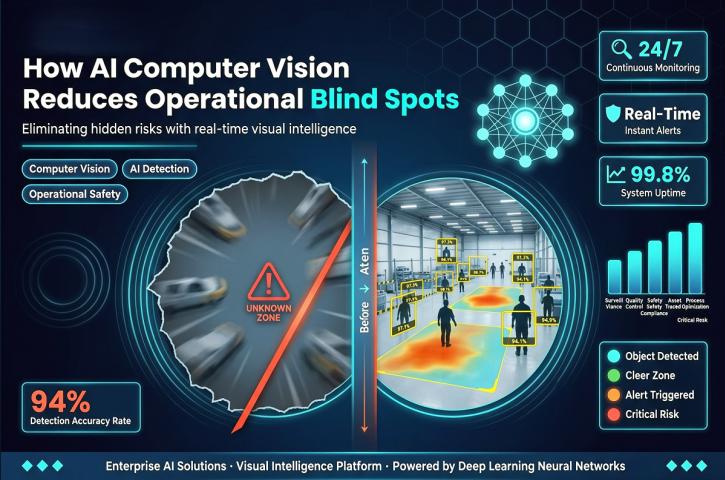
Computer vision systems enhance security through facial recognition, anomaly detection, and crowd analysis. Real-time alerts improve safety and risk management.
How Computer Vision Services Deliver ROI
The true value of computer vision services lies in measurable outcomes. Businesses adopting vision AI often experience:
Reduced operational costs
Improved accuracy and consistency
Faster decision-making
Enhanced compliance and safety
Scalable automation
By automating repetitive visual tasks, organizations free up human resources for strategic work. Over time, AI-driven insights also enable predictive capabilities, allowing companies to prevent issues rather than react to them.
The Technology Behind Modern Vision Systems
Effective computer vision solutions rely on advanced deep learning architectures such as convolutional neural networks (CNNs) and transformer-based models. These models are trained using large datasets to recognize patterns within images.
However, technology alone does not guarantee success. Proper data collection, annotation quality, infrastructure readiness, and continuous model optimization are equally important.
Deployment strategies may include cloud-based systems for scalability or edge AI solutions for real-time processing with minimal latency. Continuous monitoring ensures models adapt to environmental changes and maintain accuracy over time.
Challenges Businesses Must Address
While the benefits are significant, implementing computer vision comes with challenges. Data privacy regulations, infrastructure costs, scalability issues, and model drift require careful planning.
Organizations must also ensure that their AI solutions integrate seamlessly with existing enterprise systems. Without proper integration, even advanced models may fail to deliver meaningful business outcomes.
Partnering with experienced providers of computer vision services helps mitigate these risks by combining technical expertise with strategic implementation planning.
The Future of Computer Vision
As AI continues to evolve, computer vision will become even more sophisticated. Edge computing will enhance real-time processing capabilities. Multimodal AI systems will combine visual data with speech and text for richer insights. Autonomous systems will rely heavily on advanced visual intelligence.
Businesses that invest in computer vision today are building the foundation for smarter, more adaptive operations in the future.
Conclusion
In an increasingly visual world, the ability to interpret and act on image-based data is becoming a strategic necessity. Computer vision services empower organizations to transform raw visual inputs into actionable intelligence, driving efficiency, innovation, and long-term growth.
Those who harness the power of visual AI today will lead the markets of tomorrow.