Modern data centers are becoming more complex as applications grow and user demands increase. This is where Cisco ACI Training plays an important role, helping network engineers understand a smarter and more structured way to manage networks. Traditional networking methods often rely on manual configurations, VLAN-based segmentation, and device-by-device management, which can become difficult to scale and maintain over time.
As organizations move towards automation and policy-based networking, Cisco ACI offers a new approach that focuses on applications rather than just network devices. Migrating from a traditional network to Cisco ACI may seem challenging at first, but with the right understanding and step-by-step approach, it becomes a smooth and manageable process for both beginners and experienced professionals.
1. Understand the Core Difference
Before starting the migration, it is important to understand how Cisco ACI is different from traditional networking.
In traditional networks, engineers configure each device separately, manage VLANs manually, and apply security policies across multiple points. This often leads to complexity and errors.
In Cisco ACI, everything is centrally managed through the APIC controller. Instead of focusing on individual devices, you define policies that control how applications communicate. This makes the network more scalable and easier to manage.
2. Analyze Your Existing Network
The next step is to carefully study your current network setup.
Ask questions like:
Which VLANs are being used?
What applications are running?
How do these applications communicate?
Where are the current challenges?
This analysis helps you translate your traditional setup into ACI components like tenants, VRFs, bridge domains, and application profiles.
3. Choose the Right Migration Approach
There are two common ways to migrate:
Greenfield Approach
You build a new ACI environment from scratch and gradually move applications into it. This is clean and future-ready.
Brownfield Approach
You integrate ACI into your existing network and migrate step-by-step. This is useful when you cannot replace everything at once.
Most organizations choose a mix of both to balance risk and flexibility.
4. Design the ACI Fabric
A strong design is the foundation of a successful migration.
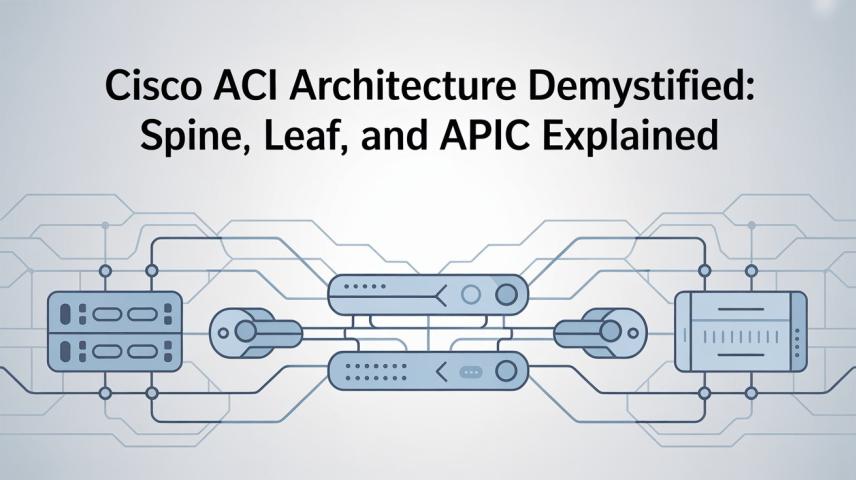
Cisco ACI uses a spine-leaf architecture:
Spine switches handle high-speed traffic
Leaf switches connect to endpoints (servers, devices)
You also configure:
Underlay network (IP connectivity)
Overlay network (VXLAN-based communication)
A well-planned design ensures smooth performance and scalability.
5. Map Traditional Concepts to ACI
To make migration easier, you need to map old concepts to new ones:
VLAN → Bridge Domain (BD)
Subnet → BD Subnet
ACL → Contract
Network segments → Endpoint Groups (EPGs)
Instead of configuring access lists on devices, ACI uses contracts to define which applications can communicate. This simplifies security management.
6. Start with a Pilot Project
Avoid migrating everything at once.
Choose a small, non-critical application and move it to the ACI environment. Test connectivity, policies, and performance.
This helps you:
Validate your design
Identify mistakes early
Gain practical experience
7. Configure Policies Carefully
Policies are the core of Cisco ACI.
You define:
Endpoint Groups (EPGs) for grouping devices
Contracts to allow or deny communication
Filters for specific ports and protocols
For example, a web server can communicate with an application server, but not directly with a database unless allowed.
This improves both security and control.
8. Connect to External Networks (L3Out)
Your ACI fabric must communicate with the outside world.
This is done using L3Out:
Connect to external routers
Use routing protocols like BGP or OSPF
Exchange routes between ACI and traditional networks
This ensures seamless integration during migration.
9. Monitor and Troubleshoot
After deploying ACI, monitoring becomes easier.
Cisco ACI provides:
Health scores
Faults and alerts
Real-time visibility
Instead of checking multiple devices, you get centralized insights, making troubleshooting faster and more efficient.
10. Migrate Gradually
Once your pilot is successful, continue migrating applications in phases.
Avoid a full migration in one go. Move workloads step-by-step, test each stage, and ensure everything works correctly.
This reduces risk and avoids downtime.
Final Thoughts
Migrating from a traditional network to Cisco ACI is not just about changing technology—it is about adopting a new way of thinking. With its policy-driven approach, centralized management, and automation capabilities, ACI simplifies modern networking challenges.
For engineers looking to build strong expertise, enrolling in a Cisco ACI Course can provide the practical knowledge needed to handle real-world deployments. Over time, learning through Cisco ACI Online Training, Cisco ACI Certification can help you stay relevant in the evolving networking landscape and confidently manage next-generation data center networks.