Everyone is using AI now.
That alone is not interesting anymore.
What is interesting is what happens when every startup starts publishing content that sounds almost identical. That’s where things start breaking.
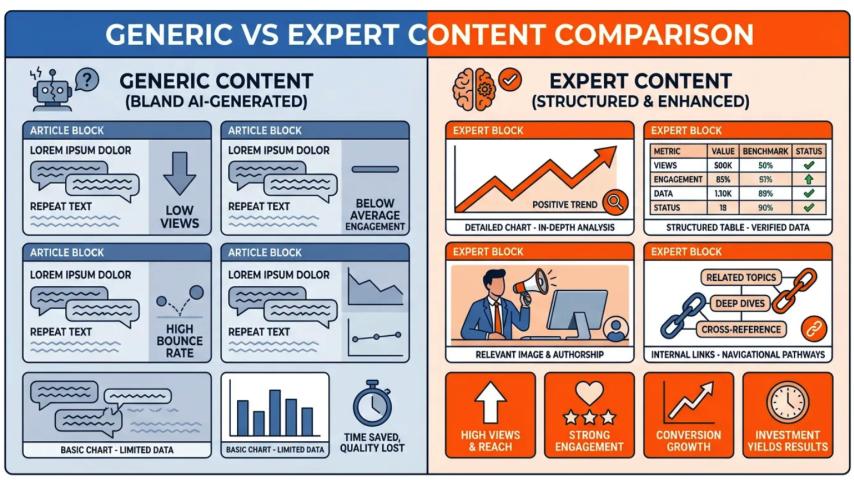
The issue is not AI, but sameness.
A lot of AI-assisted content is technically fine. It has the right headings, the right keywords, the right level of polish. It may even look “optimized.”
But the second you read a few pieces in the same space, it all starts blending together. That’s a problem. And it gets worse when discovery becomes more answer-driven.
If content is competing not just for rankings but for inclusion in AI-generated answers, summaries, and recommendation layers, generic pages become much easier to ignore.
That’s the trap a lot of teams are walking into now. They think scale is the win.
Publish faster.
Publish more.
Cover more keywords.
But if the result is a bigger pile of average content, the output may look productive without becoming more visible.
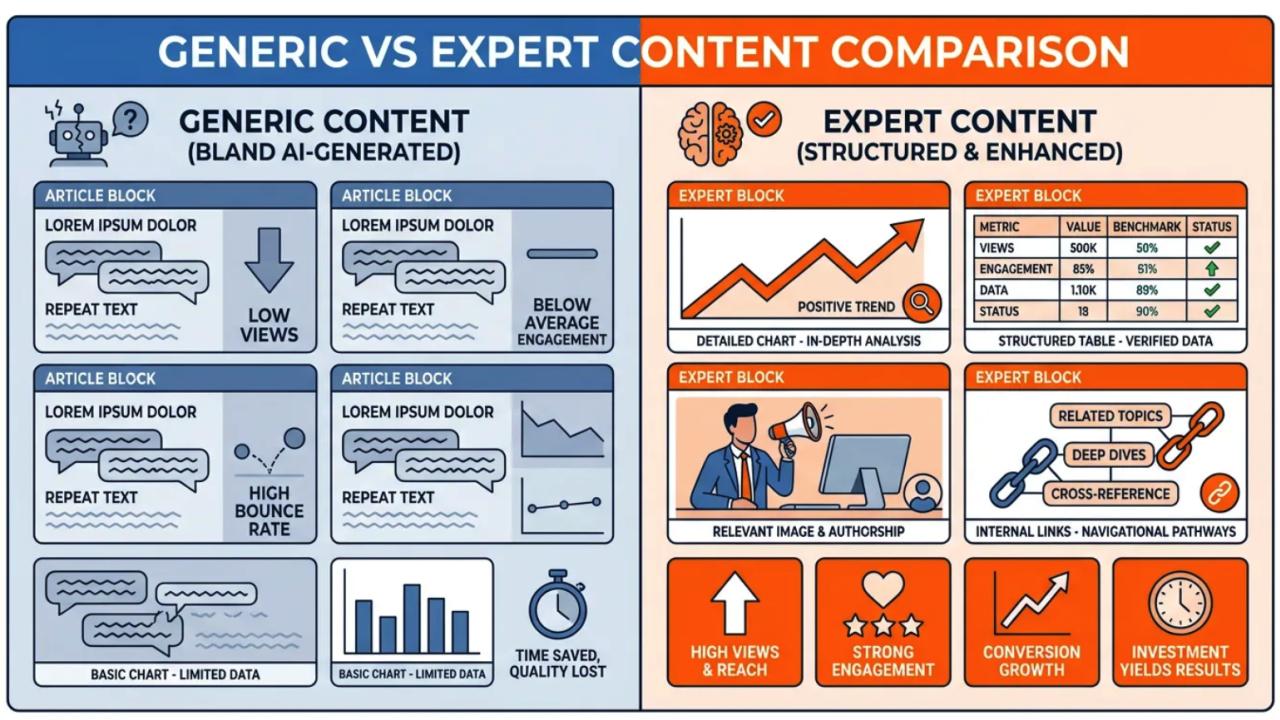
Generic content usually has a few obvious signs:
- slow intros
- vague wording
- no real point of view
- interchangeable structure
- “helpful” copy that says nothing distinct
That kind of page can sit on a site for months without doing much.
What tends to work better is simpler:
- clearer angle
- faster answer
- stronger wording
- real examples
- something specific enough to remember
This is one of the things we’ve been paying closer attention to at SeekLab.
The point is not that AI should be avoided.
The point is that AI should not be used to mass-produce forgettable pages.
A startup does not need to sound bigger.
It needs to sound clearer.
And right now, that is becoming a real advantage.
References:
seeklab.io/blog/ai-writing-for-seo-avoiding-generic-content/
seeklab.io/blog/from-seo-to-geo-adapting-content-for-ai-search/