Property management has always been a business of a thousand small things that compound into expensive problems when nobody catches them in time.
The lease that expires without a renewal conversation. The maintenance contractor paid twice because two people processed the same invoice. The tenant who quietly slides into a pattern of late payments, three months before it becomes a legal issue. The monthly close that runs three days late because one variance nobody can explain is holding up the entire board pack.
None of these are dramatic failures. They are the everyday cost of running a complex operation on systems that record what happened but don't actually watch what's happening.
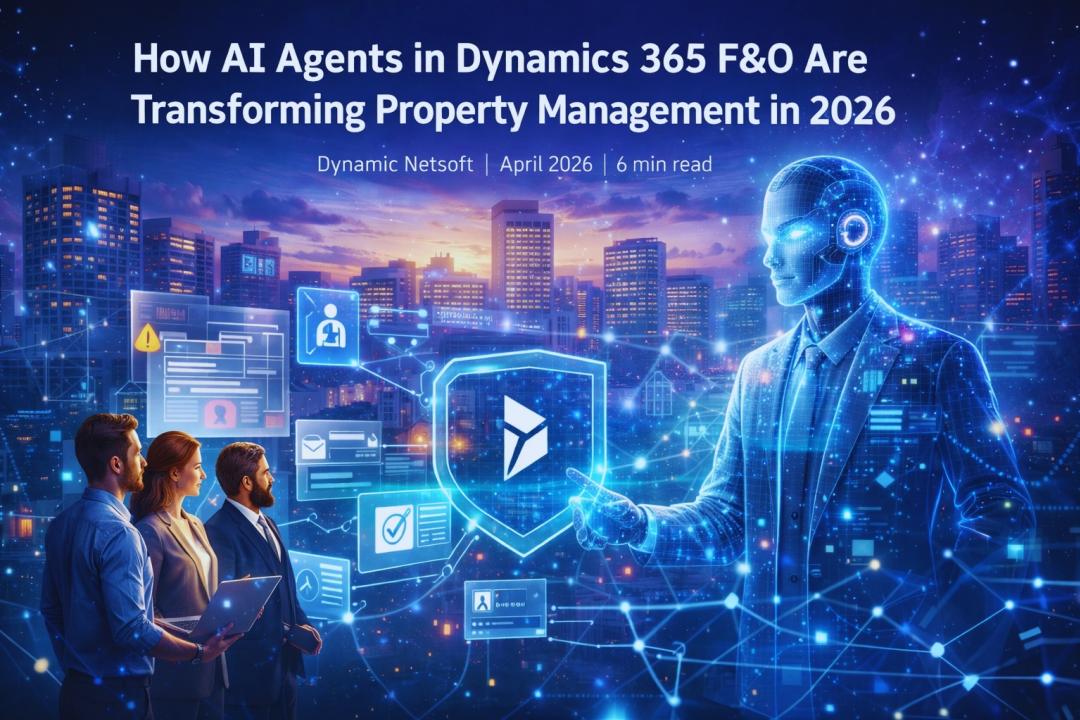
That is the gap AI agents in Microsoft Dynamics 365 F&O close in 2026. And the way they close it is more specific than most people realise.
What "Agentic" Actually Means Inside D365 F&O
The word gets thrown around a lot right now. Here is what it means in practice inside Dynamics 365 Finance & Operations.
An AI agent in D365 F&O is a program that sits connected to your live ERP data. It runs a continuous loop, monitoring signals, evaluating conditions against business rules you define, and taking action when those conditions are met. Not when you ask. Automatically.
The engine behind this became production-ready in February 2026, when Microsoft released the ERP Model Context Protocol (MCP) server into general availability. The MCP is what gives AI agents the ability to read and write your actual ERP data, not a copy, not a report, the live system. Lease records. Ledger balances. Vendor invoices. Tenant accounts. Maintenance work orders.
What makes this different from the automation tools that have existed for years, workflow rules, alerts, Power Automate flows; is that agents combine data access with contextual reasoning. A workflow rule fires when field X equals value Y. An agent reads field X, understands why it has value Y based on everything else in the record, considers the history of similar situations, and decides what the right response actually is.
That is not a small difference. For a property business managing complexity at scale, it is everything.
Six Things AI Agents Are Doing Right Now in Property Management on D365
1. The Account Reconciliation Agent - so month-end stops being a crisis
Microsoft's Account Reconciliation Agent, live in D365 Finance as part of the 2026 Wave 1 release, automatically matches subledger balances to the general ledger, flags exceptions for human review, and keeps a complete audit trail of every match and every flag.
For a property business reporting across multiple entities, each with their own rent rolls, service charge accounts, and intercompany transactions, month-end reconciliation has historically been a multi-day exercise in spreadsheet archaeology. This agent does the matching in the background, continuously, so by the time the finance team sits down to close the period, the routine work is already done. They are reviewing exceptions, not building from scratch.
The agent can be triggered by a scheduled run, a file upload, or an event in the system. It learns from corrections, if the team consistently treats a certain type of variance as acceptable, the agent adjusts its thresholds rather than flagging the same non-issue every month.
2. The Finance Agent - variance analysis that doesn't wait for someone to run a report
The Finance Agent expanded significantly in the 2026 Wave 1 release. It now supports reconciliation, variance analysis, and data preparation directly in Excel, plus tenant and owner communications drafted in Outlook, pulling from live D365 data without requiring anyone to open the ERP.
For a real estate CFO, this changes the morning. Instead of asking a finance analyst to build a variance report, the CFO opens Outlook, sees the Finance Agent's summary of the three largest deviations from budget this month, with plain-language explanations of what drove each one and decides which two need a call and which one is just a timing difference.
The institutional knowledge that used to live in a senior analyst's head "that's always high in Q1 because of the service charge cycle" — can now be documented as agent logic. It doesn't leave when people leave.
3. The Lease Agent - lease accounting without the manual extraction
There is now a production Lease Agent built by Crowe, a Microsoft partner, that automates lease data extraction and validation and integrates directly with D365 Finance for lease accounting processes.
For property businesses running IFRS 16 or ASC 842 lease accounting, which requires every lease to be recognised on the balance sheet with precise right-of-use asset and liability calculations; this is a significant operational relief. The agent extracts key lease terms from documents, validates them against the records in the system, flags discrepancies, and feeds clean data into the accounting workflow.
On RealEstatePro, where lease data already lives natively in D365, this agent has a clean foundation to work from. The lease terms are already structured, already recorded, already connected to the financial modules. The agent layer sits on top and handles the compliance and accounting automation.
4. The Supplier Communications Agent - contractor management without the inbox overhead
A property business managing 30 maintenance contractors is managing 30 relationships, 30 invoicing patterns, 30 communication >
The Supplier Communications Agent monitors incoming vendor emails, extracts relevant information, invoices, schedule changes, completion confirmations, and surfaces only what needs human input. Routine confirmations are handled. Invoice details are extracted and matched to work orders in D365. Flagged discrepancies get escalated.
What this does for a facilities management team is give back the hours previously spent on email triage. A facilities manager overseeing dozens of contractors can see, each morning, a structured summary of what came in overnight — not an inbox full of emails to process individually.
5. Collections intelligence - catching late payment patterns before they become bad debt
In a large residential or commercial portfolio, tenant arrears are an ongoing operational challenge. The combination of volume, hundreds of accounts, and the need for different responses to different situations, a first-time late payment versus a pattern of delay makes collections both time-consuming and easy to get wrong.
AI agents in D365 Finance analyse individual tenant payment history against their lease terms and payment behaviour over time. The agent identifies accounts where the pattern is shifting payments arriving later each cycle, partial payments increasing and flags them before they cross the formal arrears threshold.
For the collections team, this means intervening earlier, with more context, and with a communication already drafted that reflects the specific account history. Not a template. A response built from the actual data.
This has consistently been where we see the fastest return in property businesses after implementing agent-based collections monitoring. The value is not in the dramatic recoveries. It is in the accounts that never become dramatic because someone acted two months earlier.
6. The Immersive Home workspace - a single view of everything agents are doing
Alongside the agent capabilities themselves, Microsoft's 2026 Wave 1 introduces the Immersive Home a redesigned, AI-driven start page for D365 F&O that replaces the static dashboard with a dynamic, contextual workspace.
When a property manager logs in, they see a personalised view of what needs attention today agent activity, flagged exceptions, pending approvals, maintenance tickets outside their SLA assembled from across the system without them having to navigate to each module separately.
It sounds like a UI change. But for a property operations team that historically lost hours each morning figuring out where to start, having a system that knows what is urgent and surfaces it automatically is the kind of practical change that compounds every single day.
The Condition That Makes All of This Work
We have seen this pattern enough times to know it is consistent.
Businesses that get real operational value from D365 AI agents share one thing: their data was in reasonable shape before the agents went live. Lease records consistently maintained. Vendor master data clean. Maintenance categories standardised. Financial dimensions applied correctly.
Businesses that are disappointed and they exist usually rushed to deploy agents on top of inconsistent data. The agent faithfully automates the inconsistency and surfaces confusing outputs. The team loses trust in the system and switches it off.
The agents are not the hard part. Getting your data to a state where an agent can reason over it confidently that is where the real implementation work happens. It is not glamorous. But it is the work that determines whether AI in your D365 environment delivers measurable business value or becomes another technology experiment with a disappointing ROI.
What RealEstatePro Users Have That Others Don't
Because RealEstatePro is built natively on Dynamics 365 F&O, the agent infrastructure described above has a clean foundation to work from. Lease data, tenant records, property hierarchies, financial dimensions, maintenance logs all structured, all in D365, all readable by agents without an integration layer sitting in between.
Every Microsoft agent released through the 2026 Wave 1 and beyond applies directly to your RealEstatePro environment. No waiting. No migration. No separate implementation project.
The question is not whether these capabilities are available to you. They are. The question is which processes in your specific portfolio will benefit most from having an agent running them and how to configure those agents so they reflect how your business actually works.
That is the conversation Dynamic Netsoft has with every RealEstatePro client when they are ready to move from system of record to system of intelligence.
Frequently Asked Questions
What are AI agents in Dynamics 365 F&O?
AI agents in Dynamics 365 F&O are autonomous programs connected to your live ERP data that monitor conditions, apply business logic, and take action without waiting for a human to trigger them. They go beyond alerts and workflow rules by combining data access with contextual reasoning, understanding the history and context behind a situation before deciding how to respond.
Which AI agents are available in D365 F&O for property management in 2026?
As of 2026 Wave 1, key agents available for property management contexts include the Account Reconciliation Agent, the Finance Agent (variance analysis, tenant communications), the Supplier Communications Agent, and partner-built agents like the Lease Agent from Crowe. Custom agents can also be built using Copilot Studio connected to RealEstatePro data in D365.
Does RealEstatePro support D365 AI agents?
Yes. Because RealEstatePro is built natively on Dynamics 365 Finance & Operations, all D365 AI agent capabilities are available to RealEstatePro users without additional integration work. Lease data, tenant records, and financial transactions already structured in RealEstatePro serve as the data foundation that agents read and act on.
What does it take to implement AI agents for property management on D365?
The most important step is data quality, agents produce reliable outputs only when the underlying ERP data is consistently maintained. Configuration of specific agents typically takes 4 to 8 weeks with an experienced implementation partner, covering business rule definition, testing in sandbox environments, and governance setup before production deployment.
Dynamic Netsoft Technologies is a Microsoft-accredited ISV partner with over 15+ years of experience delivering Dynamics 365 ERP solutions for real estate, construction, finance, and retail businesses worldwide. RealEstatePro is their flagship property management solution built on Microsoft Dynamics 365 F&O.