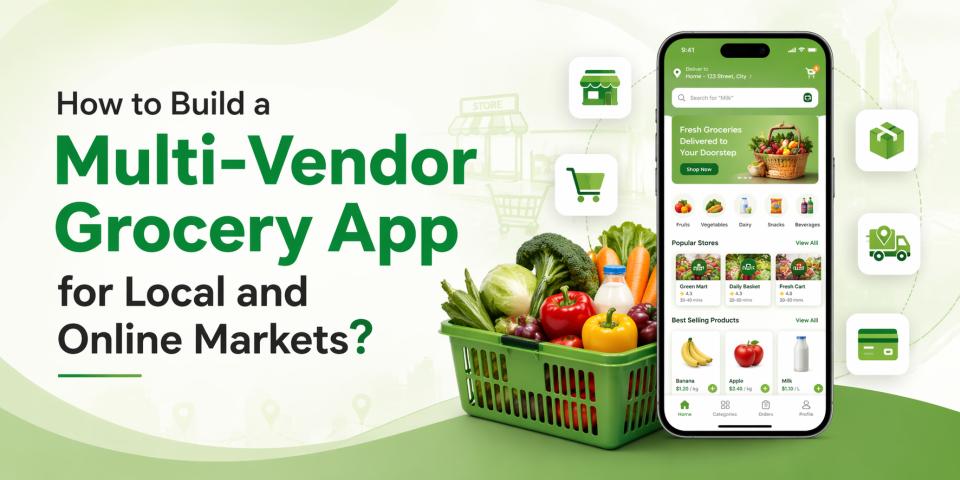
Digitalization has brought about a paradigm shift in the retail grocery industry. There is an increasing number of multi-vendor grocery apps being created to integrate local shops, supermarkets, and end users under one umbrella. Regardless of whether your target market includes local deliveries or wider reach on the internet, a properly executed development process involves a lot more than just that.
Gone are the days when shoppers only went to a store near them; now they want to access an app, select among many stores that are on offer, browse through different prices, and have the products delivered quickly to them. In such a scenario, developing a multi-store grocery application merges the best of both worlds.
What is a multi-vendor grocery app?
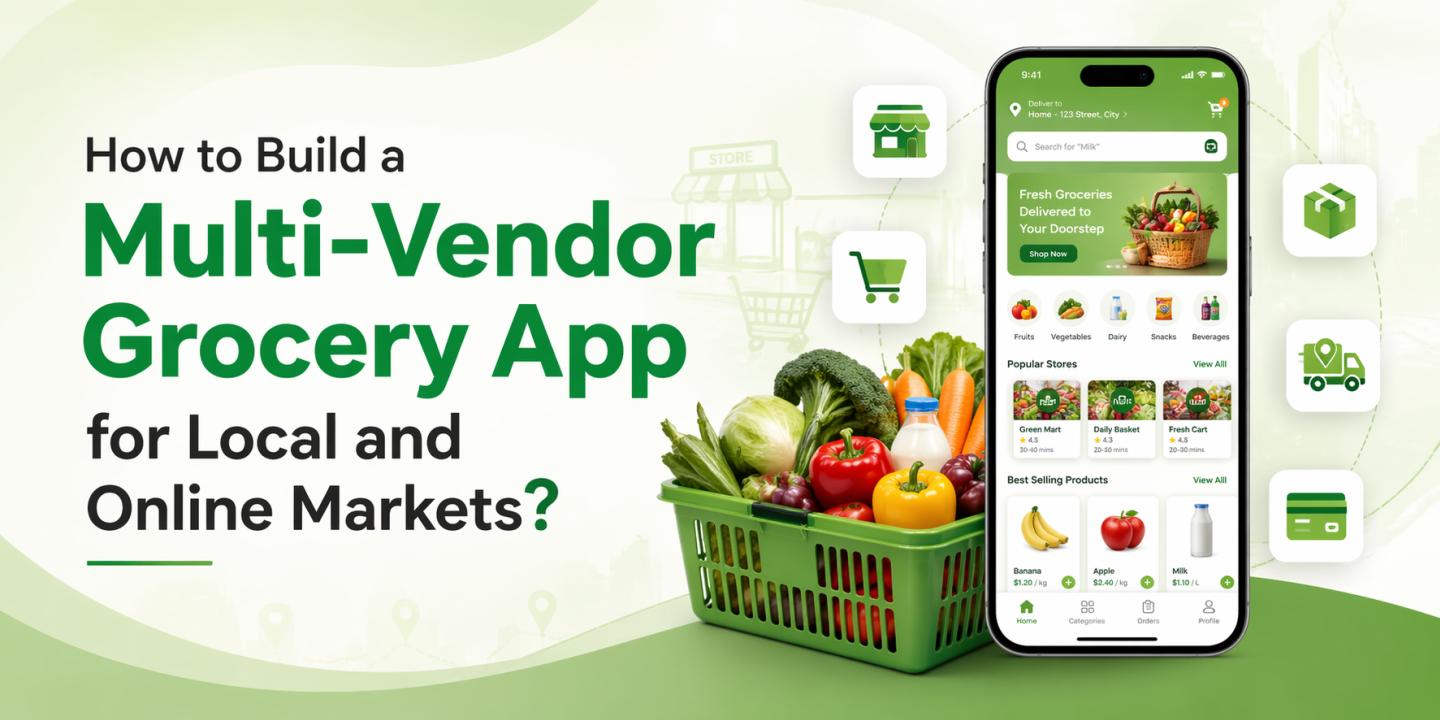
A multi-vendor grocery app is an online store that allows various vendors (local grocery stores, supermarkets, and other vendors) to enroll, offer their products, and directly sell them to customers via one platform. In contrast to the single store app, the multistore app gives the possibility for customers to choose products offered by several sellers at once via one application.
The on-demand grocery delivery service creates a link between customers and sellers, providing a combination of convenient and affordable services. This app usually consists of three main panels: Customer, Vendor, and Admin.
Features of a Multi-Vendor Grocery App
1. User-Friendly Customer Interface
A seamless and intuitive user interface allows customers to browse products, search items, compare prices, and place orders quickly. Easy navigation, filters, and secure checkout enhance the overall shopping experience and boost customer retention.2. Vendor Management Dashboard
Each vendor gets a dedicated dashboard to manage inventory, pricing, product listings, and orders efficiently. This feature ensures smooth communication between vendors and customers while enabling sellers to monitor their business performance in real time.3. Real-Time Order Tracking
Customers can track their orders in real-time from confirmation to delivery. GPS-enabled tracking improves transparency and trust, while push notifications keep users informed about order status, delivery updates, and estimated arrival times.4. Multiple Payment Integration
A robust payment system supports various options like credit/debit cards, digital wallets, UPI, and cash on delivery. Secure transactions ensure customer confidence while offering flexibility in payment choices to improve conversion rates.5. Advanced Admin Panel
The admin panel controls the entire platform, including vendor approvals, commission management, user activity, and analytics. It helps businesses monitor performance, resolve disputes, and maintain operational efficiency across the platform.Benefits of Grocery Delivery App Development
Investing in grocery delivery app development services offers numerous advantages for businesses entering the digital marketplace:
Expanded Market Reach: Connect with both local and online customers, increasing sales opportunities.
Increased Revenue Streams: Earn through commissions, delivery fees, and featured listings.
Enhanced Customer Convenience: Provide doorstep delivery with an easy ordering experience.
Better Inventory Management: Real-time stock updates reduce errors and improve efficiency.
Stronger Vendor Network: Attract multiple sellers and build a competitive marketplace.
Partnering with a professional grocery delivery app development company ensures that your platform is scalable, secure, and tailored to your business needs.
Multi-Vendor Grocery Delivery App Development Model
Selecting an appropriate development model is important in the creation of a good platform. Below are the major models that are employed when developing on-demand grocery delivery apps:
1. Aggregator Model
In the aggregator model, the app owner is linked with many vendors and customers using one platform. Earnings are made by way of commission from every order placed while the vendors are responsible for the inventory and logistics of delivery.
2. Inventory-Based Model
In this approach, inventory is maintained and warehousing carried out by the business. It gives more control over the products' quality, pricing, and delivery times, but it's more costly.
3. Hybrid Model
It combines the two models above. Using this approach, the organization will be able to carry out deliveries of their own products as well as third-party vendors' products.
4. Hyperlocal Delivery Model
This model delivers goods from the nearest store in the shortest possible time. This method suits localized grocery delivery. Selection of the best model to use relies on several factors, including target market and financial capacity.
Conclusion
Developing the multivendor grocery delivery app is one of the best ways for companies to gain control over both offline and online business. If done correctly, it will result in the creation of an on-demand grocery delivery app.
The development process of a multivendor grocery app for both physical and online markets is indeed a challenging endeavor that can be successfully achieved if several steps are taken into account. It all starts with the choice of reliable partners, creation of user-friendly customer experiences, development of a powerful network of vendors, setting up good logistics systems, and so forth.
The hiring of the dedicated team of specialists for your app development process would provide a good start to success. Cooperation with a full-stack software development company will ensure that everything related to the backend and other processes will be done properly.