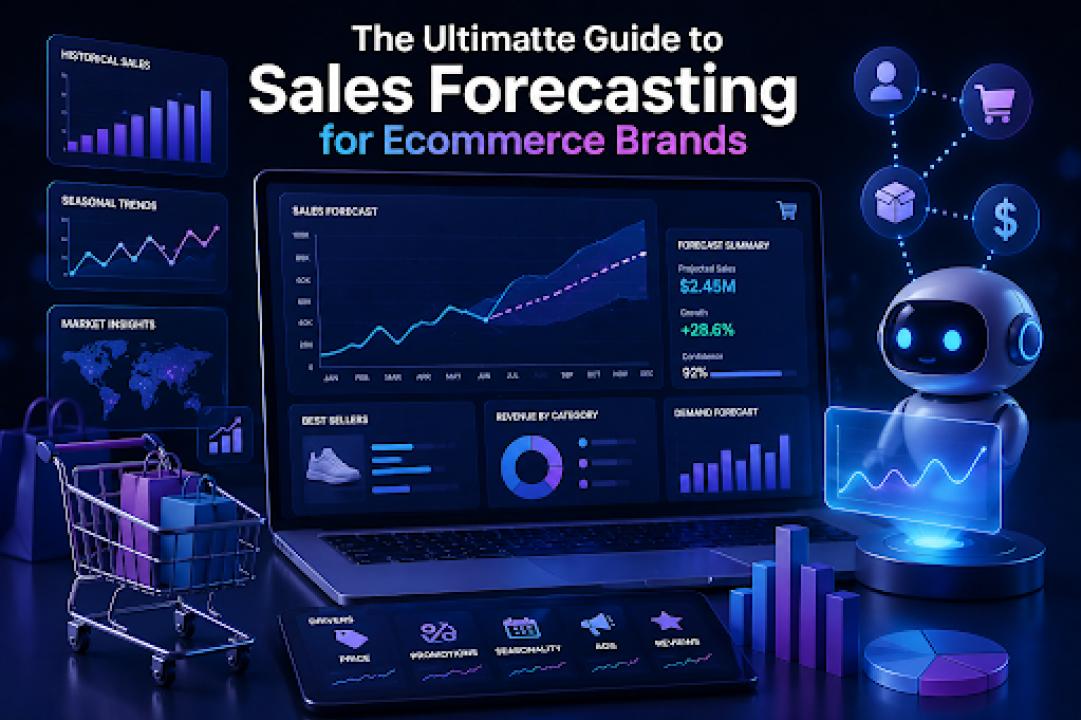
Sales forecasting is one of the most powerful — and most underutilized — capabilities in ecommerce. Done well, it lets you anticipate demand, manage inventory efficiently, allocate marketing spend wisely, and avoid the twin disasters of stockouts and overstock. Done poorly, it costs you money, customers, and competitive advantage.
This guide breaks down what modern sales forecasting looks like, why traditional methods fall short, and how AI is changing the game for ecommerce businesses of all sizes.
Why Sales Forecasting Matters More Than Ever
Ecommerce has become increasingly volatile. Supply chain disruptions, shifting consumer trends, algorithm changes on advertising platforms, and seasonal fluctuations all make it harder to predict what tomorrow looks like. A business that can forecast accurately gains a significant edge: it can prepare the right inventory levels, plan promotions with confidence, and allocate budget where returns are highest.
also read: car Insurance
Conversely, a business operating without strong forecasting is always reacting. It is firefighting instead of strategizing.
The Limits of Traditional Forecasting
Most ecommerce brands still rely on spreadsheet-based forecasting. They look at last year's numbers, apply a growth percentage, and call it a plan. This approach has several serious problems:
It does not account for real-time market signals
It ignores external variables like competitor pricing or macroeconomic trends
It requires significant manual effort to maintain
It breaks down completely in the face of sudden demand shifts
Manual forecasting is better than nothing, but it leaves enormous value on the table.
How AI Changes Sales Forecasting
Modern sales forecasting software powered by AI goes far beyond trend extrapolation. These platforms ingest historical sales data, seasonal patterns, marketing calendars, inventory levels, and external signals to produce probabilistic forecasts — not just single-point predictions, but confidence ranges that help teams plan for multiple scenarios.
The result is forecasting that adapts in real time. If a product suddenly goes viral on social media, an AI forecasting engine adjusts demand projections immediately. If a supplier signals a delay, the system recalculates expected availability and flags the risk before it becomes a stockout.
Inventory Forecasting: The Hidden Profit Lever
For many ecommerce brands, inventory is their largest capital investment. Too little stock and you lose sales and damage customer trust. Too much stock and you tie up cash, pay excess storage fees, and eventually mark down products at a loss.
AI-driven inventory forecasting solves this by predicting demand at the SKU level, accounting for lead times, reorder points, and safety stock requirements. The best systems even factor in supplier reliability data to build in appropriate buffers.
Revenue Forecasting and Business Planning
Beyond inventory, self-service analytics tools with built-in forecasting capabilities help ecommerce leaders project revenue with far greater accuracy. This matters enormously for financial planning, investor reporting, and strategic decisions about hiring, marketing investment, and product development.
Getting Started with AI Forecasting
The good news is that AI forecasting is no longer reserved for enterprise brands with large data science teams. Modern platforms are designed to be accessible, with intuitive interfaces and automated model training that does not require a PhD in statistics.
The key is starting with clean, consistent data. The more historical data you feed an AI forecasting system, the more accurate its predictions become. Most businesses have more usable data than they realize — they simply need a platform that can put it to work.
Conclusion
Sales forecasting is a competitive advantage hiding in plain sight. The ecommerce brands that invest in AI-powered forecasting today are building a structural edge that will compound over time. The question is not whether AI forecasting is worth it — it is how quickly you can get started.