The global Commercial Aircraft NextGen Avionics Market is witnessing strong growth due to the increasing demand for advanced flight management systems, enhanced aircraft safety, and improved operational efficiency in the aviation industry. NextGen avionics systems include advanced communication, navigation, surveillance, weather monitoring, and collision avoidance technologies that help improve aircraft performance and ensure safer air travel operations.
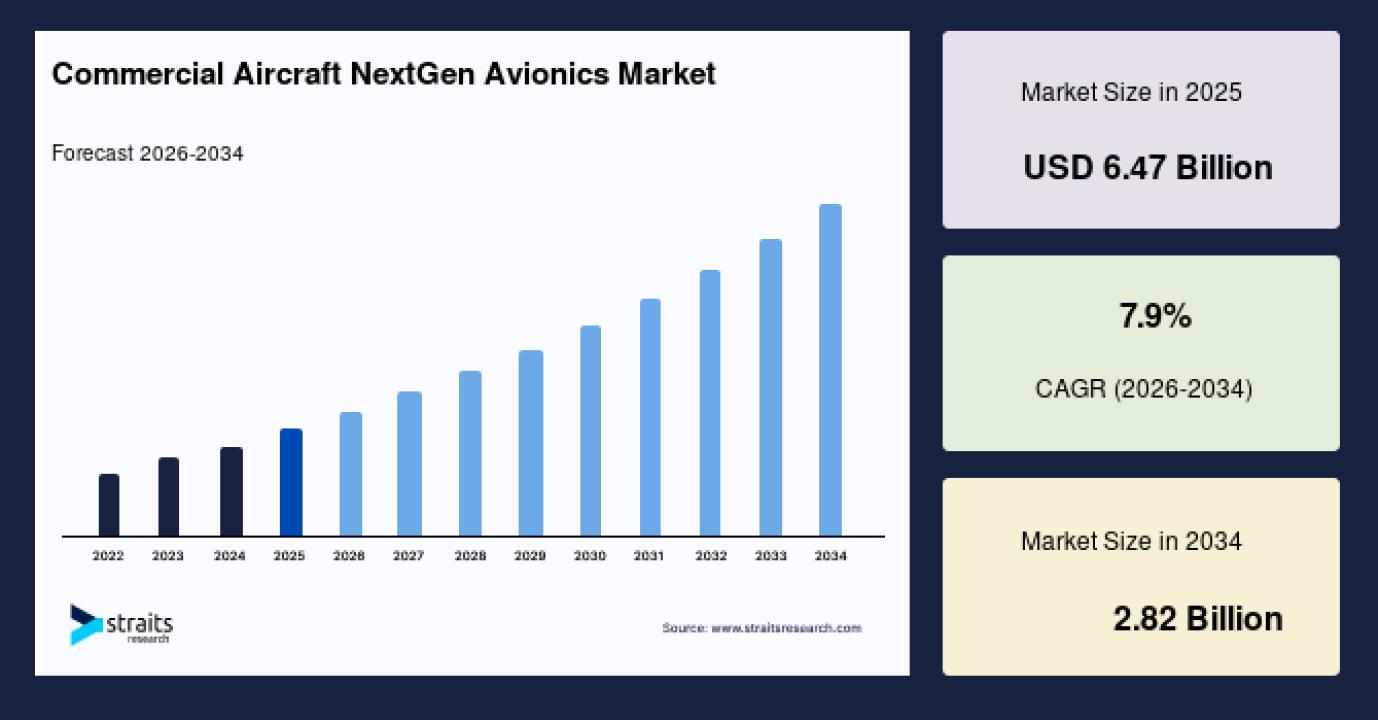
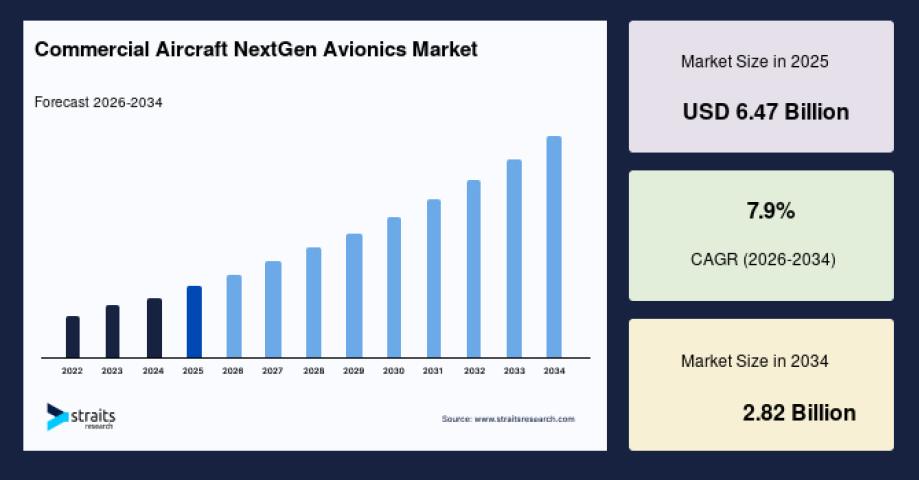
According to the latest industry analysis, the global commercial aircraft NextGen avionics market was valued at USD 6.47 billion in 2025 and is projected to grow from USD 6.98 billion in 2026 to reach USD 12.82 billion by 2034, growing at a CAGR of 7.9% during the forecast period. The increasing modernization of aircraft fleets, rising air passenger traffic, and growing investments in smart aviation technologies are major factors driving market growth.
Market Drivers
One of the key drivers of the commercial aircraft NextGen avionics market is the growing focus on aviation safety and operational efficiency. Airlines and aircraft manufacturers are increasingly adopting advanced avionics systems to improve navigation accuracy, reduce flight delays, optimize fuel consumption, and enhance communication between aircraft and air traffic control systems.
Another major factor supporting market growth is the rising global air passenger traffic. Increasing demand for commercial aircraft across both developed and emerging economies is encouraging airlines to modernize existing fleets with advanced avionics technologies. Airlines are investing heavily in digital cockpit systems and automated flight management solutions to improve flight operations and passenger safety.
The growing adoption of artificial intelligence, data analytics, and automation in aviation systems is also driving market expansion. NextGen avionics technologies help pilots and airlines make real-time operational decisions while reducing pilot workload and improving situational awareness. Advanced systems such as integrated modular avionics, digital flight displays, and predictive maintenance platforms are gaining significant popularity across the aviation sector.
In addition, government initiatives to modernize air traffic management infrastructure are creating new growth opportunities for avionics manufacturers. Regulatory authorities and aviation agencies are increasingly implementing advanced communication and navigation standards to improve airspace efficiency and reduce air traffic congestion.
Market Challenges
Despite strong growth potential, the commercial aircraft NextGen avionics market faces several challenges. One major restraint is the high cost associated with advanced avionics system installation and aircraft modernization. Airlines and aircraft operators often require significant investments to upgrade existing aircraft with advanced cockpit and communication technologies.
Another challenge is the complexity of integrating modern avionics systems into older aircraft fleets. Compatibility issues, system certification requirements, and technical integration challenges can increase project timelines and operational costs.
Cybersecurity risks also remain a major concern for the aviation industry. Increasing reliance on connected avionics systems and digital communication networks raises the risk of cyberattacks and data breaches. Airlines and avionics manufacturers must invest heavily in cybersecurity solutions to protect critical flight systems and passenger data.
In addition, strict aviation regulations and certification procedures can delay product approvals and increase development costs for avionics manufacturers.
Market Segmentation
The commercial aircraft NextGen avionics market is segmented based on system, installation stage, and aircraft type.
By system, the market includes flight management systems, communication systems, electric and navigation systems, surveillance and emergency systems, collision avoidance systems, weather systems, and others. The flight management systems segment holds a substantial market share due to increasing demand for automated flight operations and efficient route optimization technologies.
Based on installation stage, the market is categorized into forward fit and retrofit. The forward fit segment is witnessing strong growth as aircraft manufacturers increasingly integrate advanced avionics technologies into newly manufactured commercial aircraft.
By aircraft type, the market includes narrow-body aircraft and wide-body aircraft. The wide-body aircraft segment is expected to witness significant growth due to increasing long-haul international travel and rising demand for advanced navigation and communication systems in large commercial aircraft.
Regional Insights
North America dominates the global commercial aircraft NextGen avionics market due to the presence of major aircraft manufacturers, advanced aviation infrastructure, and high investments in aerospace technologies. The United States remains a major contributor because of increasing aircraft modernization programs and strong adoption of advanced avionics systems by commercial airlines.
Europe also holds a significant market share owing to strong aerospace manufacturing capabilities and increasing investments in smart aviation technologies. Countries such as Germany, France, and the United Kingdom are actively focusing on enhancing aviation safety and air traffic management systems.
Asia-Pacific is expected to witness the fastest growth during the forecast period. Rapidly increasing air passenger traffic, expanding airline fleets, and rising investments in aviation infrastructure across China, India, Japan, and Southeast Asian countries are supporting market expansion in the region.
Latin America and the Middle East & Africa are emerging markets with increasing aviation modernization projects and growing investments in commercial aviation infrastructure contributing to market growth opportunities.
Key Players Analysis
The global commercial aircraft NextGen avionics market is highly competitive, with major companies focusing on technological advancements, strategic partnerships, and product innovation to strengthen their market position. Companies are increasingly investing in AI-enabled avionics systems, advanced navigation technologies, and integrated digital cockpit solutions to improve aircraft efficiency and safety.
Key players operating in the market include BAE Systems Plc, Cobham Limited, Curtiss-Wright, General Electric Company, Honeywell International Inc., L3Harris Technologies Inc., Raytheon Technologies Corporation, Safran, Teledyne Technologies Incorporated, and Thales Group. These companies are actively expanding their research and development capabilities to support the growing demand for advanced aviation technologies.
Manufacturers are also emphasizing lightweight avionics systems, improved connectivity solutions, and real-time aircraft monitoring technologies to increase operational efficiency and reduce fuel consumption. Strategic collaborations between aircraft manufacturers, airlines, and avionics solution providers are expected to support long-term market growth.
Overall, the commercial aircraft NextGen avionics market is expected to witness significant growth over the coming years due to increasing aircraft modernization, rising focus on aviation safety, advancements in digital aviation technologies, and growing investments in smart air traffic management systems.
Read Full Report Here: https://straitsresearch.com/report/commercial-aircraft-nextgen-avionics-market
About Us
Straits Research is a leading market research and intelligence organization specializing in research, analytics, and advisory services. The company provides detailed market reports and business insights across multiple industries to help organizations make informed strategic decisions. Through comprehensive industry analysis and data-driven research methodologies, Straits Research supports businesses in understanding market trends, competitive landscapes, and growth opportunities.
Contact Us
Email: sales@straitsresearch.com
U.S. Tel: +1 646 905 0080
U.K. Tel: +44 203 695 0070