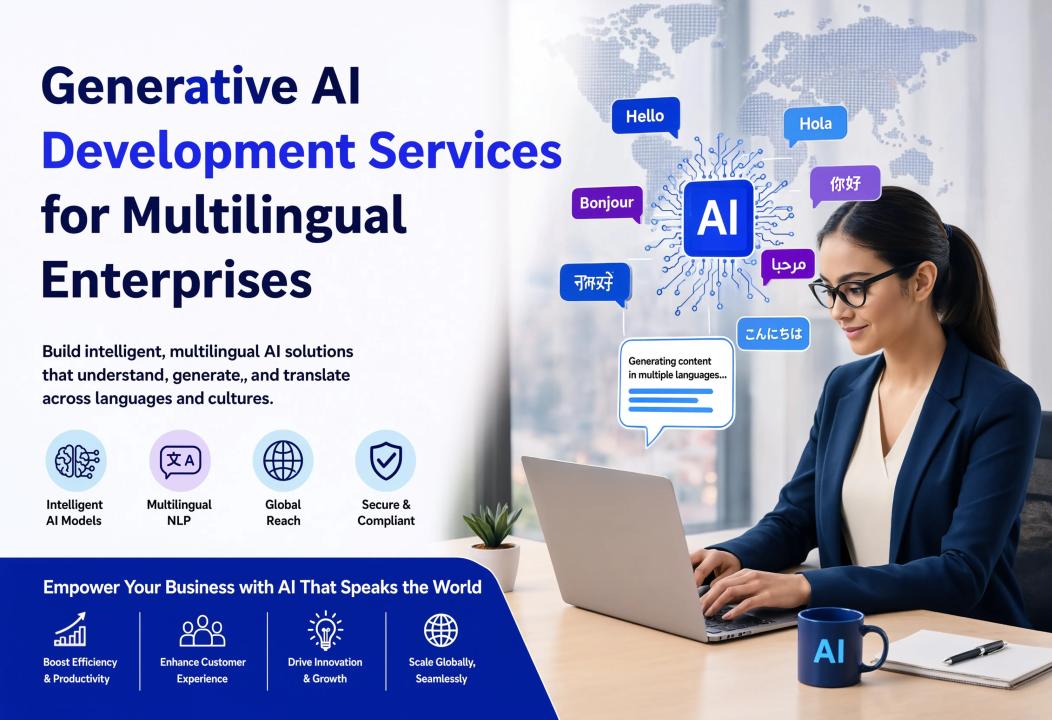

Global companies do not need one chatbot that speaks many languages. They need a system that understands regional intent, handles domain terms, follows policy, and keeps the same brand voice across markets. That is where Generative AI Development Services matter. IBM describes generative AI as software that creates original content from a prompt, and recent enterprise coverage points to a shift in 2026 from standalone models toward systems, agents, embedded AI, and stronger trust controls.
For multilingual enterprises, the real task is broader than translation. It includes customer support, document search, sales enablement, internal knowledge access, and voice experiences across languages. Newer OpenAI work on multilingual benchmarks and realtime voice translation, plus examples of multilingual localization at scale, show why language quality now sits at the center of enterprise AI planning.
Why multilingual enterprises need a different AI build
A single-language AI setup often breaks when it reaches a new market. A term that sounds normal in English may need a formal phrase in German, a local term in Hindi, or a different tone in Japanese. A good Generative AI development company does not stop at model choice. It maps user intent, business rules, and language nuances before building anything.
That matters because multilingual workflows usually span more than one channel. A customer may start with chat, move to email, then call support. An internal employee may ask a question in one language and expect a policy answer in another. Recent OpenAI and Google examples show that voice, translation, and multilingual chat are now practical enterprise use cases rather than side projects.
What 2026 AI trends mean for enterprise teams
1) Systems are taking priority over isolated models
IBM’s 2026 outlook says the competition is moving toward systems, not just models, with smaller models routing work to larger ones when needed. For multilingual enterprises, that means a better setup is often a layered one: language detection, retrieval, translation, policy checks, and response generation working together.
2) AI is moving inside existing tools
Deloitte’s 2026 prediction says more people will use gen AI when it is embedded in the tools they already use, not as a separate destination. That is important for enterprises because adoption rises when staff can ask for help inside CRM, ERP, support, or knowledge systems instead of switching apps.
3) Voice and localization are becoming practical at scale
OpenAI’s 2026 voice model announcement and Descript case study show a stronger push toward realtime translation, transcription, and multilingual media workflows. For global firms, this opens use cases like multilingual call summaries, live support assist, training content localization, and voice agents for regional markets.
4) Trust, sovereignty, and data control are now buying factors
IBM and Microsoft both point to trust, security, and AI sovereignty as major enterprise concerns in 2026. That makes sense for multilingual companies because data often crosses regions with different rules, retention needs, and approval flows. A strong AI Consulting Company should address data flow, governance, and model access before rollout begins.
What Generative AI Integration Services should cover
The best Generative AI Integration Services do not start with a demo. They start with business use cases and language risk.
Retrieval with multilingual knowledge bases
The AI should pull from approved documents in each market, not guess from generic training data. This helps with product policy, compliance text, and region-specific support answers.
Prompt and response controls by language
Good prompts in English do not always work the same way in other languages. The system needs language-aware prompt rules, glossary support, and response filters for tone and terminology.
Human review for high-risk content
Not every answer should go straight to the user. Legal, medical, financial, and public-sector content often needs review, especially when the system is handling multiple languages.
Voice, chat, and document workflows
The strongest enterprise setups connect text, speech, and documents. That is where Generative AI solutions become useful across contact centers, sales, operations, and knowledge management.
How to choose the right AI partner
A credible AI Integration Services partner should be able to show more than model names. Look for these decision points:
First, ask how they handle multilingual quality testing. Ask for examples of tone control, terminology consistency, and region-specific review.
Second, ask how they connect AI to your existing stack. A useful partner should work with your CRM, help desk, CMS, and document systems without forcing a rebuild.
Third, ask about governance. This includes access control, audit trails, approval steps, and fallback handling when the AI is unsure.
Fourth, ask how they measure success. Strong KPIs include response accuracy, deflection rate, time saved, language coverage, and user satisfaction by market.
A practical path for multilingual enterprises
A sensible rollout starts small. Pick one market, one use case, and one language pair. Customer support triage, policy search, and multilingual document summarization are often good first steps because they are measurable and low risk.
From there, expand in layers. Add more languages, connect more systems, then move into voice and agent workflows. This approach reduces noise and gives teams a chance to refine prompts, retrieval sources, and review rules before wider launch. That is often the difference between a pilot that gets attention and a program that gets used.