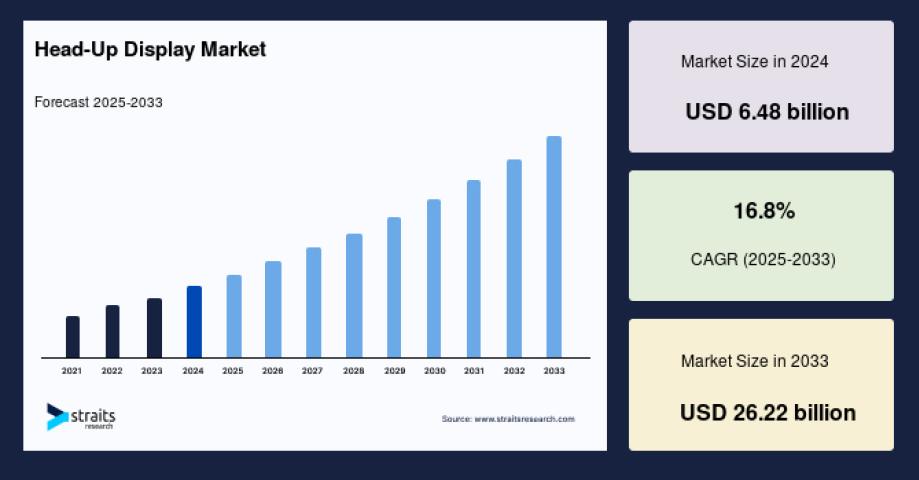

The global head-up display (HUD) market is poised for robust growth over the next decade, fueled by increasing demand for advanced vehicle safety systems, the emergence of connected mobility technologies, and the growing integration of augmented reality (AR) into automotive and aviation applications. According to recent market analysis, the global head-up display market was valued at USD 3.23 billion in 2025 and is expected to grow from USD 3.92 billion in 2026 to USD 18.43 billion by 2034, registering a remarkable compound annual growth rate (CAGR) of 21.35% during the forecast period.
Head-up displays are transparent projection systems that present critical information directly within a user's line of sight. In automotive applications, HUDs display data such as vehicle speed, navigation instructions, engine performance metrics, and safety alerts on the windshield or a dedicated combiner screen. By reducing the need for drivers to divert their attention from the road, these systems contribute to improved situational awareness and enhanced safety.
As vehicles become increasingly connected and autonomous technologies continue to evolve, head-up displays are emerging as a key interface between drivers and advanced vehicle systems.
Market Overview
The head-up display market has undergone significant transformation in recent years, evolving from a premium automotive feature into a broader safety and driver-assistance technology. Advances in display technologies, sensor integration, and software development have expanded the functionality of HUD systems across automotive and aviation sectors.
Modern HUDs can integrate navigation guidance, speed monitoring, collision warnings, lane departure alerts, pedestrian detection notifications, and environmental information directly into the driver's field of vision. These capabilities are increasingly aligned with the development of Advanced Driver Assistance Systems (ADAS), which are becoming standard features in many passenger vehicles.
In the aviation sector, HUD technology continues to play a critical role in supporting pilot decision-making by displaying essential flight information during takeoff, landing, and challenging weather conditions.
The growing emphasis on reducing accidents caused by driver distraction is expected to remain a central factor supporting market expansion through 2034.
Growth Drivers
One of the primary drivers of market growth is the increasing global focus on road safety. Governments, transportation authorities, and automotive manufacturers are actively implementing measures designed to reduce traffic accidents and fatalities caused by distracted driving.
Head-up displays contribute directly to these objectives by allowing drivers to access important information without shifting their focus away from the road. As distracted driving continues to be recognized as a major safety concern worldwide, demand for technologies that improve driver awareness is increasing significantly.
The broader adoption of ADAS technologies is also accelerating HUD implementation across vehicle segments. Safety features such as lane departure warning systems, collision avoidance technologies, blind-spot monitoring, and adaptive cruise control increasingly rely on intuitive visual interfaces, making HUDs an attractive solution for delivering real-time information to drivers.
Additionally, rising disposable incomes and increasing vehicle ownership in developing economies are supporting demand for technologically advanced automobiles equipped with premium safety and convenience features.
Emerging Technology Trends
Augmented reality has become one of the most transformative trends within the head-up display industry.
AR-based HUDs overlay digital information directly onto real-world driving environments, providing contextual guidance that enhances both safety and convenience. Unlike conventional systems, AR displays can project navigation routes directly onto road surfaces, highlight lane boundaries, identify nearby vehicles, and warn drivers of potential hazards in real time.
These advanced capabilities are significantly improving the user experience while helping manufacturers differentiate their vehicle offerings in an increasingly competitive automotive market.
Artificial intelligence is also playing an important role in HUD evolution. AI-enabled systems can process data from cameras, sensors, and vehicle systems to provide predictive alerts and more relevant information based on driving conditions.
Furthermore, holographic display technologies are attracting considerable investment as manufacturers explore next-generation interfaces capable of delivering larger viewing areas, enhanced clarity, and improved interaction between drivers and vehicles.
Market Challenges
Despite strong growth prospects, the market faces several implementation challenges.
One of the most significant obstacles is the limited space available within modern automotive cockpits. HUD systems require multiple hardware components, including projection units, mirrors, display modules, and sensors, all of which must be integrated into increasingly compact vehicle designs.
In many cases, vehicle manufacturers must redesign dashboard layouts and cockpit architectures to accommodate HUD systems effectively. This process can increase development complexity, engineering costs, and production timelines.
Another challenge involves ensuring that projected information remains clearly visible under varying lighting and environmental conditions. Manufacturers must continually improve display brightness, contrast, and optical performance to maintain system effectiveness across diverse operating environments.
Opportunities Driven by AR-Based HUDs
The integration of augmented reality into head-up displays represents one of the most promising growth opportunities within the market.
AR-based systems provide immersive visual guidance that enhances driver confidence and improves overall road awareness. Features such as real-time navigation overlays, object recognition, blind-spot visualization, pedestrian alerts, and route simulations are creating strong demand among both consumers and automotive manufacturers.
Industry participants are increasingly forming strategic partnerships and investing in research and development to accelerate AR innovation. These investments are expected to drive technological advancements, improve affordability, and expand adoption across vehicle categories.
As autonomous and semi-autonomous driving technologies become more prevalent, AR-enabled HUDs are expected to play a critical role in facilitating communication between vehicle systems and human drivers.
Regional Insights
North America Maintains Market Leadership
North America currently represents the largest regional market, accounting for approximately 36.1% of global revenue. The region's leadership is supported by strong regulatory emphasis on vehicle safety, widespread adoption of advanced automotive technologies, and growing awareness of distracted driving risks.
The United States remains a key contributor to regional growth, with increasing implementation of safety regulations and strong demand for connected vehicles equipped with advanced driver assistance features.
Canada is also emerging as an important market due to its rapid adoption of innovative automotive technologies and supportive regulatory environment.
The North American market is projected to maintain strong momentum throughout the forecast period, supported by increasing investments in autonomous vehicle technologies and connected mobility solutions.
Europe Emerges as the Fastest-Growing Region
Europe is expected to register the fastest growth during the forecast period, driven by rising adoption of premium automotive technologies and significant investments in advanced vehicle safety systems.
The United Kingdom has emerged as a notable innovation hub within the European HUD ecosystem. Automotive technology companies and startups are investing heavily in holographic displays, augmented reality interfaces, and next-generation cockpit solutions.
Growing demand for premium vehicles equipped with advanced safety features continues to create favorable market conditions across major European automotive markets.
Asia-Pacific Expands Through Automotive and Aerospace Growth
Asia-Pacific is expected to witness substantial growth due to expanding automotive production, rising disposable incomes, and increasing adoption of semi-autonomous vehicles.
China remains a major contributor to regional demand, supported by strong investments in automotive innovation, defense modernization, and advanced navigation technologies. The country's growing consumer base and expanding vehicle production capacity are expected to support continued market growth.
Segment Analysis
By Component
The display unit segment represents the largest share of the market and is projected to maintain its leadership position throughout the forecast period.
Display units serve as the core visual interface within HUD systems, projecting processed images onto windshields or combiner screens. Their ability to provide high transparency, energy efficiency, and enhanced visibility has contributed significantly to market adoption.
Other key components include video generators, projector units, software solutions, and supporting hardware systems that collectively enable real-time information delivery.
By Type
Among product categories, AR-based head-up displays are expected to witness the strongest growth and maintain a dominant market position.
The growing demand for advanced safety applications such as lane departure warnings, pedestrian detection, vehicle proximity monitoring, blind-spot alerts, and real-time navigation guidance continues to drive adoption of AR-enabled solutions.
Conventional, windshield-based, and combiner-based HUDs remain important segments, particularly within mid-range and entry-level vehicle categories.
By End User
The automotive segment represents the fastest-growing application area and is projected to expand at a CAGR of approximately 24.2% during the forecast period.
Automotive manufacturers are increasingly integrating HUD systems into passenger vehicles as part of broader efforts to enhance safety, comfort, and user experience. Growing adoption of connected vehicles and autonomous driving technologies is expected to further strengthen segment growth.
The aviation industry also remains a significant end-user, where HUD systems continue to support both commercial and military operations through improved situational awareness and flight safety.
Competitive Landscape
The global head-up display market is characterized by intense competition among automotive technology providers, electronics manufacturers, and defense systems companies focused on innovation and strategic partnerships.
Leading market participants include Bosch, Nippon Seiki Co. Ltd., Continental AG, Visteon Corporation, Denso Corporation, Panasonic Corporation, BAE Systems, Pioneer Corporation, Yazaki, and Thales Group.
Industry leaders continue to invest heavily in research and development aimed at improving display performance, expanding AR capabilities, and enhancing software integration. Partnerships between automotive manufacturers, technology providers, and software developers are expected to accelerate commercialization of next-generation HUD systems.
Recent developments highlight the pace of innovation across the sector. In January 2022, C.Y. Vision introduced an advanced automotive 3D augmented reality HUD featuring an expanded field of view. In April 2022, Bosch acquired Five to strengthen its automated driving software capabilities. Continental also unveiled a full-windshield HUD concept in December 2022, demonstrating the industry's progression toward immersive vehicle cockpit experiences.
Click Here to Access the Comprehensive Report: https://straitsresearch.com/report/head-up-display-market
About the Market Study
The market study evaluates the global head-up display industry from 2022 through 2034, with 2025 serving as the base year for analysis. The report provides comprehensive insights into market size, growth forecasts, technological developments, competitive dynamics, regulatory influences, and emerging industry trends.
The research assesses performance across components, display types, end-user industries, and geographic regions, including North America, Europe, Asia-Pacific, Latin America, and the Middle East & Africa. Country-level analysis covers major automotive and aerospace markets such as the United States, Canada, Germany, the United Kingdom, France, China, Japan, India, and South Korea.
As vehicle manufacturers continue to prioritize safety, connectivity, and user experience, head-up display technologies are expected to become an increasingly important component of modern transportation systems. Continued innovation in augmented reality, artificial intelligence, and display engineering is anticipated to drive sustained market expansion through 2034.