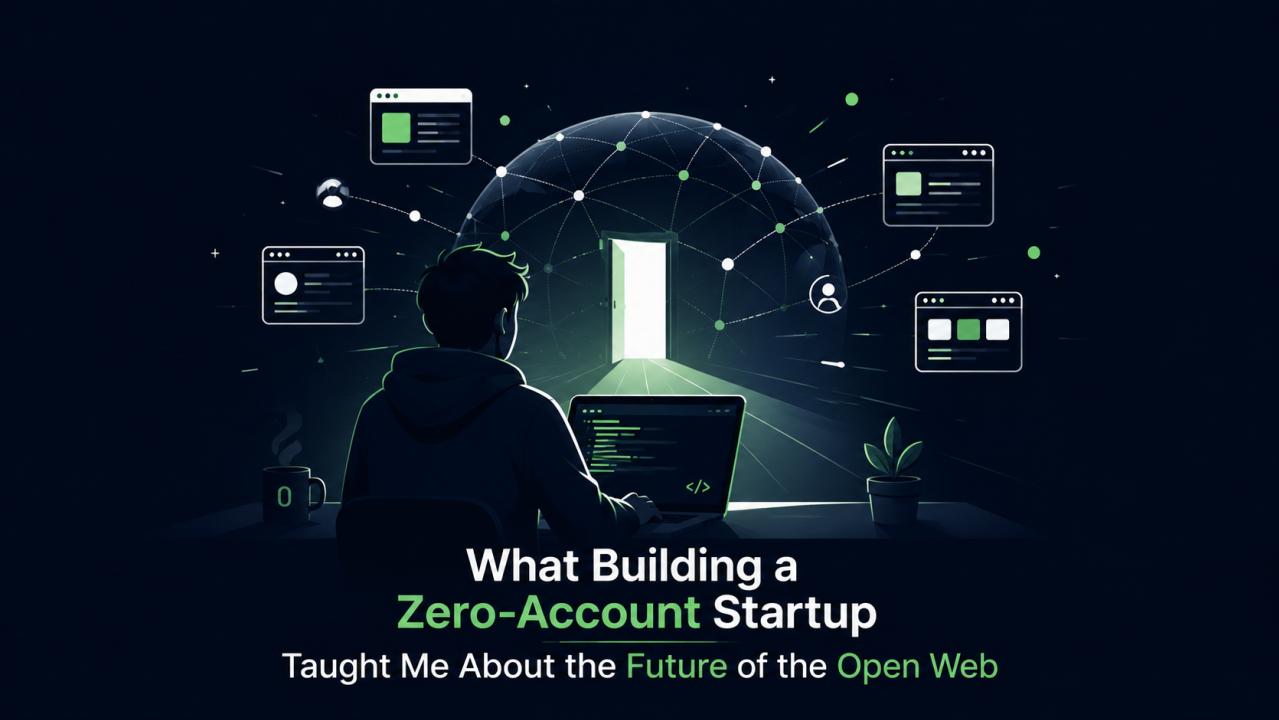
There is a particular type of startup that nobody writes about — the ones built around subtraction rather than addition.
Most startup advice is about adding things. Add features. Add users. Add revenue streams. Add integrations. The dominant model of the last decade has been to grow the product until it becomes so embedded in daily life that leaving feels impossible.
I built the opposite. A platform where users arrive with nothing and leave with nothing — no account created, no data stored, no app installed. Just a browser tab, a camera, and a conversation.
Building that product taught me more about where the internet is actually going than any growth playbook I've read.
The Problem With Gates
Every major communication platform today starts with a gate. You hand over your phone number, create a password, verify your email, accept the terms, and maybe download an app — before you've experienced a single second of the product you came for.
For hundreds of millions of users, this gate is genuinely prohibitive. Not because the steps are hard, but because the context is wrong.
Consider a user in a small town in Tamil Nadu accessing the internet for the first time on a shared family device. The idea of creating a personal account — one that connects to a real phone number, stores a profile, and persists across sessions — carries real friction and real privacy concerns. The same is true for a student in Malaysia on a low-storage Android, a worker in the UAE using a work computer during a break, or an elderly person in rural Karnataka who just wants to speak to a relative in a familiar language.
These aren't edge cases. In India alone, there are hundreds of millions of internet users who fit this profile. They are not underserved because the technology doesn't exist — they are underserved because the products were designed for someone else.
What Zero Accounts Actually Means to Build
When I decided to build a no-registration video chat platform — Chatzyo, a browser-based random video chat for Indian language communities — the first reaction from people I told was always the same: "But how do you make money without accounts?"
It's a fair question. Accounts are how most consumer platforms monetize — through subscription tiers, through data, through advertising that relies on persistent user profiles.
The honest answer is that zero-account platforms force you to think about monetization differently from day one. You cannot sell data you don't have. You cannot lock features behind a paywall for users with no login. You have to find a model that works with anonymous, transient users — or accept that the platform's value is in the audience it builds, not in the data it collects.
For a startup building in this space, that constraint is actually clarifying. It removes an entire category of tempting but ultimately harmful business decisions before they can be made.
The Startup Lesson Most Founders Miss
The broader lesson — the one that applies beyond my specific product — is about the relationship between friction and trust.
Every step you add to an onboarding flow is a bet that users trust you enough to complete it. For established brands, that bet usually pays off. For a new product from an unknown founder, every additional step is a conversion killer.
The no-login model short-circuits this problem entirely. There is no onboarding. The product works or it doesn't. Users decide in the first thirty seconds whether the experience is worth returning to — and they make that decision based entirely on the product itself, not on how many steps they've already committed to.
This forces a kind of brutal product honesty that account-based platforms can avoid for years behind the shield of sunk-cost onboarding.
Where This Goes
The idea that every internet product needs a persistent identity to function is a design assumption, not a technical requirement. WebRTC — the browser API that powers peer-to-peer video — doesn't need accounts. It needs two browsers and a signaling server.
As browsers become more capable and connectivity improves across India and Southeast Asia, the conditions for zero-friction internet products are better than they have ever been. The question for the next generation of startup founders is not just "what can we build?" but "what can we build that removes the gate entirely?"
The users who need that answer most are already online, waiting.
About the Author: Gowrishankar Rangasamy is the founder of Chatzyo, a free browser-based random video chat platform for Indian language communities, built in Coimbatore, Tamil Nadu. No app, no account, no gate.