The global Molded Fiber Packaging Market is witnessing steady growth as businesses and consumers increasingly adopt environmentally friendly packaging alternatives to reduce plastic waste. Molded fiber packaging is manufactured using recycled paper, cardboard, and natural fibers, offering biodegradable, recyclable, and compostable packaging solutions for food, beverages, electronics, healthcare products, and consumer goods. Growing environmental awareness, stringent government regulations on single-use plastics, and increasing demand for sustainable packaging are significantly accelerating market expansion.
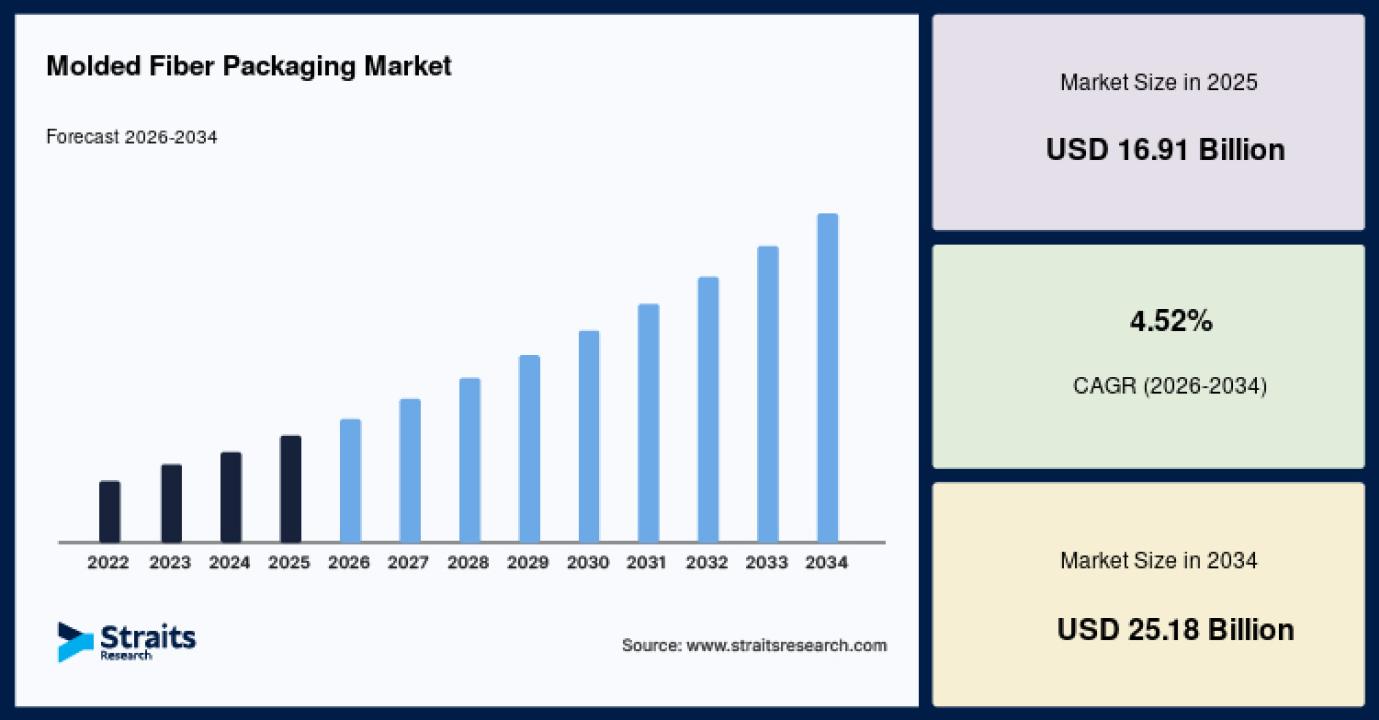
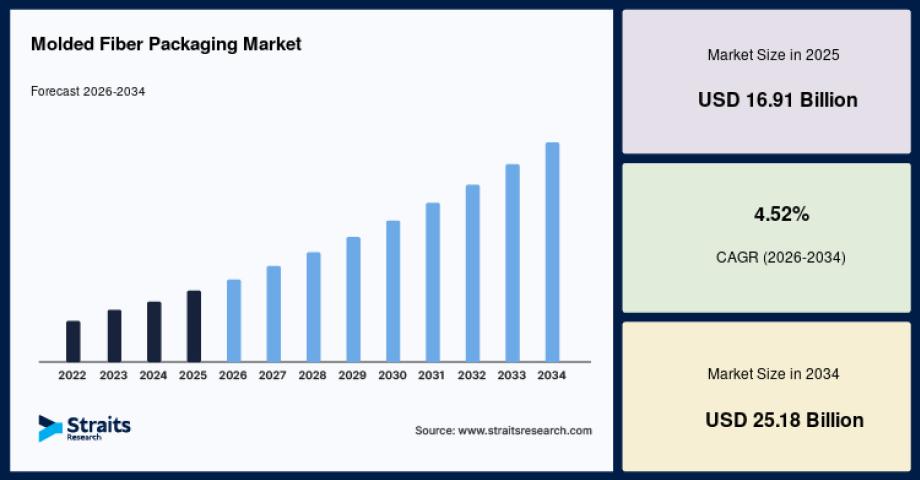
According to industry analysis, the global Molded Fiber Packaging Market size was valued at USD 16.91 billion in 2025 and is projected to grow from USD 17.68 billion in 2026 to USD 25.18 billion by 2034, exhibiting a CAGR of 4.52% during the forecast period (2026–2034).
Read Full Report: https://straitsresearch.com/report/molded-fiber-packaging-market
The increasing adoption of eco-friendly packaging, expanding e-commerce activities, rising demand from the food and beverage industry, technological advancements in packaging manufacturing, and growing corporate sustainability initiatives are among the primary factors driving market growth. Manufacturers continue to develop innovative molded fiber products with improved durability, moisture resistance, and aesthetic appeal to meet evolving industry requirements.
Growing Demand for Sustainable Packaging Fuels Market Growth
One of the primary drivers of the Molded Fiber Packaging Market is the increasing demand for environmentally sustainable packaging materials. Consumers and businesses are actively replacing plastic packaging with renewable and biodegradable alternatives that minimize environmental impact.
Molded fiber packaging offers excellent recyclability and compostability while providing sufficient strength and product protection. Its ability to support circular economy initiatives makes it an attractive solution across multiple industries.
The global transition toward sustainable packaging is expected to support long-term market growth.
Rising Restrictions on Single-Use Plastics
Governments worldwide are implementing stricter environmental regulations aimed at reducing plastic pollution. Bans on single-use plastics, extended producer responsibility (EPR) regulations, and sustainability targets are encouraging manufacturers to adopt biodegradable packaging materials.
Molded fiber packaging helps companies comply with evolving environmental standards while meeting growing consumer expectations for eco-friendly products.
Increasing regulatory support for sustainable packaging is expected to remain a major contributor to market expansion.
Expanding Food and Beverage Industry Drives Demand
The food and beverage industry represents one of the largest application segments for molded fiber packaging. Egg cartons, fruit trays, beverage carriers, takeaway containers, food service packaging, and protective inserts are increasingly manufactured using molded fiber materials.
Consumers are demanding environmentally responsible food packaging that ensures product safety while reducing waste. Restaurants, food delivery companies, and retailers are also transitioning toward sustainable packaging solutions.
The expanding food and beverage industry continues to strengthen market growth.
E-Commerce Growth Creates New Opportunities
Rapid expansion of global e-commerce is significantly increasing demand for protective packaging materials. Molded fiber packaging provides lightweight, shock-absorbing, and customizable protection for electronics, household products, cosmetics, and consumer goods during transportation.
Online retailers are adopting fiber-based packaging to improve sustainability while reducing shipping damage and packaging waste. As e-commerce continues to grow globally, demand for molded fiber packaging is expected to increase steadily.
The growth of online retail is creating substantial opportunities for market expansion.
Technological Advancements in Fiber Packaging Manufacturing
Continuous innovation in manufacturing technologies is improving the quality and performance of molded fiber packaging. Advanced molding techniques, precision tooling, water-resistant coatings, and automation are enabling manufacturers to produce lightweight, durable, and aesthetically appealing packaging solutions.
Modern production technologies also improve manufacturing efficiency while reducing raw material consumption and production costs. These advancements are expanding the range of applications across multiple industries.
Technological innovation continues to strengthen market competitiveness.
Increasing Corporate Sustainability Initiatives
Organizations across industries are integrating sustainability into their business strategies by reducing plastic usage and improving packaging recyclability. Consumer goods manufacturers, retailers, food companies, and electronics brands are investing in molded fiber packaging to meet environmental goals and strengthen brand reputation.
Corporate commitments to reducing carbon emissions, minimizing packaging waste, and supporting circular economy initiatives continue to accelerate the adoption of molded fiber products.
Growing corporate sustainability efforts are expected to generate long-term market opportunities.
Asia-Pacific Maintains Market Leadership
Asia-Pacific currently holds a significant share of the global Molded Fiber Packaging Market due to its large manufacturing base, rapidly expanding packaging industry, growing food processing sector, and increasing adoption of sustainable materials. China, India, Japan, and South Korea continue investing in environmentally friendly packaging technologies to support industrial growth and environmental objectives.
The region's strong manufacturing capabilities and rising consumer awareness continue to support market leadership.
North America Experiences Strong Market Growth
North America represents a major market for molded fiber packaging, driven by increasing consumer demand for sustainable products, expanding food delivery services, rising e-commerce activities, and stringent environmental regulations. The United States remains the largest contributor to regional market growth due to strong investments in sustainable packaging innovation and recycling infrastructure.
Growing corporate sustainability commitments continue to strengthen the regional market.
Europe Emerges as a Key Sustainable Packaging Hub
Europe is expected to witness steady growth during the forecast period, supported by ambitious environmental policies, circular economy initiatives, and increasing demand for biodegradable packaging solutions. Countries such as Germany, France, the United Kingdom, Italy, and the Netherlands continue investing in advanced fiber packaging technologies and sustainable manufacturing practices.
The region's strict environmental regulations continue to encourage the adoption of molded fiber packaging across multiple industries.
Competitive Landscape Focuses on Sustainable Innovation and Product Development
The Molded Fiber Packaging Market remains highly competitive, with leading companies focusing on biodegradable packaging materials, lightweight product designs, advanced molding technologies, recyclable coatings, and customized packaging solutions. Companies are investing heavily in research and development to improve product durability, moisture resistance, manufacturing efficiency, and design flexibility.
Strategic partnerships, acquisitions, production capacity expansions, and collaborations with food manufacturers, retailers, and e-commerce companies are helping organizations strengthen their global market positions. Manufacturers are also adopting automation and digital manufacturing technologies to improve production efficiency and reduce operational costs.
These initiatives are expected to drive continuous innovation and strengthen competition across the industry.
Future Outlook for the Molded Fiber Packaging Market
The future of the Molded Fiber Packaging Market remains highly promising as sustainability continues to shape the global packaging industry. Increasing demand for biodegradable packaging, expanding e-commerce activities, growing food delivery services, rising regulatory restrictions on plastics, technological advancements in fiber molding, and strong corporate sustainability initiatives are expected to support steady market growth through 2034.
Innovations in moisture-resistant fiber packaging, premium molded fiber designs, bio-based coatings, smart packaging integration, lightweight packaging solutions, and advanced recycling technologies will continue to reshape the industry. As businesses increasingly prioritize environmentally responsible packaging, molded fiber packaging will remain a key solution for sustainable product protection across numerous industries.
Frequently Asked Questions
What is the current size of the Molded Fiber Packaging Market?
The market was valued at USD 16.91 billion in 2025.
What is the projected market size by 2034?
The market is expected to reach USD 25.18 billion by 2034.
What is the CAGR of the Molded Fiber Packaging Market?
The market is projected to grow at a CAGR of 4.52% during 2026–2034.
What factors are driving market growth?
Key drivers include growing demand for sustainable packaging, increasing restrictions on single-use plastics, expanding food and beverage applications, rapid growth of e-commerce, technological advancements in fiber packaging manufacturing, and increasing corporate sustainability initiatives.
Which region holds a significant market share?
Asia-Pacific currently maintains a significant share of the global Molded Fiber Packaging Market.
Which region is expected to grow the fastest?
Asia-Pacific is expected to witness the fastest growth during the forecast period due to rapid industrialization, expanding packaging and food processing industries, increasing environmental awareness, rising demand for sustainable packaging materials, supportive government regulations, and growing investments in eco-friendly manufacturing technologies.