
IMARC Group's report, "Tea Premix Manufacturing Plant Project Report 2026: Industry Trends, Plant Setup, Machinery, Raw Materials, Investment Opportunities, Cost and Revenue", offers a comprehensive guide for establishing a manufacturing plant. The tea premix plant setup DPR report offers insights into the manufacturing process, financials, capital investment, expenses, ROI, and more for informed business decisions.
Tea Premix Manufacturing Plant Project Report Summary: -
- Comprehensive guide for setting up tea premix manufacturing plant.
- Covers market trends and industry outlook for 2026.
- Detailed project setup, including unit operations and processes.
- Raw material and utility requirements.
- Infrastructure and machinery specifications.
- Workforce and staffing requirements.
- Packaging and transportation details.
- Financial aspects: investment opportunities, cost analysis, and revenue projections.
In addition to covering operational aspects, the report offers detailed insights into the tea premix manufacturing plant process and project economics.
- Detailed insights into the tea premix manufacturing plant
- In-depth project economics and financial metrics.
- Covers capital investments and project funding.
- Analysis of operating expenses and income projections.
- Breakdown of fixed and variable costs, direct and indirect expenses.
- Evaluation of ROI (Return on Investment) and NPV (Net Present Value).
- Profit and Loss account analysis.
- Comprehensive financial analysis for decision-making.
- Provides a roadmap for successfully establishing a tea premix manufacturing plant.
Request for a Sample Report: https://www.imarcgroup.com/tea-premix-manufacturing-plant-project-report/requestsample
What is tea premix?
Tea premix is a convenient, ready-to-use powdered or granulated blend formulated to prepare tea instantly by simply adding hot water or milk. It typically contains tea extracts, sugar, milk solids, and flavoring ingredients, while specialized variants may include spices, herbs, sweeteners, or functional additives to cater to different consumer preferences. Tea premixes are widely used in offices, hotels, hospitals, vending machines, educational institutions, and households because they eliminate the need for brewing loose tea or tea bags, ensuring consistent taste and reducing preparation time. Available in flavors such as masala, ginger, cardamom, lemon, and green tea, these products offer versatility for both traditional and modern tea drinkers. Manufacturers also produce low-sugar, sugar-free, and herbal formulations to meet evolving health-conscious demands. Their long shelf life, ease of storage, and quick preparation make tea premixes an efficient beverage solution, supporting growing consumption across commercial and residential sectors worldwide while enhancing convenience without compromising flavor or quality.
Market Trends and Drivers:
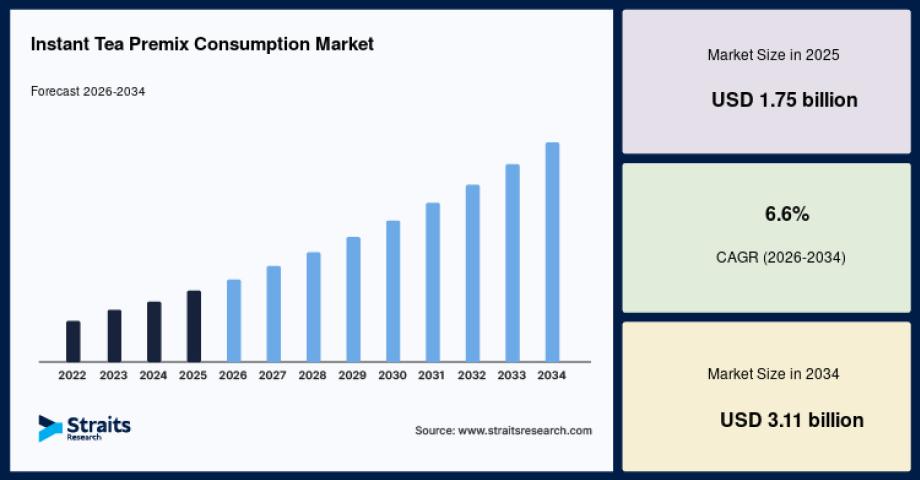
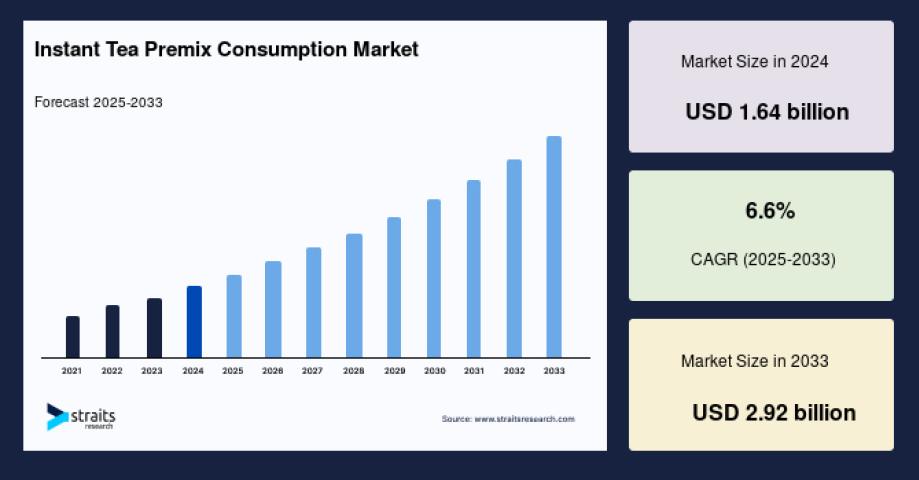
The tea premix market is experiencing robust growth due to rising consumer demand for convenient, time-saving beverage solutions that fit increasingly busy life>
The rapid expansion of e-commerce platforms and organized retail networks has further improved product accessibility, while attractive packaging and diverse flavor offerings continue to strengthen consumer appeal. Additionally, increasing demand from emerging economies, combined with product innovations and premiumization trends, is creating new business opportunities. North America dominates the market, with over 40% of the share, supported by strong consumer preference for convenient beverages, widespread vending machine infrastructure, and the presence of established food and beverage manufacturers that continuously invest in product development and distribution expansion.
Cost Optimization Strategies for a Tea Premix Manufacturing Plant
Cost optimization is a key factor in improving the profitability of a tea premix manufacturing plant. Since raw materials such as tea powder, sugar, milk powder or whitener, flavors, and spices account for approximately 75-85% of the total operating expenditure (OpEx), establishing long-term procurement agreements with reliable suppliers can significantly reduce price volatility and ensure uninterrupted production. Utilities, including electricity, steam, and water, contribute around 5-8% of operating costs, making energy-efficient machinery and optimized process scheduling essential for lowering utility expenses. Manufacturers can further reduce production costs by minimizing material wastage during extraction, spray drying, blending, homogenization, and packaging operations while implementing preventive maintenance programs to avoid unexpected equipment downtime. Investing in automated packaging systems, inventory optimization, and quality control measures also enhances operational efficiency, improves product consistency, and reduces labor costs, resulting in better overall plant economics.
ROI Analysis and Financial Performance
A detailed return on investment (ROI) analysis helps investors evaluate the long-term financial viability of a tea premix manufacturing project. Financial projections should incorporate capital expenditure (CapEx), operating expenditure (OpEx), production capacity utilization, product pricing, depreciation, taxation, and working capital requirements. According to IMARC Group's project assessment, a standard tea premix manufacturing facility with an annual production capacity of approximately 2,000 metric tons can achieve gross profit margins of 30-40% and net profit margins ranging from 12-20%, subject to market conditions and operational efficiency. Improving plant utilization, reducing raw material losses, and maintaining consistent product quality can significantly enhance profitability and shorten the payback period. Comprehensive financial evaluation, including sensitivity analysis, liquidity assessment, net present value (NPV), and profitability analysis, enables manufacturers to identify investment risks while maximizing long-term returns.
Production Planning for Maximum Operational Efficiency
Efficient production planning ensures consistent output while optimizing resource utilization throughout the manufacturing process. A well-designed production schedule should align procurement, extraction, spray drying, blending, homogenization, packaging, and inventory management with projected market demand to minimize bottlenecks and reduce idle time. Maintaining optimal inventory levels for critical raw materials helps prevent supply chain disruptions while avoiding excessive storage costs. Manufacturers should continuously monitor equipment performance, production yields, and quality parameters to improve operational efficiency and reduce waste. Demand forecasting, batch scheduling, preventive maintenance planning, and real-time production monitoring enable plants to maintain high capacity utilization while ensuring timely deliveries. A data-driven production planning strategy supports scalable operations, improves customer satisfaction, and strengthens the overall competitiveness of the tea premix manufacturing business in both domestic and export markets.
Key Aspects Required for Setting Up a Tea Premix Manufacturing Plant
Detailed Process Flow:
- Product Overview: Comprehensive description of the tea premix product and its characteristics.
- Unit Operations Involved: Step-by-step breakdown of the various operations in the production process.
- Mass Balance and Raw Material Requirements: Calculations for material inputs and outputs, along with required quantities of raw materials.
- Quality Assurance Criteria: Standards and procedures to ensure the quality of the final product.
- Technical Tests: Essential tests and evaluations to maintain product consistency and compliance.
Project Details, Requirements, and Costs Involved
- Land, Location, and Site Development: Assessment of land requirements, optimal location selection, and site development costs.
- Plant Layout: Design and layout planning for efficient plant operations.
- Machinery Requirements and Costs: Identification of machinery needed, along with the associated costs.
- Raw Material Requirements and Costs: Determination of the types and quantities of raw materials required and their costs.
- Packaging Requirements and Costs: Specifications for packaging materials and equipment, including associated expenses.
- Transportation Requirements and Costs: Logistics planning and cost estimation for the transportation of raw materials and finished products.
- Utility Requirements and Costs: Analysis of utility needs (such as water, electricity, and fuel) and their associated costs.
- Human Resource Requirements and Costs: Workforce planning, including staffing needs, roles, and costs for labor and management.
Project Economics
- Capital Investments: Initial costs required for setting up the tea premix manufacturing plant, including land, equipment, and infrastructure.
- Operating Costs: Ongoing expenses for running the plant, such as raw materials, labor, utilities, and maintenance.
- Expenditure Projections: Detailed forecasts of all costs over the short and long term.
- Revenue Projections: Expected income generated from the sale of tea premix and by-products.
- Taxation and Depreciation: Analysis of tax obligations, incentives, and asset depreciation over time.
- Profit Projections: Estimated profitability based on costs, revenues, and market conditions.
- Financial Analysis: Comprehensive evaluation of the plant's financial viability, including cash flow analysis, return on investment (ROI), and break-even point.
Ask Analyst for Customization: https://www.imarcgroup.com/request?type=report&id=15139&flag=C
Customization Options Available:
- Plant Location: Selection of optimal location for the plant.
- Plant Capacity: Customization based on desired production capacity.
- Machinery: Choice between automatic, semi-automatic, or manual machinery.
- List of Machinery Providers: Identification of suitable machinery suppliers.
Key Questions Addressed in This Report:
- How has the tea premix market performed so far and how will it perform in the coming years?
- What is the market segmentation of the global tea premix market?
- What is the regional breakup of the global tea premix market?
- What are the price trends of various feedstocks in the tea premix industry?
- What is the structure of the tea premix industry and who are the key players?
- What are the various unit operations involved in a tea premix manufacturing plant?
- What is the total size of land required for setting up a tea premix manufacturing plant?
- What is the layout of a tea premix manufacturing plant?
- What are the machinery requirements for setting up a tea premix manufacturing plant?
- What are the raw material requirements for setting up a tea premix manufacturing plant?
- And more...
How IMARC Can Help?
IMARC Group is a global management consulting firm that helps the world's most ambitious changemakers to create a lasting impact. The company provide a comprehensive suite of market entry and expansion services. IMARC offerings include thorough market assessment, feasibility studies, company incorporation assistance, factory setup support, regulatory approvals and licensing navigation, branding, marketing and sales strategies, competitive landscape and benchmarking analyses, pricing and cost research, and procurement research.
Services:
- Plant Setup
- Factoring Auditing
- Regulatory Approvals, and Licensing
- Company Incorporation
- Incubation Services
- Recruitment Services
- Marketing and Sales
Contact Us:
IMARC Group
134 N 4th St. Brooklyn, NY 11249, USA
Email: sales@imarcgroup.com
Tel No:(D) +91 120 433 0800
United States: +1-201971-6302