Data is often described as
the new oil, but unlike oil, raw data has little value until it is refined. In
its original form, data is often inconsistent, incomplete, and scattered across
multiple systems, making it difficult to use effectively. Without proper
standardization, even the most advanced analytics and AI tools struggle to
deliver reliable insights.
Research from Gartner shows
that poor data quality costs businesses an average of $12.9 million each year.
This is not just an operational inefficiency. It directly impacts revenue,
slows down decision-making, and creates missed opportunities across the
organization.
As companies increasingly
depend on AI, automation, and real-time analytics, the importance of clean,
structured data continues to grow. This is where professional data standardization services play
a critical role by transforming messy data into a consistent, usable format.
In this guide, we will explore the top data standardization companies and service providers in 2026. You will also learn what features to look for, how to choose the right partner, and why many businesses are turning to outsourcing to manage their data more efficiently.
What is Data Standardization
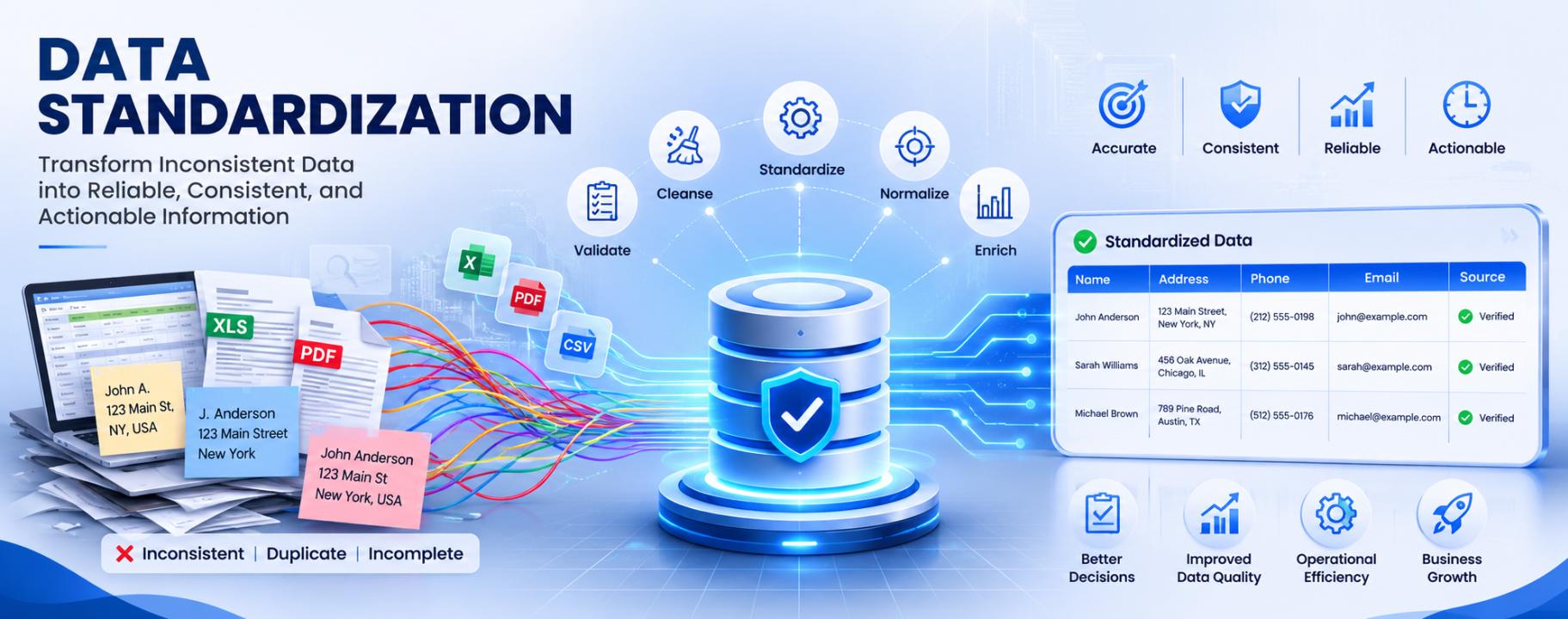
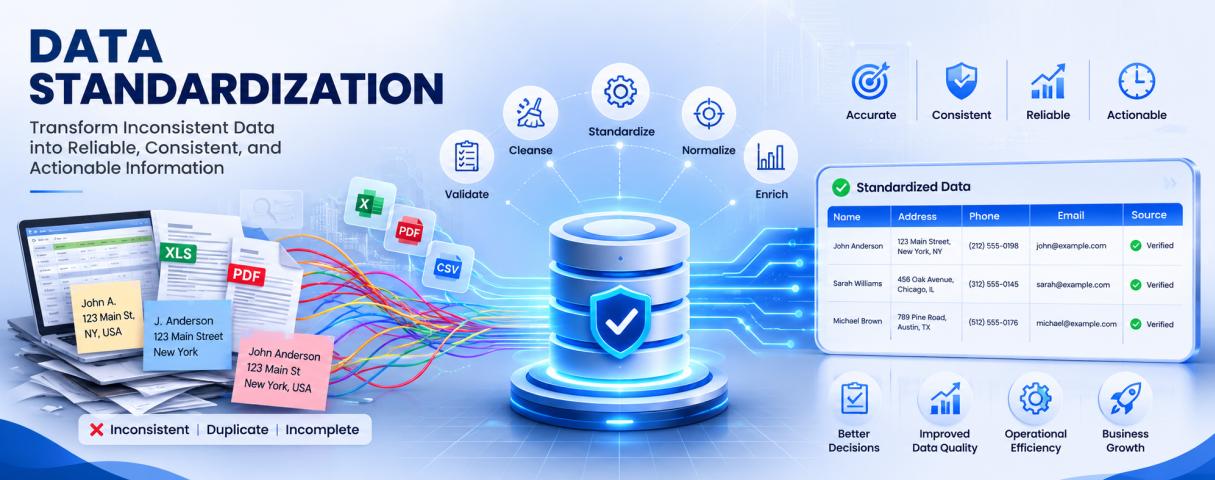
Data standardization is the
process of converting data into a consistent format across different systems,
platforms, and datasets. It ensures that information is uniform, accurate, and
easy to use across an organization.
In most businesses, data
comes from multiple sources such as CRMs, spreadsheets, APIs, and legacy
systems. Without standardization, this data often becomes fragmented and
unreliable.
By applying standard rules
and formats, organizations can create a single, consistent view of their data,
which improves usability and decision-making.
Common examples include
- Data standardization can be applied in many everyday business scenarios. Some of the most common examples include:
- Standardizing country names by converting variations like “USA,” “U.S.A,” and “United States” into a single format
- Aligning date formats across systems to avoid confusion between formats such as DD/MM/YYYY and MM/DD/YYYY
- Ensuring consistent product naming conventions across catalogs and databases
- Normalizing customer records in CRM systems to maintain uniformity in fields like names, addresses, and contact details
How it differs from related processes
Data
standardization is often confused with other data quality processes, but each
serves a distinct purpose.
- Data
Cleansing
focuses on identifying and removing duplicate records, correcting errors, and
fixing incomplete data
- Data
Standardization
ensures that data follows consistent formats and predefined rules across all
systems
- Data Enrichment enhances existing data by adding missing details or integrating external data sources
Why Data Standardization
Matters in 2026
Modern businesses generate
vast amounts of data from multiple sources, including CRM systems, cloud
platforms, mobile apps, and third-party tools. When this data is not
standardized, it becomes fragmented, inconsistent, and difficult to trust. This
is especially critical when managing sales
lead data where inaccuracies can directly impact conversions and
revenue.
As a result, teams spend more
time fixing data issues instead of using data to drive growth. This is why data
standardization has become a critical priority in 2026, especially for
organizations investing in AI and automation.
Key Benefits of Data
Standardization
- Better decision-making becomes possible when data
is consistent and trustworthy
- Customer experiences improve because records are
unified across touchpoints
- AI and machine learning models perform better
with structured inputs
- Regulatory compliance becomes easier to manage
Key Features to Look for in
Data Standardization Providers
Choosing the right data standardization
provider can significantly impact the quality, accuracy, and usability of your
data. Not all solutions offer the same capabilities, so it is important to
evaluate key features before making a decision.
Automation and intelligence
Modern
data environments require more than manual processing. Look for providers that
leverage artificial intelligence and machine learning to automate data
standardization.
These technologies help
identify patterns, detect inconsistencies, and apply rules at scale. As a
result, businesses can reduce manual effort while improving accuracy and speed.
Integration capabilities
A strong data standardization
solution should seamlessly integrate with your existing systems, including CRM,
ERP, and cloud platforms.
Without proper integration,
data remains siloed across departments, leading to inefficiencies and
incomplete insights. Smooth connectivity ensures consistent data flow across
your entire ecosystem.
Scalability
As your business grows, your
data volume will increase. Your chosen provider should be able to handle this
growth without compromising performance.
Scalable solutions allow you
to process large datasets efficiently and adapt to future data demands without
requiring major system changes.
Security and compliance
Data
security is a top priority for any organization. Ensure that the provider
follows industry standards and regulations such as GDPR and SOC 2.
Strong security measures
protect sensitive information and help your business stay compliant with global
data protection laws.
Customization
Every organization has unique
data formats, rules, and requirements. A reliable provider should offer
customizable standardization rules tailored to your business needs.
This flexibility ensures that your data aligns with internal processes and industry standards, making it more meaningful and actionable.
Top Data Standardization Companies & Service Providers
Choosing
the right data standardization partner can significantly improve data accuracy,
operational efficiency, and decision-making. Below is a curated list of ten
leading companies offering reliable and scalable data standardization solutions.
1. Hitech BPO
Hitech
BPO is a well-established outsourcing provider known for its data-centric
services. The company specializes in data
cleansing, formatting, and database standardization.
It combines cost efficiency
with a skilled workforce, making it an ideal choice for small and mid-sized
businesses. Organizations dealing with large volumes of unstructured or legacy
data can particularly benefit from its services.
2. HabileData
HabileData brings more than
two decades of experience in data processing and standardization. It focuses on
delivering high-accuracy solutions for customer, product, and financial
datasets.
The company offers customized
workflows tailored to different business needs. It is a strong option for
businesses looking to outsource large-scale data standardization tasks without
compromising on quality.
3. Informatica
Informatica is widely recognized as a global leader in data management. Its platform integrates data quality, governance, and master data management into a single solution.
With AI-driven automation, it
enables enterprises to standardize complex datasets efficiently. It is
particularly suitable for organizations with large and diverse data ecosystems.
4. IBM
IBM
offers advanced data standardization capabilities through its Cloud Pak for
Data platform. The solution emphasizes data governance, compliance, and AI
integration.
It is especially valuable for
regulated industries such as finance and healthcare, where data accuracy and
compliance are critical. IBM’s tools are designed to manage large-scale data
environments effectively.
5. Oracle
Oracle provides
enterprise-grade data quality and standardization tools that integrate
seamlessly with its broader ecosystem.
Known for its scalability and
reliability, Oracle is a preferred choice for organizations already using its
database and cloud solutions. It helps create a unified and consistent data
environment.
6. SAP
SAP
Data Services is a strong option for organizations operating within the SAP
ecosystem. It offers powerful data transformation and standardization
capabilities.
With robust ETL
functionality, it supports businesses managing large volumes of transactional
data. Its seamless integration with SAP systems enhances overall data
consistency.
7. SAS
SAS
combines advanced analytics with data management to deliver highly accurate
data standardization solutions.
It is particularly useful in
industries such as healthcare and finance, where precision and compliance are
essential. SAS helps organizations prepare data for advanced analytics and
reporting.
8. Talend
Talend
is known for its flexible and modern approach to data integration and quality
management. Its platform includes strong data standardization capabilities
along with ETL tools.
The cloud-based architecture
makes it a popular choice among mid-sized and growing businesses looking for
scalable solutions.
9. Melissa
Melissa specializes in
contact data standardization, including address verification and email
validation.
Its real-time APIs allow easy
integration with existing systems. It is widely used in industries such as
e-commerce, logistics, and customer data platforms.
10. Ataccama
Ataccama offers a unified,
AI-powered platform for data quality, governance, and standardization.
Its ability to detect anomalies and automate corrections makes it highly efficient. It is an excellent choice for organizations seeking a modern, intelligent approach to data management.
How to Choose the Right Data
Standardization Company
Selecting the right data
standardization provider is a critical decision that can directly impact your
data quality, operational efficiency, and long-term scalability. The ideal
partner should align with your business goals, technical requirements, and
budget.
Consider your business size
- Your
organization’s size plays a key role in determining the right solution.
- Large
enterprises typically require comprehensive platforms with advanced features
such as automation, governance, and integration capabilities.
- Small
and mid-sized businesses often benefit more from niche providers or outsourcing
partners that offer flexibility and cost-effective solutions.
Evaluate your data volume
- ·
The
amount of data you handle will influence the type of solution you need.
- ·
Organizations
dealing with high-volume data should prioritize scalable platforms that can
process large datasets efficiently without performance issues.
- ·
For
smaller datasets, specialized service providers can deliver accurate results
without the need for complex infrastructure.
Assess your budget
- Budget
is another important factor when choosing a provider.
- Enterprise-grade
tools often come with higher costs due to their advanced capabilities and
infrastructure requirements.
- On
the other hand, outsourcing data standardization can be a more cost-effective
option, especially for businesses looking to reduce operational expenses while
maintaining quality.
Check integration
requirements
- A
reliable data standardization solution should integrate seamlessly with your
existing systems.
- This
includes CRM platforms, ERP systems, cloud applications, and databases.
- Proper
integration ensures smooth data flow across systems and prevents the creation
of data silos.
Determine processing needs
- Understanding
how your data needs to be processed is essential.
- Real-time
processing is ideal for businesses that rely on live data updates, such as
e-commerce or financial services.
- Batch processing is better suited for organizations that handle periodic data updates or large data transfers at scheduled intervals.
Benefits of Outsourcing Data
Standardization
Outsourcing
data standardization has evolved into a strategic decision for organizations
aiming to improve efficiency while controlling costs. Instead of building
in-house teams and infrastructure, many businesses are partnering with
specialized providers to handle their data processes
Key benefits include
- Reduced operational costs
- Faster turnaround times
- Access to experienced professionals
- Scalability as data grows
Many businesses report efficiency gains of up to 40 to 60 percent after outsourcing data-related processes.
Emerging Trends in Data
Standardization
- The field continues to evolve rapidly.
- AI is playing a larger role in automating data
standardization
- Real-time data pipelines are becoming standard
- Data fabric and decentralized architectures are
gaining popularity
- Low-code tools are making data management
accessible to non-technical users
- Privacy-focused data strategies are becoming essential
Common Challenges and
Solutions
Despite its importance, data standardization
comes with several challenges that organizations must address to maintain data
quality and consistency.
One of the most common issues is data silos
across different systems, which prevent seamless data flow and create
fragmented datasets. In addition, inconsistent legacy data often leads to
inaccuracies, making it difficult to achieve a unified data format. Complex
integrations between multiple platforms further add to the difficulty,
especially in large or evolving data environments.
To overcome these challenges, organizations should implement strong data governance frameworks to ensure consistency and accountability. Leveraging automation tools can help streamline standardization processes and reduce manual errors. Additionally, partnering with experienced data service providers can simplify implementation and ensure high-quality, scalable results.
Conclusion
Data standardization is no longer just a
technical necessity but a strategic business priority. It plays a crucial role
in improving efficiency, ensuring data accuracy, and enabling informed
decision-making.
With a wide range of solutions available, from
enterprise platforms to specialized service providers, organizations have the
flexibility to choose what best fits their needs. The right choice ultimately
depends on factors such as business size, data complexity, and budget.
By investing in the right data standardization
approach or partner, businesses can unlock the full value of their data,
enhance operational performance, and remain competitive in an increasingly
data-driven landscape.