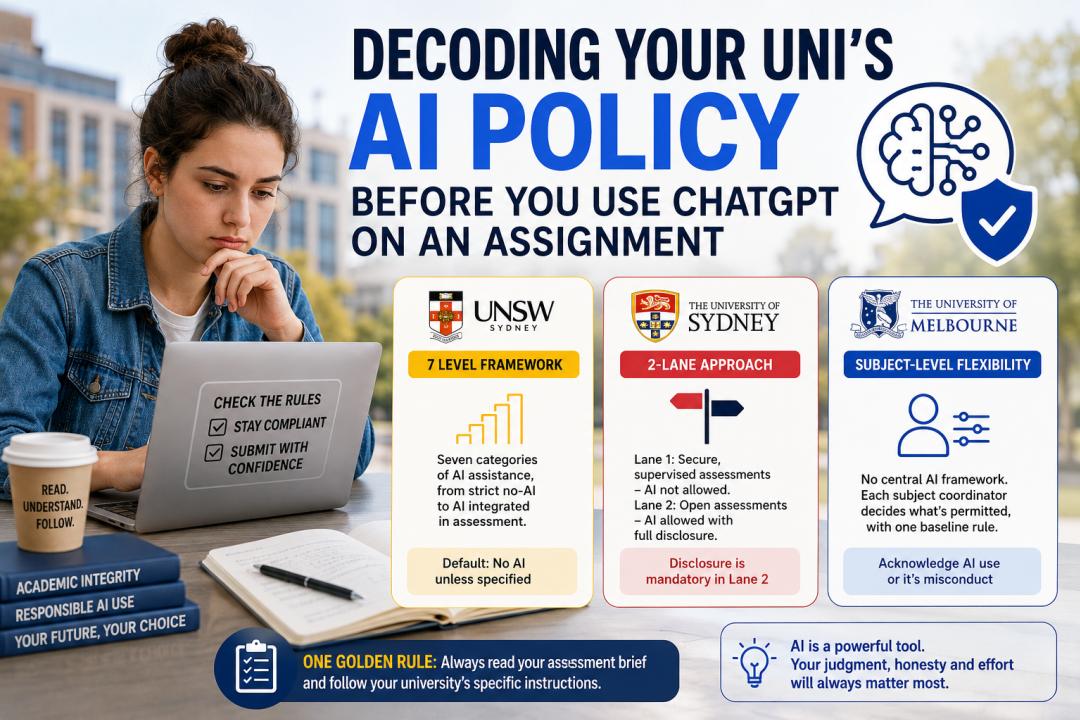
Students spend hours watching videos about writing better ChatGPT prompts, but many skip the document that matters most—their assessment brief. That single oversight can turn an otherwise good assignment into an academic integrity issue. Across Australian universities, AI rules vary significantly, and knowing those rules has become just as important as knowing how to use the technology itself.
Learning to work within your university's AI policy isn't a barrier to success. It's becoming an essential academic skill.
Good Prompts Cannot Override University Rules
ChatGPT can help students organise ideas, improve sentence structure, and explain difficult concepts. None of those benefits matter if the assessment prohibits AI use.
Australian universities have adopted different approaches to generative AI. Some define several levels of permitted assistance, some classify assessments into secure and open categories, while others allow individual subject coordinators to decide what students can and cannot do. The technology remains the same, but the rules change depending on where and what you study.
That means the smartest prompt in the world cannot make prohibited AI use acceptable.
Every Assignment Deserves a Fresh Check
One of the easiest mistakes students make is assuming that if AI was allowed on the previous assignment, it must also be allowed on the next one.
In reality, permissions are often set for each assessment individually. An instructor may encourage AI-assisted brainstorming for a literature review while banning AI completely during a reflective assessment that measures personal understanding.
Think of every assignment as a new contract. Before beginning the work, read the conditions carefully so you know exactly what is expected.
This small habit only takes a few minutes but can prevent serious academic consequences.
Responsible Students Keep Their AI Use Transparent
Universities are placing increasing importance on disclosure rather than secrecy.
When AI use is permitted, students are often expected to explain how they used it during the assignment process. Honest disclosure shows integrity and demonstrates that AI supported the work instead of replacing the student's own thinking.
Keeping brief notes throughout the assignment makes this much easier. Recording how AI helped with planning, editing, or generating ideas creates a clear record if disclosure becomes necessary.
For students who need additional support beyond AI, Expertsmind.com's subject expert network offers guidance with assignment planning, research strategies, referencing, and academic writing while encouraging students to remain within the AI rules established by their university.
AI Is Most Valuable When It Supports Learning
The purpose of university assessments has never been to produce polished documents alone. They are designed to measure critical thinking, analysis, and subject knowledge.
Using AI responsibly means allowing it to improve efficiency without replacing those core learning outcomes. Students still need to evaluate evidence, question AI-generated information, and make independent academic decisions before submitting any work.
Just as spell-check improved writing without replacing writers, generative AI should strengthen learning rather than substitute it.
Universities are likely to keep refining their AI policies as technology develops. Students who make a habit of reading assessment instructions, understanding disclosure requirements, and using AI responsibly will be prepared for those changes. The most valuable skill is not mastering the latest AI tool—it is knowing when and how that tool can be used appropriately.