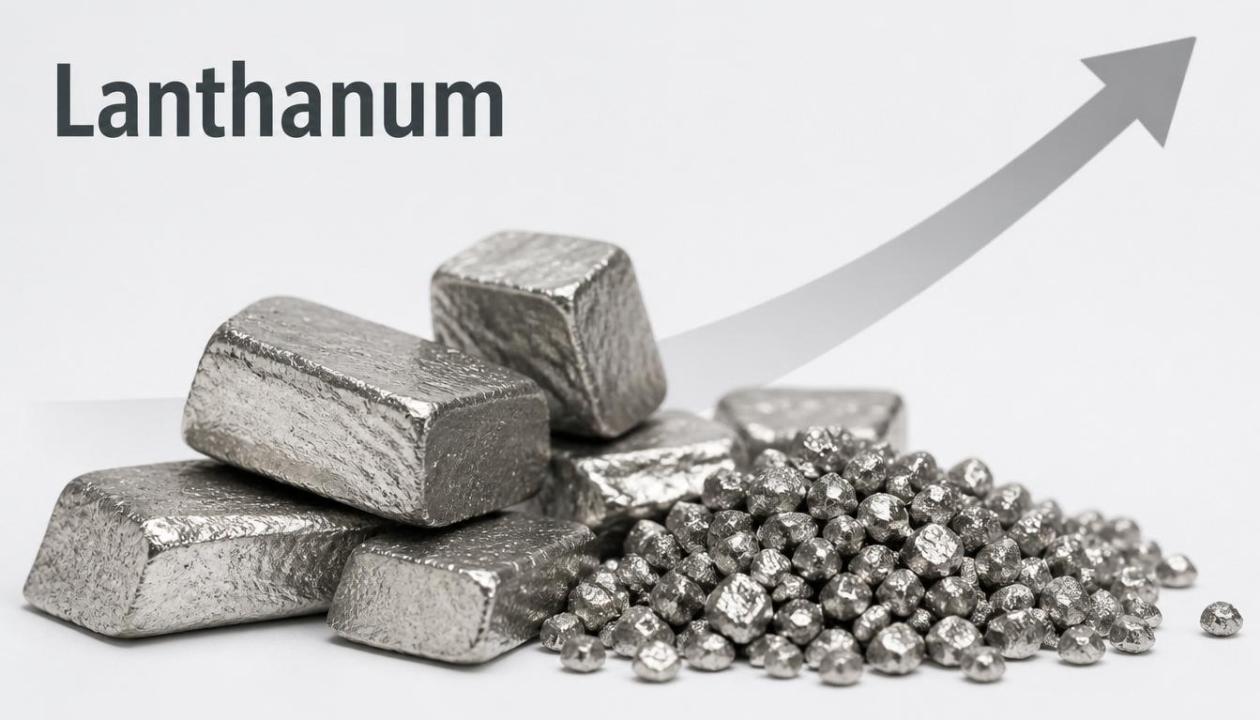
The lanthanum price trend has become an important indicator for businesses operating in the rare earth metals industry. As global industries continue to expand their use of advanced materials, lanthanum remains a valuable element in applications ranging from petroleum refining and rechargeable batteries to optical glass and specialty alloys. Although it is considered one of the more abundant rare earth elements, its pricing is influenced by a unique combination of supply chain dynamics, industrial demand, environmental regulations, and geopolitical developments.
Unlike many conventional industrial metals, lanthanum is primarily produced alongside other rare earth elements. This means its availability depends not only on direct demand but also on broader rare earth mining and processing activities. Companies monitoring procurement costs increasingly follow the lanthanum price trend to anticipate market movements, improve purchasing strategies, and manage long-term supply risks.
Key Factors Influencing Lanthanum Prices
Several interconnected factors determine lanthanum Prices in global markets.
Mining production remains one of the strongest influences. Since rare earth extraction is concentrated in only a few countries, any disruption in mining output, refining capacity, or export policies can affect global availability. Production decisions made by major suppliers often influence international market sentiment.
Industrial demand also plays a significant role. Petroleum refineries consume lanthanum in fluid catalytic cracking catalysts, while battery manufacturers, optical glass producers, metallurgical companies, and electronics manufacturers rely on the metal for specialized applications. When these industries expand production, procurement activity generally increases.
Energy costs represent another important pricing factor. Mining, chemical separation, purification, and metal refining require significant energy consumption. Rising electricity and fuel costs frequently increase production expenses, creating upward pressure on market prices.
Transportation expenses further contribute to market fluctuations. Shipping costs, freight availability, port congestion, and international logistics disruptions can influence delivered prices, particularly for overseas buyers.
Environmental regulations continue to reshape production economics. Rare earth mining requires strict environmental compliance in many regions. New sustainability standards, waste management requirements, and emissions controls may increase operational costs while limiting production capacity.
Currency movements also affect international trade. Since rare earth metals are traded globally, exchange rate fluctuations can influence import costs and export competitiveness across different markets.
Supply and Demand Dynamics in the Global Market
The global lanthanum market operates within a carefully balanced supply chain. Because lanthanum is usually extracted together with other rare earth elements, production levels are influenced by the economics of the broader rare earth industry rather than demand for lanthanum alone.
On the supply side, investments in mining projects, processing facilities, recycling technologies, and refining capacity contribute to overall market stability. Diversification efforts outside traditional producing regions are gradually improving supply resilience, although establishing new rare earth production remains capital-intensive and time-consuming.
Demand continues to evolve across multiple industries. Petroleum refining remains one of the largest consumers due to lanthanum's role in catalyst production. Growth in renewable energy technologies, hybrid vehicles, electronics manufacturing, specialty glass production, and advanced materials has also strengthened long-term consumption prospects.
Market participants increasingly focus on maintaining balanced inventories rather than excessive stockpiling. Procurement decisions often depend on production schedules, expected industrial activity, and broader economic conditions.
Regional Market Performance
Asia continues to dominate both production and consumption within the global lanthanum market. Strong manufacturing activity, integrated supply chains, and extensive rare earth processing capabilities support the region's leadership.
China remains the largest producer and processor of rare earth materials, making developments within its mining sector highly influential for global pricing. Government policies regarding production quotas, environmental standards, and export management frequently shape international market expectations.
North America continues investing in domestic rare earth projects to improve supply chain security. Increased interest in strategic minerals has encouraged exploration, refining investments, and recycling initiatives aimed at reducing import dependence.
Europe maintains steady demand from automotive, renewable energy, electronics, and specialty manufacturing industries. Sustainability initiatives and circular economy programs have also encouraged greater emphasis on rare earth recycling.
Other regions are gradually increasing participation through exploration projects, processing investments, and partnerships designed to diversify global supply sources.
Lanthanum Market Analysis Across Major Industries
A comprehensive lanthanum Market Analysis shows that industrial diversification has become one of the market's greatest strengths.
Petroleum refining remains a major consumption sector because lanthanum-based catalysts improve fuel production efficiency. As refineries modernize operations and pursue higher processing efficiency, catalyst demand continues to support market stability.
Battery technology represents another important growth area. Although newer battery chemistries receive significant attention, lanthanum continues to serve various rechargeable battery applications, particularly nickel-metal hydride technologies used in selected transportation and industrial systems.
Glass manufacturing utilizes lanthanum to enhance optical quality, durability, and light transmission. High-performance camera lenses, scientific instruments, medical devices, and precision optics continue to support demand.
Metallurgical industries use lanthanum to improve alloy properties, while electronics manufacturers incorporate rare earth materials into specialized components requiring high performance and reliability.
Emerging technologies may create additional opportunities as advanced manufacturing, renewable energy infrastructure, and next-generation materials continue to evolve.
Challenges Affecting the Lanthanum Market
Despite encouraging long-term prospects, several challenges continue influencing market performance.
Geopolitical uncertainty remains a major concern because rare earth supply chains are geographically concentrated. Trade restrictions, export regulations, diplomatic tensions, or changes in industrial policy can quickly influence market confidence.
Environmental compliance requirements continue increasing production costs. Companies must invest in cleaner extraction methods, waste management systems, and sustainable processing technologies while maintaining competitive operations.
Market volatility also presents procurement challenges. Buyers often adjust purchasing strategies based on anticipated demand, inventory positions, and macroeconomic developments, creating periodic price fluctuations.
Competition from alternative materials and technological innovation may gradually reshape demand patterns in certain applications, although many industries continue to rely on lanthanum's unique chemical and physical characteristics.
Future Outlook for the Lanthanum Price Trend
The long-term outlook for the lanthanum price trend remains cautiously optimistic. Global industrial growth, increasing demand for advanced materials, and continued investment in energy-efficient technologies are expected to provide ongoing support for market consumption.
Supply diversification efforts may gradually improve market resilience as additional mining projects and processing facilities become operational. Recycling initiatives are also expected to contribute more significantly to future supply, reducing dependence on newly mined materials.
Digital supply chain management, improved forecasting tools, and better inventory planning may reduce short-term market volatility while helping buyers make more informed procurement decisions.
Businesses that closely monitor lanthanum Prices, production developments, industrial demand, and international trade policies will be better positioned to respond to changing market conditions.
👉 👉 👉 Please Submit Your Query for lanthanum price trend, demand-supply, suppliers, market analysis: https://www.price-watch.ai/book-a-demo/
Conclusion
The lanthanum price trend reflects the complex interaction between global supply chains, industrial demand, production economics, environmental regulations, and technological progress. As rare earth materials become increasingly important across modern industries, understanding pricing dynamics will remain essential for manufacturers, traders, procurement professionals, and investors.
A thorough lanthanum Market Analysis demonstrates that while short-term fluctuations are inevitable, the long-term fundamentals continue to support the strategic importance of lanthanum within the global industrial economy. Companies that remain informed about evolving market conditions will be better equipped to manage procurement risks, optimize sourcing strategies, and capitalize on future growth opportunities.
About Price-Watch™
Price-Watch™ is an India-based, independent price reporting agency (PRA) that provides real-time price forecasts and data-driven insights into global raw material markets. It specializes in tracking prices, analyzing market trends, and delivering timely updates on plant shutdowns, supply disruptions, capacity expansions, and demand–supply dynamics. Price-Watch™ reporting goes beyond prices to include grade-level insights, applications, and country-level demand intelligence you can trust. Powered by AI forecasting and over a decade of historical data, the Price-Watch™ platform empowers manufacturers, traders, and procurement professionals to make faster, smarter decisions and turn market volatility into actionable opportunity.
Futura Tech Park,
C Block, 8th floor 334,
Old Mahabalipuram Road,
Sholinganallur, Chennai, Tamil Nadu, Pin code - 600119.
Linkedin: https://www.linkedin.com/company/price-watch-ai/
Facebook: https://www.facebook.com/people/Price-Watch/61568490385598/
Twitter: https://x.com/pricewatchai
Website: https://www.price-watch.ai/