Flash USDT software
development:
Flash USDT software development has gained attention as
blockchain businesses look for faster and more cost-effective ways to test USDT
transactions, crypto wallets, payment gateways, blockchain APIs, and
multi-network applications before deploying them in production.
However, there is an important distinction businesses need
to understand. The term “Flash USDT” is sometimes used online to describe tools
that display fake or temporary USDT balances without a genuine blockchain
transaction. Such software should not be confused with legitimate blockchain
testing tools. A valid USDT transfer must exist on the appropriate blockchain
and be independently verifiable through that network.
For legitimate development of
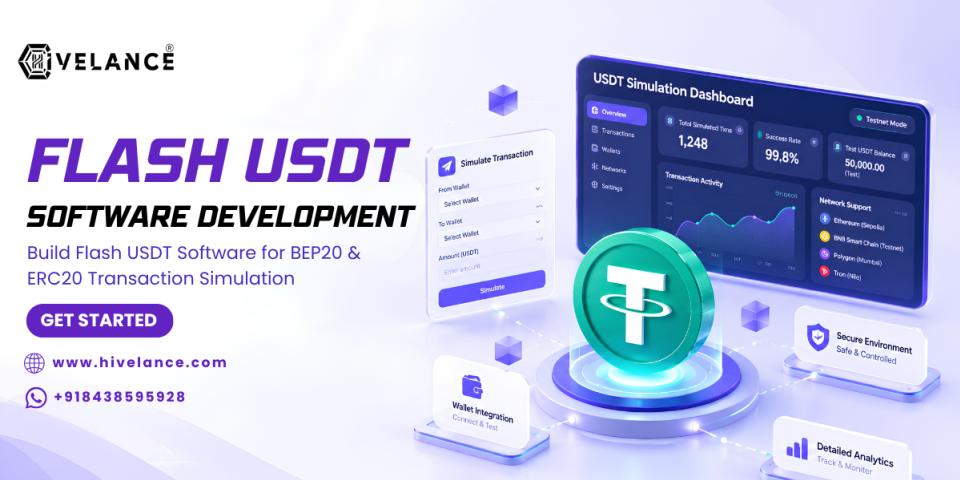
Flash USDT software should therefore be designed as a controlled USDT
transaction simulation and testing environment. It can help developers
reproduce transaction scenarios, test wallet integrations, validate APIs,
monitor application behaviour, and demonstrate payment workflows without
representing simulated funds as genuine USDT.
At Hivelance, the focus is on building blockchain testing,
wallet, payment, and transaction-simulation solutions around secure
architecture and clearly separated testing environments. Hivelance's existing
Web3 development services include blockchain integration, wallet development,
smart contracts, security testing, and API-based applications.
A secure USDT-oriented application can include transaction
validation, wallet integration, API connectivity, encryption, authentication,
role-based permissions, activity monitoring, reporting, and network
verification. Developers can also integrate genuine USDT payment functionality
into web and mobile applications using supported blockchain networks and secure
APIs.
What Is Flash USDT
Software?
Flash USDT may refer to software designed to make a wallet
or interface appear as though USDT has been received even when there is no
genuine, confirmed USDT transfer on the blockchain. A displayed balance alone
does not prove that funds exist. Such deceptive use can expose users and
businesses to financial, ethical, and legal risks.
Legitimate Flash USDT testing software, by contrast, should
operate only in a testnet, private blockchain, sandbox, mock-token, or clearly
labelled simulation environment. Its purpose is to help developers understand
transaction behaviour without misleading another party or falsely representing
test tokens as real assets.
Tether's official documentation confirms that genuine Tether
tokens operate on supported blockchain protocols and provides specific
integration details and contract information for those networks. Therefore,
applications handling real USD₮ should verify the network, token contract or
asset identifier, transaction hash, transaction status, and required
confirmations rather than relying only on what a wallet interface displays.
In simple terms, legitimate Flash USDT software development
should mean:
simulating and testing USDT-related workflows without
creating, counterfeiting, or misrepresenting real USDT.
How Does Flash USDT
Software Work?
A properly designed USDT transaction simulator follows a
controlled development and testing workflow.
Select the Test
Environment:
The process begins by selecting an appropriate blockchain
testnet, sandbox, private network, or local development environment.
For Ethereum application development, Sepolia is currently
the recommended default public testnet. Ethereum's documentation distinguishes
Sepolia for application and smart-contract development from Hoodi, which is
primarily intended for validator and staking-related testing.
TRON currently documents Shasta and Nile as its public
testnets. Shasta closely follows mainnet functionality and is suitable for
learning and pre-production testing, while Nile is designed for testing
upcoming network features and parameter changes.
Connect a Test Wallet:
A compatible test wallet is connected to the selected
development environment. Production wallets containing valuable assets should
normally remain separate from testing infrastructure.
The system can then associate simulated transaction activity
with the selected test account.
Set the Amount and
Transaction Parameters:
Developers define the test amount, originating account,
destination account, network, transaction state, timestamps, and other
parameters required for a specific QA scenario.
These values represent test data, not newly created real
USDT.
Generate the
Simulation:
The platform generates the configured transaction scenario.
Depending on the architecture, the transaction may take place through test
tokens on a public testnet, mock tokens on a private environment, or completely
simulated backend records.
Real production USDT is not moved unless the application is
intentionally operating on a supported mainnet and processing an authentic
blockchain transaction.
Display the Test
Result:
Transaction information is displayed through the wallet,
application, or administrative dashboard.
A responsible interface should clearly identify simulated
assets, test networks, and mock transactions so that they cannot reasonably be
confused with genuine mainnet funds.
Record Transaction
Activity:
The system records relevant test information such as
transaction identifiers, account references, timestamps, network responses, API
events, transaction states, and QA results.
These records help developers diagnose failures and verify
application behaviour.
Expire or Clear
Simulation Data
Temporary transaction records and simulated balances can
automatically expire according to configured session or lifecycle policies.
This keeps test environments controlled and prevents
outdated testing data from being mistaken for production information.
Must-Have Features of
Flash USDT Software
Transaction
Simulation Engine:
A transaction simulation engine allows developers to
reproduce different USDT-related transaction scenarios for software testing,
demonstrations, training, QA, and application validation.
Testnet and Sandbox
Support:
A legitimate platform should support testnets, private
networks, sandbox environments, or mock tokens so development teams can test
blockchain functionality without repeatedly risking real assets.
Multi-Network
Compatibility:
Businesses may require different development environments
depending on where their application will eventually operate.
As of 2026, Tether's official integration information covers
USD₮ across networks including Ethereum, TRON, Solana, TON, Aptos and several
other supported protocols. Tether has also discontinued redemption support for
USD₮ on Omni, Bitcoin Cash SLP, Kusama, EOS, and Algorand, effective September
1, 2025. Network support should therefore always be checked against current
official documentation before beginning an integration.
Wallet Integration:
The software can connect with compatible development or test
wallets to reproduce deposit, withdrawal, transaction-history, and payment
workflows.
For production applications, the wallet layer should
separately verify genuine blockchain transactions.
Transaction
Management Dashboard:
A centralized dashboard allows authorized users to create
testing scenarios, monitor transaction activity, inspect network responses,
check test results, and review historical simulations.
Expiry and Session
Controls:
Automated lifecycle controls can expire temporary balances,
transaction scenarios, login sessions, and development data after predefined
periods.
Role-Based Access Control:
Role-based access control helps ensure that sensitive
administrative and testing capabilities are available only to authorized
developers, administrators, QA engineers, or other approved users.
Security Controls:
Authentication, encryption, secured APIs, access
restrictions, secrets management, audit logging, rate limits, and environment
separation can help reduce unauthorized access and misuse.
Analytics and Reports:
Reporting tools allow development and QA teams to analyze
transaction activity, API performance, failed requests, response times, testing
outcomes, and other operational metrics.
Benefits of Flash
USDT Software for Legitimate Testing:
Low-Cost Blockchain
Testing:
Testnets and simulated transaction environments reduce the need
to repeatedly spend real tokens or incur production-network fees while an
application is under development.
Effective Product
Demonstrations:
Businesses can demonstrate wallets, payment applications,
dashboards, and transaction workflows without exposing customer funds or
production accounts.
Practical Blockchain
Learning:
A controlled USDT transaction simulator helps developers and
other authorized users understand wallet behaviour, blockchain confirmations,
transaction states, network integration, and API interactions.
Efficient Software
Testing:
Development teams can test wallet integrations, payment
APIs, dashboards, transaction-status logic, error handling, and
blockchain-related application workflows before production launch.
Reduced Development
Expenses:
Using test tokens and simulation environments can reduce
repetitive spending on real assets and network fees during development, debugging,
and quality assurance.
Customizable
Functionality:
Businesses can customize transaction scenarios, supported
networks, interfaces, access permissions, APIs, reports, and other features
according to their project requirements.
Multi-Wallet
Compatibility:
The application can be designed around multiple compatible
wallets for testing, integration, and demonstration purposes.
Enhanced Access
Security:
Authentication, permission management, API controls,
logging, encryption, and environment segregation help protect the testing ecosystem
from unauthorized access.
Realistic Testing
Experience:
Well-designed simulations can reproduce relevant transaction
states such as pending, confirmed, failed, rejected, delayed, or expired
transactions, giving developers a practical environment for validating
application behaviour.
Step-by-Step Flash
USDT Software Development Process:
Requirement Analysis:
The process starts by identifying the business objective,
intended use cases, supported networks, wallet requirements, transaction
scenarios, API integrations, dashboard features, lifecycle settings, deployment
requirements, and security controls.
At this stage, legitimate testing functionality should also
be clearly separated from production payment functionality.
Wireframing and UI/UX
Design:
The development team creates the user journey, transaction
dashboard, administration interface, reports, wallet screens, and other
application components.
Simulated or test transactions should be visually identified
as test data wherever appropriate.
Backend and
Simulation Engine Development:
Backend services are developed to manage transaction
scenarios, APIs, account permissions, activity logs, session controls,
application logic, and administrative functionality.
Blockchain Network
Integration:
Required blockchain environments are integrated according to
the intended application.
Projects involving Ethereum-compatible USD₮ may require
ERC-20-oriented integrations, while TRON applications may involve TRC-20
workflows.
For TRON development specifically, its current documentation
recommends Shasta for first-time learning and realistic pre-production testing,
with Nile available for developers who need to experiment with upcoming network
changes. TRON also provides test tokens through its public testnet
infrastructure.
Wallet Integration:
Compatible wallets are connected so developers can test
wallet addresses, transaction displays, account activity, deposits, payment
flows, and related features.
Security
Implementation:
Security architecture may include encryption,
authentication, permission controls, secured APIs, secrets management,
transaction validation, monitoring, audit trails, and infrastructure
restrictions.
Hivelance states that its Web3 development process
incorporates code audits, vulnerability assessments, and testing as part of its
security approach.
Testing and Quality
Assurance:
The QA team conducts functional testing, API testing,
integration testing, security testing, performance checks, transaction-state
testing, and user-interface validation.
Testing should also confirm that simulated transactions
cannot be mistaken for confirmed production transfers.
Deployment:
After successful validation, the software can be deployed to
suitable cloud infrastructure, a private server, or another approved
environment based on business and security requirements.
Maintenance and
Technical Support:
Post-launch support can include security updates, network
compatibility updates, API maintenance, performance monitoring, bug fixes,
infrastructure improvements, and additional legitimate features.
Hivelance publicly describes an end-to-end workflow covering
consultation, architecture planning, design, development, testing, deployment,
monitoring, and post-launch technical support.
Flash USDT Software
Development Cost in 2026:
The cost of Flash USDT software development cannot be
accurately determined with a single fixed price because the technical scope can
vary significantly.
For a broader customized blockchain solution, project
budgets may begin around $20,000, depending on architecture, supported
networks, integrations, security requirements, infrastructure, and custom
functionality.
A more focused USDT transaction simulation or testing MVP
may start at approximately $15,000, while multichain support, advanced
dashboards, production wallet integrations, enterprise security, extensive
APIs, compliance-related features, analytics, and custom infrastructure can
increase the overall development cost.
These figures should be treated as indicative project
estimates rather than universal fixed pricing. A detailed technical assessment
is required before determining the final development budget.
2026 Update: What
Businesses Should Know Before Building USDT Software:
Blockchain infrastructure changes over time, which makes
current network verification especially important.
Tether's latest supported-protocol documentation shows that
businesses should not assume an older USD₮ network integration remains
supported indefinitely. Tether ceased redemption obligations for USD₮ on Omni,
Bitcoin Cash SLP, Kusama, EOS, and Algorand from September 1, 2025, while
continuing to document other supported protocols.
Businesses should therefore design USDT applications around
configurable network layers instead of hard-coding assumptions about permanent
blockchain support.
Developers should also distinguish between testnet tokens
and real USD₮. A token shown on a testnet is useful for application development
but does not represent production USDT and should never be marketed,
transferred, or represented as real funds.
For payment applications, blockchain verification should be
the source of truth. Wallet interfaces can display information, but transaction
authenticity should be determined from the correct network, token identifier,
transaction record, and confirmation state.
Why Choose Hivelance
for Flash USDT Software Development?
Hivelance provides blockchains, Web3, wallet, smart
contract, and related development services that can be applied to legitimate
USDT simulation, transaction testing, wallet integration, and crypto payment
workflows.
Rather than developing tools intended to Building Flash
USD Software, our approach focuses on controlled transaction
environments that businesses can use for development, QA, demonstrations,
training, and blockchains application testing.
Our development process can incorporate customized
architecture, wallet connectivity, API integrations, blockchain network
configuration, transaction dashboards, role-based access, security controls,
analytics, and deployment infrastructure based on individual project
requirements.
Hivelance's existing wallet development offering includes
Web3 connectivity, wallet integrations, administrative monitoring, APIs,
encryption-related security features, and support for different blockchain
environments.
We begin by identifying the project's business purpose,
technical requirements, intended networks, testing scenarios, security
expectations, and future scalability needs. From architecture and development
through testing and post-launch support, the objective is to build a
transparent environment where simulated activity remains clearly separated from
authentic blockchain transactions.
For businesses planning a USDT wallet, transaction-testing
platform, crypto payment gateway, or blockchain application, this approach
creates a more sustainable foundation for secure, transparent, scalable, and
production-ready development.