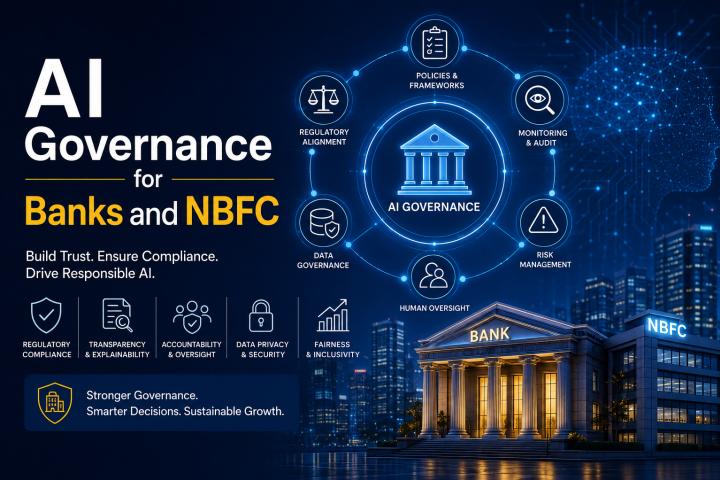
AI Governance for Banks: How to Manage Model Risk, Compliance, and Agentic
AI
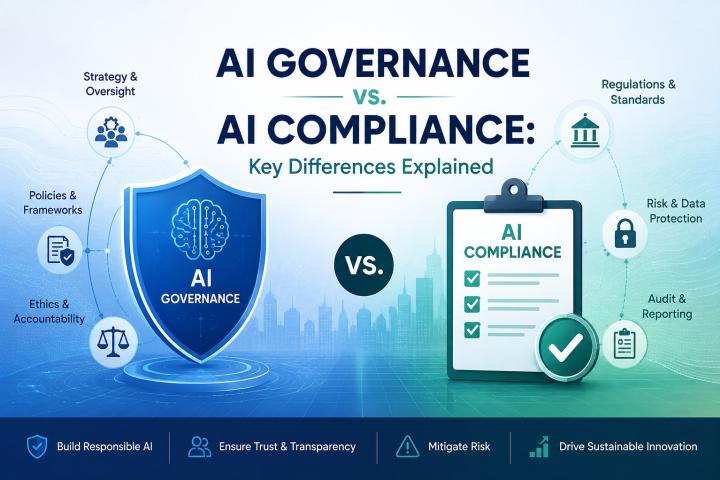
Most banks already have a model
risk management program. Fewer have an AI governance program that actually
covers what their AI is doing today. That gap matters, because AI governancefor banks now spans three things that used to live in separate silos: traditional
model risk, regulatory compliance, and — increasingly — autonomous AI agents
that don't behave like the models MRM teams were built to validate.
Treating these as one problem,
rather than three separate checklists, is what turns AI governance from a
compliance exercise into something that actually reduces risk.
Model Risk: Where Most Banks Already Have a Head Start
Banks have run formal model
risk management for decades, built around validation, documented assumptions,
and ongoing performance monitoring. That foundation still applies to AI: models
used for credit decisions, fraud detection, or underwriting still need
independent validation, clear intended-use documentation, and monitoring for
drift.
Where the older MRM playbook
falls short is scale and pace. AI models retrain more often, ingest more varied
data, and degrade in ways that are harder to spot with periodic reviews alone.
A model that passed validation in January can behave differently by June
without anyone deliberately changing it. Extending MRM to AI means keeping the
validation discipline but replacing the annual review cadence with continuous
monitoring that catches drift as it happens, not at the next scheduled check.
Compliance: A Moving Regulatory Target
Regulatory expectations for AI
in banking are tightening from multiple directions at once. In India, the RBI's
FREE-AI framework sets out seven guiding principles across six pillars,
operationalized through 26 recommendations that apply to scheduled commercial
banks, NBFCs, and the technology vendors that serve them. Globally, banks are
also navigating the EU AI Act's high-risk classification for credit-scoring
systems, and evolving expectations from US regulators around AI-specific risk
disclosure.
The common thread across these
frameworks is a demand for evidence, not intent. Regulators increasingly want a
current AI inventory, a board-approved AI policy, documented risk
classification, and audit trails that can reconstruct how a specific AI-assisted
decision was made. A written policy that hasn't been checked against what's
actually deployed doesn't satisfy that bar — and the gap between the two is
exactly what examiners tend to find first.
Agentic AI: The Governance Problem MRM Wasn't Built For
AI agents introduce a genuinely
different risk category. A model produces an output a human reviews; an agent
can call APIs, move funds between systems, update records, or trigger workflows
with limited human review in the loop. That autonomy is what makes agents
useful in banking — for reconciliation, customer service, and back-office
automation — and also what makes them hard to govern with tools built for
static models.
An agent with standing access
to core banking systems that gets manipulated through a poisoned document or a
hijacked prompt doesn't just produce a wrong answer — it can take an
unauthorized action with real financial consequences. Governing agents well means
defining exactly what each agent is permitted to do, enforcing least-privilege
access to systems and data, logging every tool call and action an agent takes,
and keeping a human in the loop for anything consequential. None of that is
optional in a regulated environment where every automated decision needs to be
explainable after the fact.
Bringing Model Risk, Compliance, and Agentic AI Into One Program
The practical fix is treating
AI governance as one continuous program rather than three separate ones. That
means a single AI inventory that covers models and agents alike, one
risk-classification method applied consistently, and monitoring that runs continuously
instead of on an audit cycle. This is the gap platforms like Trusys are built to close for banks and NBFCs
— discovering AI systems and agents automatically, mapping them against
frameworks like the RBI FREE-AI framework and ISO 42001, and generating the
audit-ready evidence examiners and boards actually ask for, rather than leaving
teams to assemble it manually before every review.
Banks that get this right
aren't necessarily the ones with the most detailed policy document. They're the
ones that can show, on short notice, exactly which models and agents are
running, what each one is authorized to do, and proof that those boundaries
held in production. That's the standard AI governance for banks is converging
toward — and it's worth building before an examiner or an incident forces the
question.
Frequently Asked Questions
Is AI governance for banks different from model risk management?
It builds on MRM but goes
further. MRM was designed for models whose outputs a human reviews before
acting. AI governance also has to cover generative AI tools and autonomous
agents that take actions directly, which traditional MRM validation cycles weren't
built to monitor continuously.
What does the RBI FREE-AI framework require of banks?
It sets out seven guiding
principles across six pillars, operationalized through 26 recommendations,
applying to scheduled commercial banks, NBFCs, and other RBI-regulated
entities, including their technology vendors. A board-approved AI policy and an
accurate AI inventory are treated as foundational starting points.
Why are AI agents harder to govern than traditional models?
Agents can take actions —
calling APIs, moving data, triggering workflows — rather than just producing an
output for a human to review. That means governance has to control what an
agent is permitted to do and log what it actually did, not just validate its
outputs.