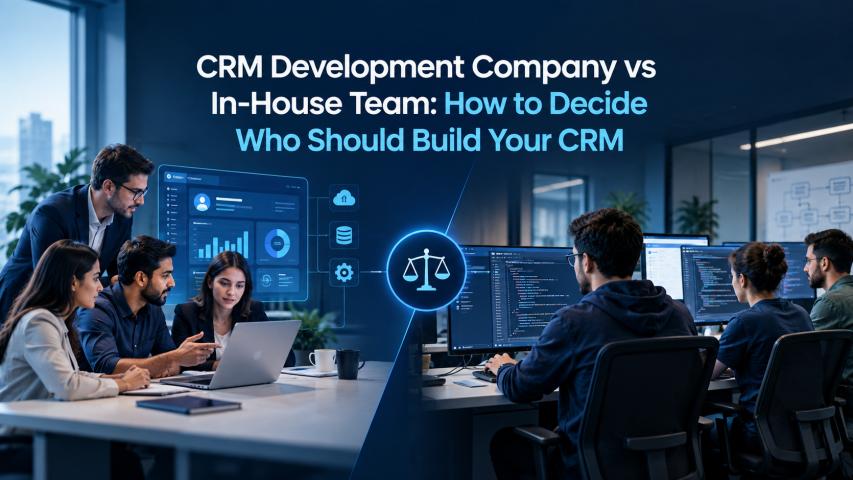

Hiring an in-house team and outsourcing your CRM build aren't two versions of the same decision. They're different bets, with different payoffs and different ways things go wrong.
If you're comparing paths for CRM software development, here's where they actually diverge.
Cost: The Sticker Price Lies
An in-house hire looks cheaper until the invoice arrives six months later. You're paying for:
- Recruiting and interviews, often 2-3 months before anyone writes code
- Salaries and benefits for developers, QA, and a project lead
- Training when a new integration or framework shows up
- Payroll during the gaps between projects
An outside team bills for the work itself. There's no salary running during downtime.
Speed: Who Starts Building First
An in-house hire has to exist before they can build anything. Job postings, interviews, and ramp-up all before the CRM project even begins.
A working CRM software development partner already has developers and QA who've shipped CRM systems. Nobody's hiring while the clock runs, so development starts closer to day one.
Knowledge: Who Holds the System in Their Head
Companies underestimate this part. An in-house developer quits, and a good chunk of the CRM's internal logic leaves with them. Documentation helps, but it rarely captures everything one person knew.
Ask a potential outsourced partner three things:
- Do they document architecture and integration decisions while building, not after the fact?
- Will they hand over code someone else could actually read?
- Is there a plan for moving maintenance in-house later, if you want it?
The answers tell you whether they're building for the long run or just shipping and leaving.
Flexibility: What Happens When Requirements Shift
CRM requirements don't sit still. Sales processes change, new integrations get requested, reporting needs outgrow the original scope.
An in-house team is a fixed headcount. When requirements spike, you're hiring again or stretching three people across five people's workload. A custom CRM software development company can scale a team up for a specific phase and back down once it's done. No hiring cycle stuck in the middle of a project.
When In-House Actually Wins
In-house isn't wrong for everyone. It works when your CRM ties into a process only your internal team understands, when developers need to sit with sales or support every day, or when you already have engineers with room to spare.
Most growing companies don't have that spare capacity lying around, which is usually where outsourcing removes the bottleneck.
Making the Call
There's no clean universal answer here. It comes down to budget, timeline, and how much you want to manage directly versus hand off.
Get specific about cost, who owns the system knowledge, and how much flexibility you'll actually need six months from now, not just today. Talk through your requirements with a CRM software development services team that's built across a few different industries before locking into either path.
FAQs
Is outsourced CRM development less secure than building in-house?
Security comes down to the vendor's practices, data handling agreements, access controls, and code review, not whether the team sits in your building.
How long does outsourced CRM development typically take?
Most mid-sized builds run 3-6 months from requirements to launch, depending on integrations and customization.
Can I move maintenance in-house after an outsourced team builds the CRM?
Yes, if the partner documents the system properly and hands over clean code. Confirm this in the contract before the project starts.