India Construction Materials Market: Industry Report
2026–2034
The construction
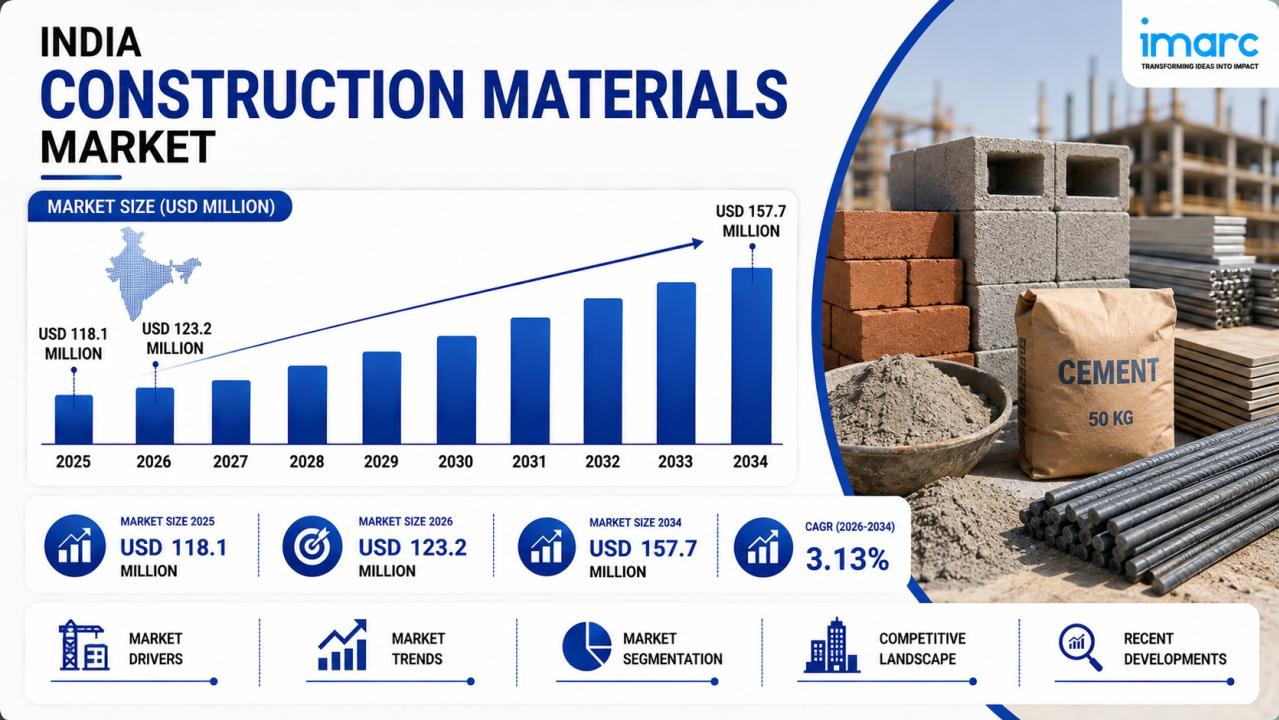
materials market in India grew from USD 118.1 Million in
2025 to an estimated USD 123.2 Million in 2026 and is
projected to reach USD 157.7 Million by 2034, exhibiting a
steady compound annual growth rate (CAGR) of 3.13% during the
2026–2034 forecast period. Positioned at the intersection of the
fastest-growing major economy and the most ambitious public infrastructure
investment program in emerging market history, India's construction materials
sector is witnessing highly resilient, structural demand across all categories.
What Is the Size and Growth Forecast of the India
Construction Materials Market?
The market is exhibiting consistent expansion, firmly
anchored by the structural permanence of India's construction demand. The
combination of a massive population, rapid urbanization, and a persistent
housing deficit ensures durable volume consumption.
- Market
Size in 2025: USD 118.1 Million.
- Market
Size in 2026: USD 123.2 Million.
- Market
Forecast in 2034: USD 157.7 Million.
- Compound
Annual Growth Rate (CAGR): 3.13% during the 2026–2034 forecast
period.
- Underpinning
Momentum: The post-COVID construction recovery, massive highway
expansions, relentless cement capacity additions, and the surging
integration of green building materials guarantee a continuous,
high-volume domestic procurement pipeline.
What Are the Latest Emerging Trends in the India
Construction Materials Market?
- Shift
Toward Sustainable and Green Materials:
Environmental consciousness is fundamentally altering
procurement. Builders are increasingly deploying fly ash bricks, recycled
aggregates, and low-carbon blended cements. This aggressive shift is heavily
supported by compliance with the Energy Conservation Building Code (ECBC) and
highly lucrative tax incentives for LEED/GRIHA green building certifications.
- Integration
of Smart Materials:
The market is beginning to adopt highly advanced structural
materials that offer superior durability and energy efficiency, aligning with
the Smart Cities Mission. Technologies such as self-healing concrete (which
utilizes embedded bacteria to seal micro-cracks) and thermochromic glass are
entering the premium commercial real estate sector.
- Prefabrication
and Modular Construction:
To drastically reduce on-site labor dependency, minimize
material waste, and accelerate project delivery timelines, leading EPC
contractors are aggressively transitioning to prefabricated and modular
construction components, shifting structural assembly from dusty sites into
controlled factory environments.
Grab a sample copy of this report: https://www.imarcgroup.com/india-construction-materials-market/requestsample
What Growth Factors Are Driving the India Construction
Materials Market?
- Unprecedented
Public Infrastructure Expenditure:
The Government of India's historic capital expenditure
thrust is the absolute primary volume driver. The National Infrastructure
Pipeline (NIP) committing massive investments across roads, railways, ports,
and urban infrastructure alongside the Bharatmala Pariyojana, guarantees an
immense, multi-year pipeline for cement, steel, and aggregates.
- Relentless
Urbanization and the Housing Deficit:
Rapid migration to cities is fueling a massive demand for
both residential and commercial real estate. Central initiatives like the
Pradhan Mantri Awas Yojana (PMAY-U) strictly aim to provide affordable housing
to the urban poor, serving as a critical catalyst for the consumption of basic
masonry, bricks, and structural steel.
- Industrial
Expansion via PLI Schemes:
The central government’s Production-Linked Incentive (PLI)
schemes are driving a manufacturing renaissance. The consequent setup of
massive greenfield factories, mega-warehouses, and data centers requires highly
durable, specialized construction materials, propelling the industrial end-user
segment to grow at the fastest rate.
- Rising
Foreign Direct Investment (FDI):
Increased FDI allowances in real estate, townships, and
infrastructure projects have injected critical liquidity into the sector,
allowing private developers to scale massive commercial complexes and IT parks.
What Are the Key Challenges Facing the India Construction
Materials Market?
- Raw
Material and Fuel Price Volatility: The manufacturing of
foundational materials like cement, steel, and bricks is incredibly
energy-intensive. Fluctuating costs of coking coal, petcoke, electricity,
and freight transportation drastically compress manufacturer operating
margins. This volatility inevitably leads to frequent product price hikes,
which can stall price-sensitive residential and public projects.
- Stringent
Environmental Regulations and Mining Constraints: Environmental
regulations are tightening aggressively. Mining-related constraints
increase the compliance burden for quarrying limestone, sand extraction,
and iron ore mining. Strict mandates on industrial emissions, waste
management, and land-use clearances often create severe supply-side
bottlenecks.
Explore the Full Report with Charts, Table of Contents,
and List of Figures: https://www.imarcgroup.com/india-construction-materials-market
Who Are the Key Players Shaping the India Construction
Materials Sector?
The competitive landscape is dominated by massive,
vertically integrated domestic conglomerates that control the extraction,
manufacturing, and distribution of primary structural materials. Leading
entities actively shaping the sector include:
- Aditya
Birla Group
- Tata
Group
- JSW
Group
- SAIL
- Adani
Group
Deep-Dive Segment Insights
The market is meticulously segmented to reflect specific
structural compositions, massive end-user verticals, and critical regional
infrastructure hubs.
By Material Type
- Cement
(31.8% in 2025): The undisputed market leader. Because of its
universal application across absolutely all construction categories,
cement remains India's single most consumed construction material by
value.
- Metals: Expected
to grow steadily at a ~3.40% CAGR, heavily driven by massive
structural steel requirements in bridges, railways, and industrial factory
setups.
- Other
Segments: Aggregate, Bricks and Blocks, and Others (including
glass, ceramics, and insulation).
By End User
- Infrastructure
(37.4% in 2025): Dominates the end-user landscape, driven by
unprecedented government capital allocations for roads, bridges, metro
rails, water grids, and power infrastructure. It is projected to grow at
a ~3.50% CAGR.
- Industrial: Identified
as the fastest-growing end-user segment (expanding at a ~3.80%
CAGR), fueled directly by the manufacturing boom under the PLI
schemes.
- Commercial: Growing
at a ~3.20% CAGR, driven by the construction of retail spaces,
IT parks, and massive logistics warehouses.
- Residential: Remains
a massive volume driver owing to continuous urban housing projects.
By Region
- West
India (32.8% in 2025): Leads the national market comprehensively.
This dominance is heavily anchored by dense construction activity in
Maharashtra and rapid industrial, port, and corridor infrastructure
development across Gujarat.
- Other
Regions: Include North India, South India, and East and Northeast
India, which collectively manage significant real estate and regional
infrastructure networks.
Recent Developments
- Mid-2026
(Robust Industry Revenues): Heavy equipment suppliers to the
construction sector continued to post exceptional financial results,
directly mirroring the intense activity on the ground. For instance,
Caterpillar announced a massive 35% surge in Q2 2026 revenue for its
construction equipment division, highlighting the relentless pace of
global and regional infrastructure execution.
- August
2026 (Major Manufacturing Joint Venture): Action Construction
Equipment (ACE) and Japan's Kato Works Co. formed a highly strategic ₹200
Crore joint venture. This partnership is explicitly designed to
manufacture high-capacity crawler, truck, and rough-terrain cranes
domestically in India, bolstering the heavy-lifting capabilities required
for the nation's massive infrastructure pipeline.
- July
2026 (Regulatory Formalization for Consultancies): To ensure the
structural integrity and quality of critical projects, the National
Highways Authority of India (NHAI) officially implemented minimum pay
standards for engineers operating on National Highway consultancy
projects, aiming to retain top-tier talent and strictly enforce
construction material standards on-site.
Customization Note: If you require any specific
information not covered within this report's scope, we will provide it as part
of the customization.
Request Report Customization: https://www.imarcgroup.com/request?type=report&id=32506&flag=E
Frequently Asked Questions (FAQs)
Q1. What is the current size of the India construction
materials market?
The India construction materials market was valued at USD
118.1 Million in 2025 (as per reported metrics) and grew to an
estimated USD 123.2 Million in 2026.
Q2. What is the projected growth rate for this sector?
The market is projected to reach USD 157.7 Million
by 2034, exhibiting a steady CAGR of 3.13% during the
2026–2034 forecast period.
Q3. Which material type commands the highest market
share?
Cement is the dominant material type, capturing
a 31.8% share in 2025. It remains India's most universally consumed
construction material across all structural applications.
Q4. Which end-user and regional segments lead the market?
The Infrastructure segment dominates
end-user demand with a 37.4% share (2025), driven by massive public
capital expenditure. Geographically, West India commands the
largest footprint at 32.8% (2025), fueled by intense industrial and
real estate development across Maharashtra and Gujarat.
Q5. What are the key factors driving market growth in
India?
Primary growth catalysts include unprecedented government
infrastructure spending (via the National Infrastructure Pipeline and
Bharatmala), rapid urbanization fueling a persistent housing deficit, massive
industrial expansion under the PLI schemes, and a highly aggressive industry
shift toward sustainable and green building materials.