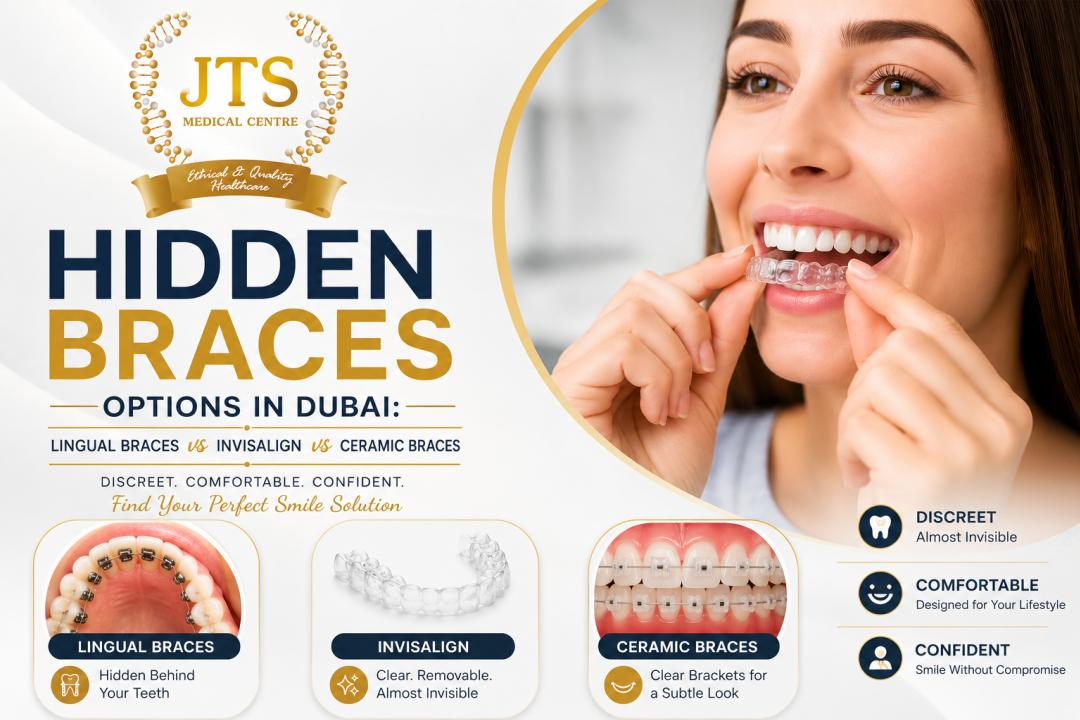
Nobody wants a mouth full of metal staring back at them on every video call. If you're an adult weighing up orthodontic treatment in Dubai, chances are the first question isn't "will this work" — it's "will people be able to tell." Fortunately, clinics across the city now offer a few genuinely good ways to straighten your teeth without the classic train-track look.
The catch is that lingual braces, Invisalign, and ceramic braces aren't interchangeable. They work in different ways, suit different cases, and land at very different price points. Here's the plain-language rundown, so you walk into your consultation already knowing what to ask.
Why "Hidden" Braces Took Off
Metal braces still do the job — they're not going anywhere. But a lot of people, especially working professionals, want something that:
Doesn't announce itself in every photo
Doesn't get in the way of a client-facing job or an active social life
Feels less bulky day to day
Still gets the job done properly, not just cosmetically
That's the gap lingual braces, Invisalign, and ceramic braces each try to fill, just from different angles.
1. Lingual Braces — Invisible, Full Stop
Lingual braces are basically standard fixed braces flipped around: the brackets and wire sit on the back of your teeth instead of the front. Stand across the table from someone, and they'll have no idea you're wearing anything at all.
The mechanics: each bracket is custom-made to fit the exact shape of the tooth it's bonded to, and a wire runs behind your teeth linking them together, tightened over time the same way traditional braces work.
Who tends to go for this? People who don't want a hint of metal showing, even up close — think TV presenters, salespeople, anyone whose face is their job. It's also a solid option for more complicated bite corrections that really need the control a fixed appliance gives you.
Worth knowing before you commit: there's usually a short stretch, maybe a week or two, where your speech sounds slightly different while your tongue adjusts. Cleaning is a little more fiddly since you can't see the brackets easily. And because everything is custom-fabricated for your mouth, the planning stage takes longer than with off-the-shelf systems — which is also part of why lingual braces are typically the priciest of the three.