When winter weather is approaching, one question quickly becomes important for parents, students, teachers, and school staff: Will school be closed tomorrow?
The answer is rarely based on snowfall totals alone. School administrators typically have to consider several conditions at once, including snow accumulation, ice, temperature, wind, visibility, road conditions, storm timing, and the safety of school transportation.
That is why modern snow day calculators can be useful. Instead of looking at a general weather forecast and trying to interpret what it means for a school morning, a snow day calculator can organize multiple weather factors into an easy-to-understand estimate.
Snowfall Is Only One Part of the Equation
It is tempting to assume that a certain number of inches of snow automatically means a school closure. In reality, the same amount of snow can have very different effects depending on local conditions.
For example, several inches of light, dry snow may be manageable if roads are cleared quickly. Meanwhile, a smaller amount of freezing rain can create dangerous travel conditions because ice can form on roads, bridges, sidewalks, and parking lots.
Temperature also matters. Snow that falls when temperatures remain below freezing may stay on the ground, while snow falling near the freezing point can become wet, compacted, or mixed with rain.
A useful winter forecast therefore considers more than accumulation. It looks at the broader combination of conditions expected during the hours when buses, students, teachers, and staff need to travel.
Why Storm Timing Matters
The timing of a winter storm can significantly affect a school's decision.
A storm that arrives late in the afternoon may give road crews many hours to clear and treat roads before the next morning. A storm that begins shortly before sunrise presents a different challenge.
Overnight snowfall is particularly important because school districts may have only a limited window to evaluate road conditions before buses begin their routes.
The situation can become even more complicated when snow continues throughout the morning. Even if roads are initially treated, additional accumulation can make travel progressively more difficult.
For this reason, looking at an hourly forecast can provide more useful information than simply checking the total snowfall expected over an entire day.
Ice Can Be More Important Than Snow
Snow gets most of the attention during winter storms, but ice can be one of the most significant factors in transportation decisions.
Freezing rain can create slippery roads even when total precipitation amounts appear small. Bridges and elevated roadways can become hazardous quickly, while untreated sidewalks and parking lots may also become difficult to navigate.
A winter weather assessment should therefore consider precipitation type as well as precipitation amount.
Snow, sleet, freezing rain, and ordinary rain can produce very different travel conditions. A forecast that identifies the type and timing of precipitation gives families a better understanding of what the morning may actually look like.
Temperature and Wind Chill Matter Too
Extreme cold can influence school operations even when there is little or no snow.
Very low temperatures can create concerns about students waiting for buses, walking to school, or traveling between buildings. Strong winds can make already-cold conditions feel substantially colder.
Wind can also reduce visibility when it blows loose snow across roads and open areas. In some locations, drifting snow can create transportation problems even after snowfall has stopped.
This is why a useful snow day prediction should consider temperature and wind alongside snowfall.
What Does a Snow Day Calculator Actually Do?
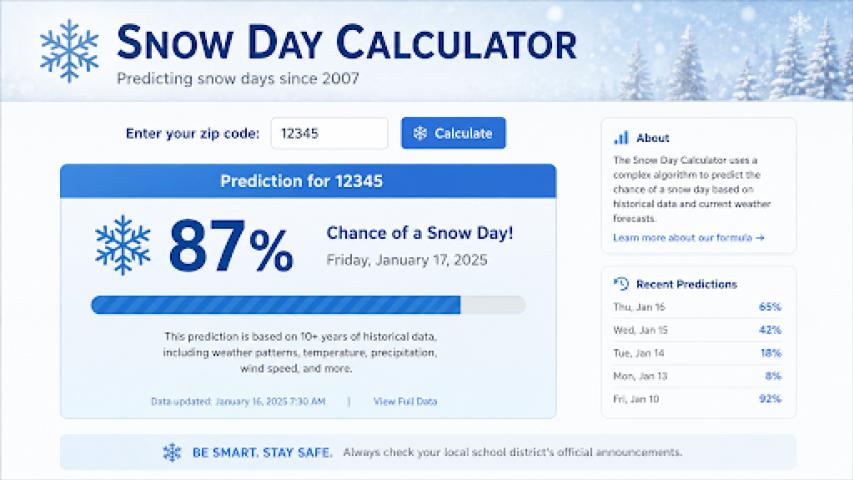
A snow day calculator takes weather information for a specific location and turns it into an estimate of school closure or delay risk.
For example, SnowDayCalculator.io uses location-based forecast information and considers factors such as expected snowfall, precipitation type, temperature, wind, visibility, storm timing, and potential road conditions. Its tools are designed to provide a practical estimate rather than simply display raw weather data.
The site supports locations throughout the United States and Canada, allowing users to enter a city, state or province, ZIP code, or Canadian postal code. It also provides separate tools for situations such as school delays and full school closures.
The important distinction is that the result is a prediction, not an official school announcement.
Why Predictions Can Change
Weather forecasts are continually updated as new information becomes available.
A storm expected to produce six inches of snow several days in advance might later be forecast to produce less—or more. The storm's track can shift, temperatures can change, and precipitation can arrive earlier or later than originally expected.
Consequently, a snow day prediction made three days before a storm should not necessarily be treated the same way as one made shortly before school begins.
For better planning, families can check the forecast periodically as the storm approaches. Rechecking the conditions the evening before and again early in the morning can provide a more current picture.
Local School Policies Still Matter
No weather calculator can know every factor that a particular school district considers.
Districts may have different policies for snow, ice, extreme cold, transportation, and road conditions. Rural districts may also face different challenges from districts in densely populated areas.
Other considerations can include:
- Bus route conditions
- Availability of transportation staff
- Road treatment and snow removal
- Sidewalk conditions
- School building conditions
- Expected weather during arrival and dismissal
- Local emergency guidance
- District-specific closure policies
This is why a calculator should be viewed as a planning resource rather than a replacement for an official announcement.
Snow Day Calculator vs. a General Weather App
A standard weather app can tell you that snow is expected. A snow day calculator attempts to answer a more specific question: How might those weather conditions affect the likelihood of school being delayed or closed?
The difference is primarily one of context.
A general forecast might show:
Snow: 5 inches
Temperature: 25°F
Wind: 15 mph
A school-focused tool can use those conditions together with timing and other relevant factors to produce a more practical assessment of potential school disruption.
This can save parents and students from trying to interpret multiple weather measurements themselves.
How Parents Can Prepare for a Possible Snow Day
Even when a prediction suggests that a closure or delay is possible, it is useful to have a backup plan.
Parents may need to consider childcare, work schedules, transportation, meals, and whether children will need activities at home.
Students can also prepare by making sure schoolwork, books, chargers, and other necessary materials are available in case the district switches to remote learning or assigns work for the day.
Most importantly, families should keep notifications enabled for their school district and check official announcements.
Use Weather Predictions as One Piece of Information
The most useful approach is not to treat a snow day calculator as an authority that can guarantee tomorrow's schedule.
Instead, use it to understand the weather situation and prepare for different possibilities.
A forecast that shows increasing snow, freezing temperatures, poor visibility, and significant travel risk may be a reason to make contingency plans. The final decision, however, belongs to the school district and local authorities.
For families looking for a convenient way to translate winter weather forecasts into school-related planning information, a tool such as SnowDayCalculator.io can provide a useful starting point. Its broader collection of winter calculators also covers related questions involving delays, road conditions, ice risk, snowfall, and winter driving.
Final Thoughts
Predicting a snow day is more complicated than counting snowflakes.
Snowfall totals, precipitation type, temperature, wind, visibility, storm timing, and road conditions can all influence whether traveling to school is practical and safe. Forecasts can also change as a storm develops, which makes regular updates important.
A snow day calculator can help organize this information into a straightforward estimate, but it should always be used alongside official school announcements and local weather guidance.
When winter weather is on the way, the best preparation is simple: check the forecast, understand the risks, prepare for different possibilities, and confirm the final decision with your school district.