
IMARC Group, a leading global market research and management consulting firm, has published its latest market intelligence report on the 5G infrastructure market. The global 5G infrastructure market size was valued at USD 20.7 Billion in 2025. Looking forward, IMARC Group estimates the market to reach USD 403.0 Billion by 2034, exhibiting a CAGR of 37.94% from 2026-2034. Growth is driven by escalating demand for high-speed, low-latency internet, increasing automation of industrial operations to improve efficiency, and stringent regulations and policies aimed at improving connectivity.
The industry is experiencing strong growth momentum as rising mobile data consumption, extensive government support for network expansion, and demand for faster, more reliable connectivity converge. Telecom operators and technology providers are forming strategic partnerships to widen coverage and improve service quality. Asia Pacific currently leads with over 62.0% share, radio access network (RAN) equipment anchors the infrastructure stack, and sub-6 GHz spectrum carries the bulk of deployments.
5G Infrastructure Market at a Glance
- Market Size: Currently valued at USD 20.7 Billion
- Projected Market Size: USD 403.0 Billion
- Growth Rate 2026-2034: CAGR of 37.94%
- Leading Communication Infrastructure: Radio Access Network (RAN), with around 67.1% share
- Leading Network Technology: Network Function Virtualization
- Leading Frequency: Sub-6 GHz, with around 84.5% share
- Leading End User: Home User, with around 26.7% share
- Dominant Region: Asia Pacific, with over 62.0% share
How AI, Open RAN, and Private Networks Are Reshaping the 5G Infrastructure Market
- AI-Native Network Automation: Nokia launched an rApp Marketplace for its Service Management and Orchestration platform, while Ericsson introduced Agentic rApp as a Service on AWS. The two rivals also agreed to join each other's automation ecosystems, a sign that multivendor, AI-driven RAN management is becoming an industry norm. Nokia's marketplace makes it easier to discover, evaluate, and deploy automation applications in multivendor environments.
- Open RAN at Commercial Scale: AT&T announced plans with Ericsson to lead the United States in commercial-scale Open RAN deployment, building a more robust ecosystem of network infrastructure suppliers. Operators are using open interfaces to lower capital expenditure and speed up service rollout.
- Private 5G for Heavy Industry: Ericsson was appointed the partner 5G network provider for private 5G under a multi-nation reselling arrangement with Becker Mining Systems. The deal covers Canada, the United States, Mexico, Chile, France, Germany, and Poland, and shows how mining and other harsh-environment sectors are adopting dedicated networks.
Grab a sample PDF of this report: https://www.imarcgroup.com/5g-infrastructure-market/requestsample
5G Infrastructure Market Trends and Drivers
Data demand is the foundation of the market. Smartphones, tablets, and wearables now rely on seamless connectivity, IoT ecosystems keep adding sensors and devices, and AR and VR applications in gaming, healthcare, and education need high bandwidth and ultra-low latency. GSMA estimates that 5G connections worldwide have passed 1.5 billion, which reflects how central the technology has become to digital transformation. In the United States, fixed wireless access (FWA) has become the second-largest 5G use case, with approximately 9 million connected business and residential premises. About 59 percent of North American smartphone subscriptions are already 5G-enabled.
Industry 4.0 and automation are the second major growth lever. In manufacturing, 5G supports smart factories where interconnected machines enable predictive maintenance and real-time analytics. In logistics, it enables live tracking of goods and vehicles. In agriculture, sensors and drones feed precision farming with real-time data on soil, weather, and crop health. Each of these use cases needs dense, reliable, scalable networks, which is why enterprise demand is now a core pillar of infrastructure spending.
Government backing is the third driver. Authorities are allocating spectrum, offering financial incentives, and streamlining permitting to reduce barriers for operators and infrastructure providers. Many nations also treat 5G leadership as a strategic and competitive goal, which accelerates deployment. Smart city programs, which rely heavily on high-speed connectivity, add further momentum.
Ask an analyst for customized report: https://www.imarcgroup.com/request?type=report&id=2795&flag=E
Global Regulatory, Spectrum, and Investment Landscape Shaping Demand
- Spectrum Availability Sets the Pace: In the United States, recent legislation restored the FCC's authority to auction spectrum and directs a pipeline of at least 800 megahertz, with the Upper C-band (3.98 to 4.2 GHz) as the one band expressly mandated for auction. More licensed mid-band spectrum directly supports new radio and capacity investments.
- The Standalone Gap in Europe: The European Commission's 5G Observatory finds that basic 5G coverage reaches 96.8% of EU households, and 87.9% in rural areas. However, 5G standalone base stations account for only 20.9% of all mobile base stations, compared with 36.2% in the US and 34.8% in China. That gap points to a large upgrade opportunity for core and RAN vendors.
- Security and Resilience Requirements: Regulatory frameworks and public-private partnerships are strengthening network resilience and cybersecurity, and 5G participants are aligning with security needs and compliance requirements to maintain trust in their networks.
- Energy Efficiency and Cost Discipline: Operators are placing growing emphasis on energy-efficient radio equipment and cost management, which favors virtualized and software-defined architectures.
Key Government Schemes and Policy Programs Supporting the Industry
- China, Set Sail Action Plan: The second "Set Sail" plan, issued by the Ministry of Industry and Information Technology with 11 other government bodies, targets 38 5G base stations per 10,000 people, 5G user penetration above 85%, and more than 75% of network traffic carried over 5G. China now has close to 4.96 million 5G base stations, with 5G-Advanced rolled out across 330 cities and 5G coverage in every town.
- India, Telecom PLI Scheme and 5G Ecosystem Programs: The PLI scheme for telecom and networking products carries an outlay of Rs. 12,195 crore and has generated total sales above Rs. 96,240 crore, including Rs. 19,240 crore in exports, along with nearly 29,600 jobs. India's 5G network now reaches 99.9 per cent of districts with around 5.23 lakh base stations, and 100 specialised 5G labs have been set up at a cost of Rs. 97.67 crore. A national 5G forum also supports the Digital India, Make in India, and Smart Cities missions.
- United States, Spectrum Pipeline and Public-Private Investment: Restored auction authority and a multi-band spectrum pipeline give operators visibility on future capacity, while economic stimulus measures and policy reforms support a favorable investment climate.
- European Union, Digital Decade Policy Programme: The programme aims for all populated areas to be covered by 5G and for European households to have gigabit connectivity, with the 5G Observatory tracking progress on coverage, spectrum, and standalone deployment.
- Defense Collaboration: In July, the U.S. Department of Defense signed a Statement of Intent with the Singapore Ministry of Defense to enhance collaboration on data, analytics, and AI, highlighting the role of 5G in secure communications and real-time data processing.
5G Infrastructure Industry Segmentation
The report has segmented the market into the following categories:
Breakup By Communication Infrastructure:
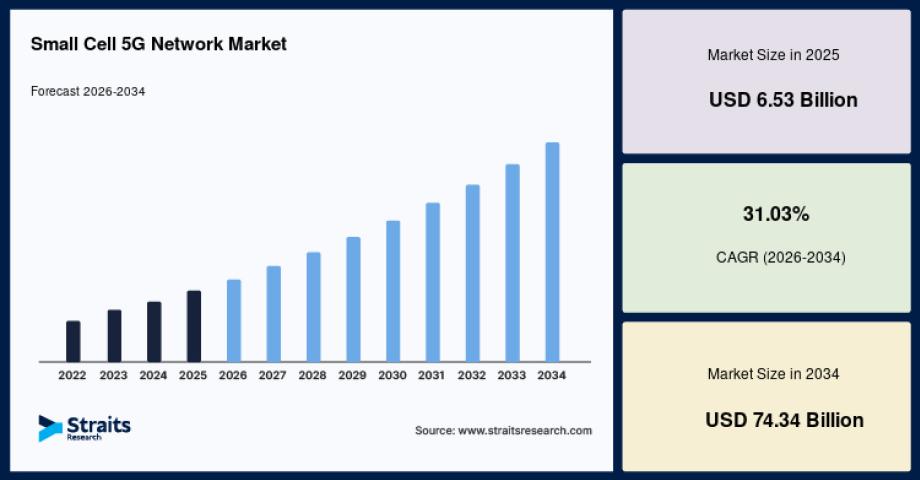
- Small Cell
- Macro Cell
- Radio Access Network (RAN)
- Others
RAN leads with around 67.1% share. It is the interface between mobile devices and the core network, managing wireless connections, signal transmission, and data traffic, and it enables beamforming, network slicing, and low-latency communication.
Breakup By Network Technology:
- Software-Defined Networking
- Network Function Virtualization
- Others
Network function virtualization leads the segment. NFV replaces hardware-based appliances such as firewalls, load balancers, and routers with virtualized instances on standard servers and cloud platforms, helping operators reduce capital expenditure and scale faster.
Breakup By Network Architecture:
- Standalone
- Non-Standalone
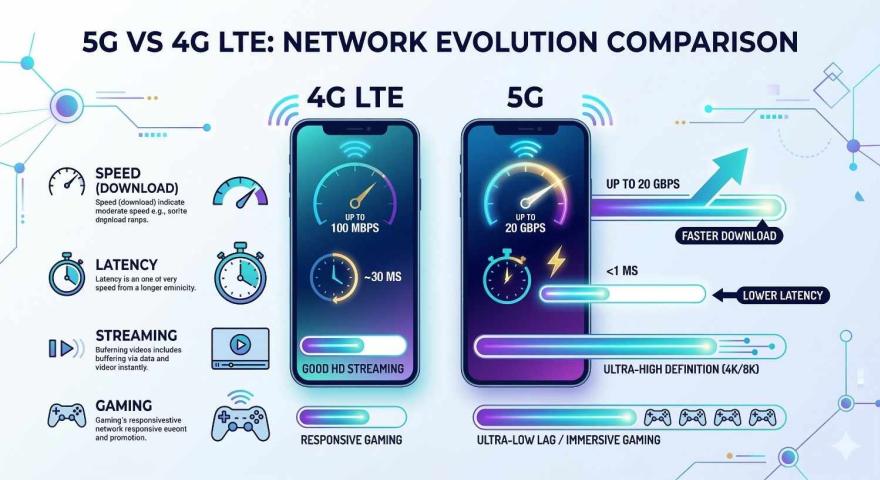
Standalone networks deploy both the 5G core and new radio independently, unlocking lower latency and full 5G capability for applications such as autonomous vehicles and critical IoT. Non-standalone networks lean on existing 4G LTE infrastructure and remain the faster, lower-cost route to launch 5G services.
Breakup By Frequency:
- Sub-6 GHz
- Above 6 GHz
Sub-6 GHz leads with around 84.5% share. It balances coverage and capacity, requires fewer base stations, and suits rural and suburban rollouts as well as enhanced mobile broadband.
Breakup By End User:
- Automotive
- Energy and Utilities
- Healthcare
- Home User
- Others
Home users lead with around 26.7% share, supported by remote work, online learning, streaming, smart home adoption, and FWA, which is extending broadband to urban and rural households and reducing reliance on fiber.
Breakup By Region:
- North America (United States, Canada)
- Asia Pacific (China, Japan, India, South Korea, Australia, Indonesia, Others)
- Europe (Germany, France, United Kingdom, Italy, Spain, Russia, Others)
- Latin America (Brazil, Mexico, Others)
- Middle East and Africa
Asia Pacific leads with over 62.0% share, driven by heavy technology investment and government support in China, Japan, and South Korea. In North America, the United States accounts for 92.90% of the regional market. Low-band 5G covers 90% of the US population, while mid-band serves an estimated 210 to 300 million people.
In Europe, Telekom Deutschland has extended 5G to 96% of Germany's population, and Western Europe has recorded an estimated 226 million 5G mobile subscriptions, up from 143 million a year earlier. Asia Pacific is on course for a sharp climb in the 5G share of connections, projected by GSMA to rise from a low single-digit base to about 41%.
Latin America's total mobile data traffic is set to roughly triple, and operators are investing in spectrum management, fiber backhaul, and small-cell sites. In the Middle East and Africa, mobile internet users in the MENA region are projected to rise from 327 million to about 422 million, which supports continued network expansion.
Competitive Landscape
The report provides a comprehensive analysis of the competitive landscape in the 5G infrastructure market, with detailed profiles of key companies, including:
- Telefonaktiebolaget L M Ericsson
- Nokia Oyj
- Huawei Technologies Co. Ltd.
- ZTE Corporation
- Cisco Systems Inc.
Other prominent players covered include Airspan Networks Inc., AT&T Inc., Comba Telecom Systems Holdings Limited, Hewlett Packard Enterprise Company, Mavenir Systems Inc. (Comverse Technology), NEC Corporation, and Oracle Corporation. Leading vendors are investing heavily in R&D to improve spectral efficiency and create new use cases, and are collaborating with automotive, healthcare, and manufacturing players to unlock 5G-enabled applications.
Competitive Dynamics Shaping the Sector
- Share Shifts Are Reshaping RAN Leadership: Ericsson became Virgin Media O2's primary RAN partner in a five-year extension that will power the majority of the operator's nationwide UK radio network. Nokia, meanwhile, secured a three-year contract with Telecom Italia to expand 5G coverage and add capacity.
- Emerging Markets Are the New Battleground: Saudi Arabia's stc signed a multi-year agreement with Ericsson to expand 5G and accelerate standalone deployment, while TIM Brasil expanded its partnership with Nokia to 14 more states covering roughly 42 percent of Brazil's population.
- Enterprise Services Extend the Revenue Pool: T-Mobile partnered with Cisco to launch the Connected Workplace managed service for mid-sized enterprises with multi-site operations, showing how operators and network vendors are moving into enterprise connectivity.
- Automation and Software Take Center Stage: AT&T expanded its multi-year partnership with Nokia to enhance 5G network automation, including Voice over New Radio (VoNR) and Digital Operations software, for faster deployment and better operational efficiency.
What Does the Full Report Cover?
If you are tracking the 5G infrastructure market for investment decisions, market entry planning, competitive benchmarking, or strategic advisory, IMARC Group's report gives you everything in one place:
- Comprehensive quantitative analysis of market segments by communication infrastructure, network technology, network architecture, frequency, end user, and region
- Detailed assessment of market drivers, challenges, and opportunities
- Mapping of the leading and fastest-growing regional markets, with identification of key country-level markets within each region
- Country-level coverage for the United States, Canada, Germany, France, United Kingdom, Italy, Spain, Russia, China, Japan, India, South Korea, Australia, Indonesia, Brazil, and Mexico
- Competitive landscape and key company profiles
- Porter's Five Forces analysis to assess new entrants, rivalry, supplier power, buyer power, and threat of substitution
The report is delivered in PDF and Excel formats and includes 10% free customization.
Recent News and Developments in 5G Infrastructure Market
- September: Saudi Arabia's stc signed a multi-year agreement with Ericsson to expand its 5G network, increase capacity, and accelerate 5G Standalone deployment.
- March: Ericsson became Virgin Media O2's primary RAN partner in a five-year partnership extension, powering the majority of the UK operator's nationwide radio network.
- March: TIM Brasil expanded its partnership with Nokia to cover 14 additional states, representing approximately 42 percent of Brazil's population.
- November: Nokia won a three-year contract with Telecom Italia to expand 5G coverage and add capacity.
- February: AT&T announced an expansion of its multi-year partnership with Nokia to enhance 5G network automation, including VoNR and Nokia's Digital Operations software.
- January: T-Mobile partnered with Cisco to launch the Connected Workplace managed service aimed at mid-sized enterprises with operations spread across multiple locations.
- January: Telekom Deutschland extended its 5G network to reach 96% population coverage in Germany.
Note: If you require specific details, data, or insights that are not currently included in the scope of this report, we are happy to accommodate your request. As part of our customization service, we will gather and provide the additional information you need, tailored to your specific requirements. Please let us know your exact needs, and we will ensure the report is updated accordingly to meet your expectations.
Key Questions This Report Answers
- What is the current global 5G infrastructure market size and what is its projected value?
- Which communication infrastructure, network technology, frequency, and end user segments hold the largest share in the global 5G infrastructure market?
- What are the key drivers of global 5G infrastructure market growth?
- Which region dominates the global 5G infrastructure market and why?
- How are spectrum policies and government programs reshaping investment in 5G networks worldwide?
- Who are the top companies in the global 5G infrastructure market and what are their competitive strategies?
- How are standalone architectures, Open RAN, and AI-driven automation changing the way 5G networks are built and operated?
About Us
IMARC Group is a global management consulting firm that helps the world's most ambitious changemakers to create a lasting impact. The company provides a comprehensive suite of market entry and expansion services. IMARC offerings include thorough market assessment, feasibility studies, company incorporation assistance, factory setup support, regulatory approvals and licensing navigation, branding, marketing and sales strategies, competitive landscape and benchmarking analyses, pricing and cost research, and procurement research.
Media and Sales Contact
IMARC Group
Email: sales@imarcgroup.com
United States: +1-201-971-6302
India: +91-120-433-0800
United Kingdom: +44-753-714-6104