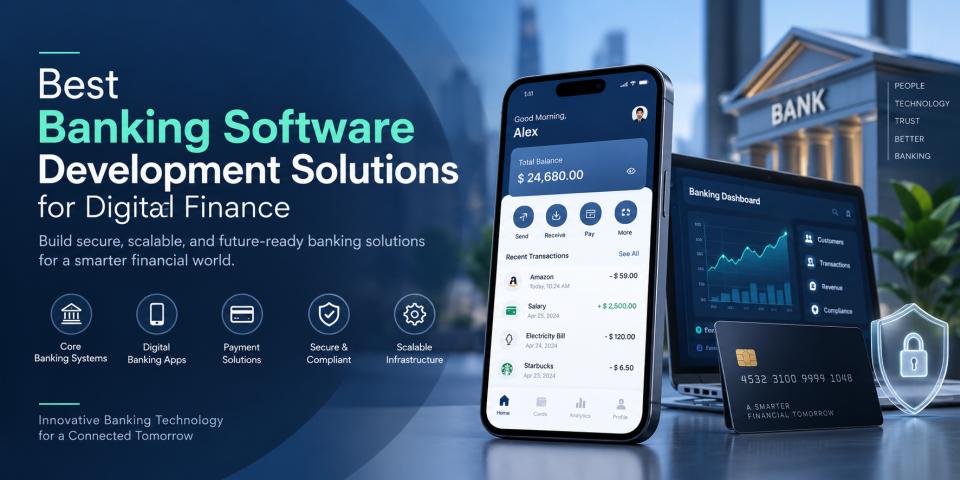
When people talk about banking software, the conversation often starts with dashboards, mobile apps, and payment buttons. In reality, the difficult part sits underneath the interface. A digital finance platform has to keep balances accurate, process transactions safely, manage failed payments, connect with external financial services, and maintain a reliable record of every important action.
That is why choosing a Banking Software Development Company should begin with the financial workflow, not the feature checklist.
What Banking Software Actually Needs to Handle
Consider a simple transfer. A customer sends money, the transaction enters a pending state, the external payment service responds slowly, and the user refreshes the application. Your software must prevent duplicate processing while showing the correct status.
This is where custom banking software development becomes valuable. The backend can be designed around transaction states, ledger management, reconciliation, permissions, notifications, and audit trails from the beginning.
A practical digital banking solution can include:
Customer and account management
Digital onboarding and KYC workflows
Payment and fund-transfer processing
Transaction history and statements
API-based financial integrations
Role-based administrative controls
Fraud monitoring and transaction alerts
Automated reconciliation
Reporting and audit capabilities
Building Around the Business Model
A payment company does not need the same software architecture as a lending platform. Similarly, a digital wallet may require different infrastructure from a full-service banking platform.
A Banking Software Development Company should therefore first understand your transaction flows, customer journey, required integrations, regulatory environment, and operational processes.
For example, a FinTech startup may begin with customer onboarding, wallets, payments, and transaction management. Additional services such as cards, lending, international payments, or financial analytics can then be introduced without rebuilding the entire platform.
The Real Goal
The goal isn't to build the software with the most features. It is to build a financial system where every transaction has a clear state, every important action can be traced, sensitive data is protected, and new services can be integrated without creating unnecessary technical complexity.
For businesses entering digital finance, that foundation is often more important than the visual design of the banking app.